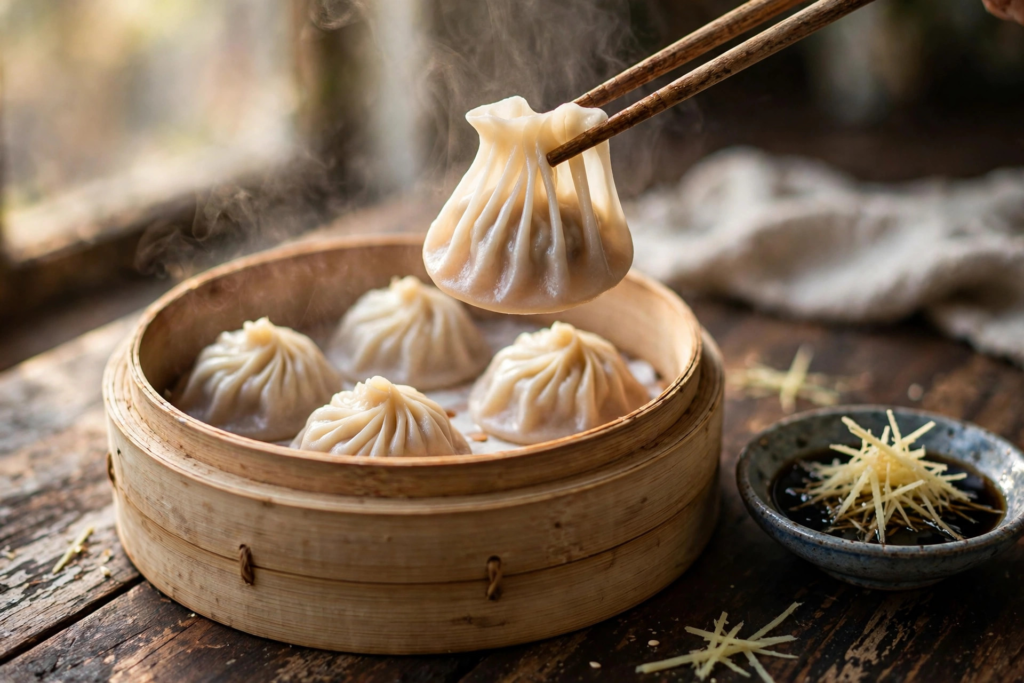
The first time you eat a xiaolongbao properly, something small and strange happens. You lift this delicate little parcel with your chopsticks, set it on your spoon, take the tiniest nibble — and hot, savory soup floods your mouth from inside a dumpling that looked completely solid a second ago. It feels like a magic trick. It kind of is.
Xiaolongbao (pronounced shao-long-bao) are Shanghai’s famous soup dumplings: paper-thin wheat wrappers pleated around seasoned pork and a spoonful of rich broth that is somehow sealed inside. They arrive at your table in stacked bamboo steamers, trembling slightly, daring you to pick one up without breaking it. This guide covers what they are, where they came from, the ingenious trick that puts soup inside a dumpling, how they’re made, and how to eat them without scalding your mouth.
What Is Xiaolongbao, Exactly?
Strip away the mystique and a xiaolongbao is a small steamed bun — that’s literally what the name means. 小笼包 (xiǎolóngbāo) translates to “small steamer basket buns,” named for the little bamboo baskets they’re steamed and served in.
But calling it “a steamed bun” is like calling a croissant “bread.” Technically true, spiritually wrong. What makes a xiaolongbao a xiaolongbao is the soup inside. Each dumpling holds a mouthful of hot, gelatin-rich pork broth sloshing around seasoned ground pork, all wrapped in a skin so thin you can almost see through it — yet strong enough to survive the trip from steamer to spoon.
They belong to the broader bao family, but they’re nothing like the fluffy white char siu bao you might know from dim sum carts. Those are leavened and pillowy. Xiaolongbao use an unleavened wheat dough rolled thin, closer to a dumpling wrapper than a bun. If bao is the umbrella, xiaolongbao is the branch obsessed with soup.
How to pronounce it without embarrassment
Say it like this: shao (rhymes with “cow”) — long — bao (rhymes with “cow”). Shao-long-bao. The tones in Mandarin are xiǎolóngbāo, but honestly, if you nail “shao-long-bao” at a restaurant, nobody is grading your tones. As one longtime Shanghai food writer puts it in a complete guide to Shanghai’s soup dumplings, the word looks impossible and sounds easy — which is exactly backwards from how most Chinese food vocabulary works.
Where Did Xiaolongbao Come From?
There are two stories, and nobody fully agrees — which is exactly how you know a dish matters.
The legend goes that an emperor touring the Jiangnan region in the 1700s stumbled on soup-filled dumplings and couldn’t get enough of them, spreading their fame along the Yangtze as he traveled. It’s a good story. It’s also the kind of story every old Chinese dish seems to have.
The more grounded version credits a Shanghai restaurateur named Huang Mingxian, who in 1870 started selling an unusual dumpling from his shop in Nanxiang, then a town outside Shanghai. His “large meat buns” hid a surprise: bite in and soup poured out. Customers started calling them xiaolongbao after the small bamboo baskets they were steamed in, and the name stuck. Fine Dining Lovers traces both origin stories in their history of the dish, and leans toward Huang as the popularizer even if the idea is older.
What isn’t disputed: xiaolongbao grew up in the Jiangnan region — the Shanghai-Suzhou-Hangzhou triangle — where the local cuisine prizes delicacy and a gentle sweetness over bold heat. It’s one of the proudest exports of China’s regional cooking traditions, and Nanxiang’s old town still draws pilgrims to the original shops.
Global fame came later, largely thanks to Din Tai Fung, the Taiwanese chain that turned precise, eighteen-pleat xiaolongbao into an international luxury-dumpling experience. Purists will argue about whether the chain version matches a Shanghai back-alley basket. Eat both. Decide for yourself.
The Real Magic: How Does the Soup Get Inside?
This is the question everyone asks, and the answer is one of the cleverest tricks in all of cooking.
Nobody injects the soup. Nobody spoons liquid into the dumpling and seals it before it spills. The soup goes in as a solid.
Here’s how it works. Pork skin and bones — loaded with natural collagen — get simmered for hours with ginger, scallions, and Shaoxing wine until the liquid is deeply savory. Then it’s chilled. As it cools, the collagen sets the stock into a firm, wobbly aspic, essentially a meat jelly. That jelly gets diced into small cubes and folded into the seasoned ground pork filling.
At wrapping time, everything is solid and easy to handle. Then the dumplings hit the bamboo steamer. The blast of steam heats the filling past the melting point of the gelatin, and the aspic liquefies back into soup — now trapped inside the sealed wrapper with nowhere to go. Solid in, liquid out. Physics does the plating.
The ratio matters enormously. Too little aspic and the dumpling eats dry, just another pork dumpling. Too much and the wrapper turns soggy or bursts in the steamer, and all that precious soup ends up in the bamboo instead of your mouth. Getting it right is why a great xiaolongbao maker trains for years, and why a mediocre one is instantly obvious on the first bite.
Anatomy of a Perfect Xiaolongbao
Judging xiaolongbao is a whole pastime in Shanghai. Here’s what the serious eaters look for, so you can play along.
The skin. It should be thin enough to be slightly translucent — you can see the shadow of the filling through it — but strong enough to lift with chopsticks without tearing. Thick, doughy skins are the mark of a lazy kitchen. The center of each wrapper is rolled slightly thicker than the edges, which is what lets it hold liquid without collapsing.
The pleats. A well-made xiaolongbao is gathered into at least a dozen fine, even pleats twisted shut at the top. The famous shops aim for eighteen. Count them sometime; it’s the easiest quality test there is. Sloppy, uneven pleating usually means sloppy everything else.
The filling. Traditionally ground pork — shoulder is common — seasoned with ginger, scallion, Shaoxing wine, light soy, sesame oil, white pepper, and a pinch of sugar. It should taste fresh and savory, never greasy or heavy. The pork is mixed until sticky so it holds together in a tender little meatball once cooked.
The soup. The whole point. It should be hot — genuinely hot, not warm — rich, and deeply porky with ginger in the background. When you sip it, it should coat your mouth the way a good stock does. If the soup tastes thin or watery, the kitchen cut corners on the bones.
Among Chinese dumplings broadly, xiaolongbao sits in a class of its own precisely because all four elements have to succeed at once. A jiaozi can survive a thick wrapper. A xiaolongbao cannot survive anything.
Here’s how it stacks up against its closest relatives:
| Dumpling | Wrapper | Cooking method | Soup inside? | Home region |
|---|---|---|---|---|
| Xiaolongbao | Thin, unleavened wheat | Steamed in bamboo baskets | Yes — the whole point | Shanghai / Jiangnan |
| Jiaozi | Thicker wheat wrapper | Boiled, steamed, or pan-fried | No | Northern China |
| Shengjian bao | Thicker, slightly leavened | Pan-fried, crisp bottom | Yes, a little | Shanghai |
| Wonton | Very thin, silky | Boiled, served in broth | No — the broth is outside | Cantonese / nationwide |
How Xiaolongbao Are Made, Step by Step
Making xiaolongbao at home is a full-day project and a humbling one. The professionals make it look easy because they’ve done it ten thousand times. Here’s the process in outline, so you understand what you’re eating even if you never attempt it.
1. Make the aspic a day ahead. Simmer pork skin and meaty bones with ginger, scallions, and Shaoxing wine for a couple of hours until the liquid reduces and turns silky. Strain it, season lightly, and refrigerate until completely set. It should wobble like firm jelly. Dice it into small cubes. (Short on time? Some home cooks cheat with powdered gelatin stirred into good stock. Traditionalists will find you.)
2. Mix the dough. All-purpose flour, warm water, a pinch of salt. Knead until smooth and elastic, then rest it under a damp cloth for at least half an hour. This is an unleavened dough — no yeast, no baking powder — which is why the wrapper stays thin and tender instead of puffy.
3. Season the pork. Ground pork mixed with minced ginger, chopped scallions, Shaoxing wine, light soy sauce, sesame oil, sugar, salt, and white pepper. Mix it vigorously in one direction until it turns sticky and cohesive — this texture is what keeps the filling juicy rather than crumbly.
4. Fold in the aspic. Gently combine the diced soup jelly with the pork mixture. From this point on, work quickly and keep everything cool so the aspic doesn’t start melting in your hands.
5. Roll and pleat. Divide the dough, roll each piece into a thin circle about three inches across — thicker in the middle, thinner at the edges. Add a spoonful of filling, then pleat: pinch, fold, pinch, fold, working around the circle and twisting the top closed. Eighteen pleats is the aspiration. Your first twenty will look, charitably, rustic.
6. Steam hard and fast. Line bamboo steamers with cabbage leaves or parchment, arrange the dumplings with space between them, and steam over boiling water for about eight minutes. Serve immediately, still in the basket. Xiaolongbao wait for no one — the soup starts re-setting as they cool, and a lukewarm xiaolongbao is a tragedy.
How to Eat Xiaolongbao Without Burning Yourself
Everyone burns their mouth on their first xiaolongbao. It’s a rite of passage. But you only need to do it once, because there’s a method:
- Lift gently from the top. Grip the little twisted knot with your chopsticks — that’s the strongest part. The thin sides tear if you squeeze them.
- Park it on your spoon. Don’t try to eat it straight from the chopsticks. Set it in a Chinese soup spoon, which catches any leaks and gives you a stable platform.
- Nibble a small hole and sip. Bite or poke a tiny opening in the side, then sip the soup out first. It will be extremely hot — blow on it, let steam escape, take your time. This is the best part; don’t rush it.
- Then dip and eat. Once the soup is sipped, dip the dumpling in black vinegar with shredded ginger and eat it in one or two bites. The vinegar’s sharpness cuts the richness of the pork beautifully. If you want to make your own, here’s an easy dumpling dipping sauce to start from.
That’s the whole ritual. Chopsticks, spoon, nibble, sip, dip, eat. After two or three baskets it becomes muscle memory, and you’ll wonder why anyone ever found it intimidating.
Variations Worth Knowing
Pork is the classic, but the xiaolongbao format has absorbed plenty of variations — some traditional, some modern.
Crab xiaolongbao is the luxury version, especially in autumn when Shanghai’s hairy crabs are in season. Crab meat and roe get folded into the pork filling, turning the soup golden and intensely savory. It’s the one to order when you want to understand what the fuss is about.
Shrimp, chicken, and vegetable versions show up on menus catering to different tastes and diets. They’re pleasant, but let’s be honest: the pork-and-aspic original is the benchmark everything else is measured against, because pork collagen is what makes the soup work in the first place.
Shengjian bao are xiaolongbao’s pan-fried cousins — thicker skin, crisp browned bottoms, still soupy inside. They’re a different experience entirely: heartier, crunchier, less delicate. Worth trying side by side if you ever get the chance.
Quick guide to what to order:
- First visit? Classic pork xiaolongbao — that’s the benchmark.
- Autumn in Shanghai? Crab xiaolongbao with hairy crab roe.
- Feeding a crowd? A mix of pork and shrimp for variety.
- Want crunch? Shengjian bao alongside, for contrast.
Frequently Asked Questions
Are xiaolongbao and soup dumplings the same thing?
Yes. “Soup dumplings” is just the English nickname for xiaolongbao. You’ll also see them called “soup buns.” Same dumpling, same soup, same burned mouths.
Why is my xiaolongbao soup not soupy?
Usually one of three things: not enough aspic in the filling, the dumplings sat too long after steaming (the soup re-sets as it cools), or they were under-steamed and the gelatin never fully melted. At a restaurant, soup-less xiaolongbao is a sign to order something else next time.
Can you make xiaolongbao without pork?
You can make dumplings without pork, but the signature soup is hard to replicate — it depends on pork collagen to set into aspic and melt back into broth. Chicken-based versions exist and can be good, but they won’t have quite the same rich mouthfeel.
How many pleats should a xiaolongbao have?
There’s no law, but a well-made one has at least a dozen fine, even pleats, and the famous shops aim for eighteen. It’s a useful quality signal: neat pleating correlates strongly with everything else being done right.
What’s the difference between xiaolongbao and bao?
Xiaolongbao are a type of bao — the word just means bun or steamed bread. But most bao people know (like char siu bao) use leavened dough and have no soup. Xiaolongbao use thin unleavened wrappers and hide broth inside, which puts them in a category of their own.
Xiaolongbao rewards attention. Notice the pleats, sip the soup before it scalds you, taste the ginger in the broth — and suddenly a three-bite dumpling becomes the most interesting thing on the table. Next time a bamboo basket lands in front of you, you’ll know exactly what you’re looking at, how it got that way, and what to do with it. The only thing left is to order another basket.
[…] you’ve already fallen for soup dumplings, here’s the full story of xiaolongbao — where they came from and how the soup gets inside. This one’s about the sibling […]
[…] you’re still fuzzy on what these dumplings even are, start with what xiaolongbao are and how the soup gets inside. This guide is purely about the eating: the physics of the burn, the step-by-step method, the […]
[…] job. A small dish of black vinegar with julienned fresh ginger is the traditional partner for soup dumplings, and a mix of black vinegar, light soy sauce, and a drop of sesame oil is the all-purpose dip for […]
[…] jar all week. If you want to keep exploring Shanghai’s noodle shops from your own kitchen, the city’s famous soup dumplings are the natural next […]
[…] something fresh and green to cut the richness, like blanched bok choy, and something delicate like soup dumplings if you’re going full Shanghai-Jiangnan. And because the dish reheats beautifully — arguably […]
[…] the food and cradle it on top of the tips instead of squeezing; this is how you avoid bursting a xiaolongbao all over the table. (If you’re nervous about soup dumplings specifically, read how to eat […]