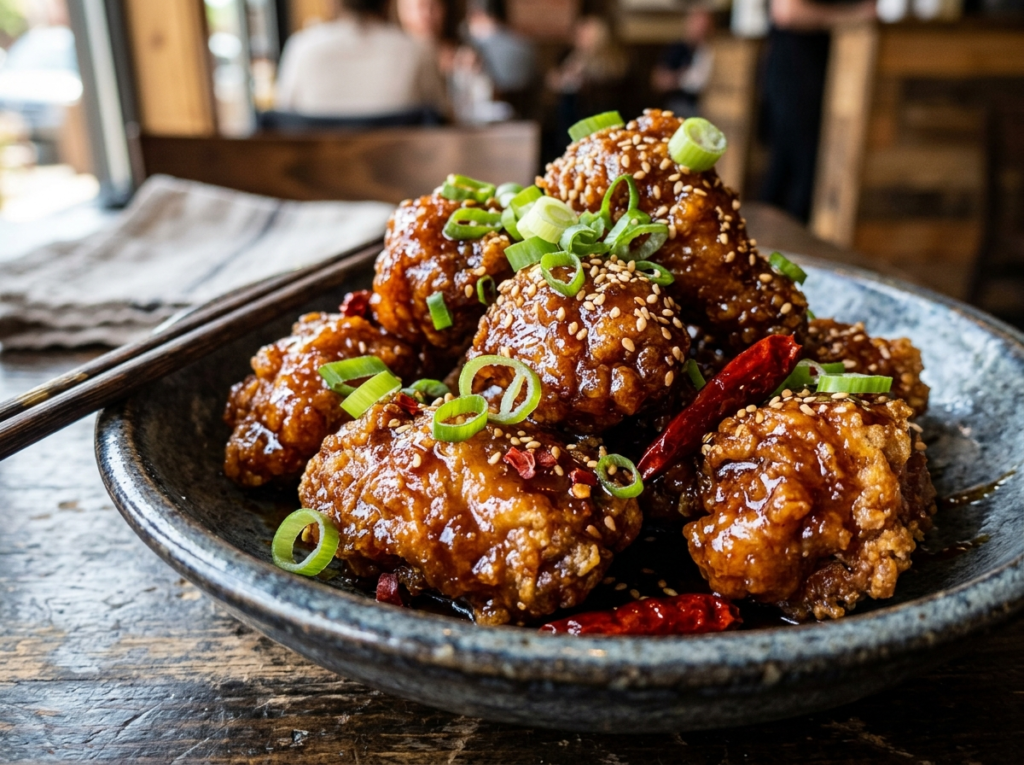
The difference between great General Tso’s chicken and a soggy, disappointing pile of fried chicken sits at about 25 degrees. That’s it. A mere 25°F separates crispy, lacquered perfection from greasy, limp coating that slides right off the meat.
Most recipes online tell you to “fry until golden” and call it a day. But if you’ve ever stood over a pot of hot oil, tongs in hand, wondering why your chicken looks nothing like what you get at your favorite takeout spot, the answer almost always comes down to temperature control — both your oil and your chicken.
This guide breaks down the exact temperatures, timing, and techniques you need to make General Tso’s chicken that’s genuinely restaurant-quality. We’re talking crispy coating that stays crispy even after being tossed in sauce, tender chicken that isn’t dried out, and a glaze that clings to every piece.
Why Temperature Is Everything in General Tso’s Chicken
General Tso’s chicken isn’t technically complicated. You’re working with boneless chicken pieces, a starch-based coating, hot oil, and a sweet-savory sauce. Simple enough, right?
The tricky part is that each of those elements behaves differently depending on temperature. Too-cool oil absorbs into the coating instead of crisping it. Chicken that’s overcooked turns rubbery. Sauce that’s too hot reduces into sticky cement instead of a glossy glaze.
Temperature isn’t just one detail among many — it’s the backbone of the entire dish. Get it right, and everything else falls into place. Get it wrong, and no amount of seasoning or technique will save you.
Think of it like ironing a shirt. The iron needs to be hot enough to smooth out wrinkles, but not so hot that it scorches the fabric. With General Tso’s chicken, you’re managing that same kind of balance across multiple steps simultaneously.
The Right Oil Temperature for Frying
Let’s start with the single most important number in this recipe: 350°F (175°C).
That’s your target oil temperature for frying General Tso’s chicken. Some recipes suggest 375°F, which can also work well, but 350°F gives you a wider margin for error — especially if you’re frying in batches and the oil temperature drops each time you add chicken.
What Happens Below 325°F
Drop below 325°F and you’re in trouble. The coating absorbs oil instead of creating a crisp shell. You end up with chicken that’s greasy on the outside and potentially undercooked on the inside. It’s the most common mistake home cooks make, usually because they add too many pieces at once and crash the oil temperature.
What Happens Above 400°F
Go too hot and the coating burns before the chicken cooks through. You’ll see dark brown or even black spots on the outside while the center is still pink. Plus, oil near its smoke point starts breaking down and gives your food an acrid, bitter taste.
The Sweet Spot: 350°F–375°F
In this range, the moisture in the coating rapidly converts to steam, pushing outward and preventing oil from soaking in. The starches on the surface dehydrate and form a rigid, crunchy shell. The chicken inside gently cooks through from the residual heat and the consistent oil temperature surrounding it.
Pro Tip: Invest in a deep-fry thermometer or use a digital probe thermometer clipped to the side of your pot. Don’t guess. Experienced Chinese restaurant cooks can judge temperature by how oil moves and shimmers, but that kind of instinct takes years to develop. A $12 thermometer gets you there instantly.
Choosing Your Oil
Not all cooking oils behave the same at high heat, and your choice directly affects flavor and crispiness.
You want a neutral oil with a high smoke point. Peanut oil is the traditional choice in many Chinese-American restaurants because it stays stable at frying temperatures and adds a subtle richness. Vegetable oil and canola oil both work perfectly well too.
Avoid olive oil — its smoke point is too low for deep frying, and the flavor competes with the sauce. Sesame oil is wonderful as a finishing drizzle, but it’ll burn and turn bitter at frying temperatures.
You’ll need enough oil to submerge the chicken pieces fully. For most home setups, that means about 2–3 inches of oil in a heavy-bottomed pot or Dutch oven. If you’re using a properly seasoned wok, you can use less oil due to the shape, but you’ll need to fry in smaller batches.
Quick Fact: Peanut oil can typically handle temperatures up to 450°F before it starts smoking, giving you a generous safety buffer above your 350°F target.
Internal Temperature of the Chicken
Here’s a number that doesn’t get mentioned enough in General Tso’s chicken recipes: 165°F (74°C) internal temperature.
That’s the USDA-recommended safe minimum internal temperature for all chicken products. And yes, it applies here even though the pieces are small and coated.
Why People Skip This Step (and Shouldn’t)
Most home cooks eyeball it. “The coating is golden brown, so it must be done.” But color tells you about the coating, not the meat inside. A beautifully golden piece of fried chicken can still be undercooked at the center, especially if your pieces are cut unevenly.
Cut your boneless chicken thighs (or breasts) into consistently sized pieces — roughly 1 to 1.5 inches. Uniform size means uniform cooking. If you’ve got a mix of tiny scraps and big chunks, the small ones will overcook while the big ones stay raw in the middle.
⚠️ Food Safety Note: Always use an instant-read thermometer to verify your chicken reaches 165°F internally. Consuming undercooked chicken carries risk of Salmonella and Campylobacter contamination. This is especially important if you’re cooking for children, elderly individuals, pregnant women, or anyone with a compromised immune system.
Thighs vs. Breasts: The Great Debate
Most Chinese restaurants use dark meat (thighs) for General Tso’s chicken. There’s a good reason for that.
Thighs contain more fat and connective tissue, which means they stay juicy and tender even if you slightly overcook them. Breast meat is leaner and less forgiving — overshoot by 10°F and it starts drying out.
Thigh meat also has more flavor on its own, which holds up better against the bold, sweet-spicy sauce. If you prefer breast meat for health or personal reasons, just be extra careful with your timing and make sure to pull the chicken right at 165°F.
The Coating: Starch, Technique, and Temperature
The coating on General Tso’s chicken isn’t batter in the Western sense. It’s more of a starch dredge — lighter, crunchier, and designed to stand up to being tossed in sauce without turning to mush.
Cornstarch vs. Potato Starch vs. All-Purpose Flour
Cornstarch is the most common choice and produces a light, shatteringly crisp coating. It creates irregular, craggy surfaces that hold sauce beautifully.
Potato starch gives you an even crunchier result that stays crisp longer. If you can find it (most Asian grocery stores carry it), it’s worth trying.
All-purpose flour on its own produces a softer, more bread-like coating. Some recipes use a mix of flour and cornstarch to get a balance of structure and crunch.
For the crispiest results, most experienced cooks lean toward pure cornstarch or a 50/50 cornstarch and flour blend.
The Double-Fry Technique
This is the real secret behind the crunch that survives the sauce. And it’s all about managing temperature across two separate frying stages.
First fry: 325°F for 3–4 minutes. This cooks the chicken through and sets the coating. The pieces will look pale and not particularly appetizing at this stage. That’s exactly what you want. Pull them out and let them rest on a wire rack for at least 5 minutes.
Second fry: 375°F for 1–2 minutes. This higher temperature rapidly dehydrates the outer layer of the coating, creating a rigid crust. The pieces will turn deep golden brown quickly. Pull them as soon as they look right.
What’s happening during that rest between fries? The residual moisture from the chicken migrates outward through the coating. When you hit it with the higher-temperature second fry, that moisture flashes off instantly, leaving behind an extra-dry, extra-crunchy shell.
This double-fry method is used throughout Asian cooking — it’s the same technique behind twice-fried Korean fried chicken, and it’s why restaurant fried foods seem to stay crispier than anything you make at home with a single fry.
Pro Tip: If you’re frying in batches, bring your oil back up to temperature between each batch. Adding cold chicken drops the oil temp by 15–25°F, and it needs time to recover. Patience here pays off enormously.
Making the Sauce at the Right Temperature
The sauce is where General Tso’s chicken gets its identity — that sticky, sweet, spicy, slightly tangy glaze. And just like frying, temperature control matters here.
Sauce Components
A solid General Tso’s sauce typically includes soy sauce, rice vinegar, sugar (or honi), Chinese cooking wine (Shaoxing wine), chicken broth, garlic, ginger, and dried red chili peppers. Some versions add hoisin sauce or tomato paste for extra depth and color.
Cooking the Aromatics
Start with a clean wok or large skillet over medium-high heat — roughly 375°F at the surface. Add a small amount of oil, then your dried chilies, minced garlic, and grated ginger.
Here’s where timing is critical. Dried chilies go in first because they need about 30 seconds to bloom and release their oils. Garlic and ginger go in right after, but they only need about 15–20 seconds before they start browning. Burned garlic tastes acrid and bitter, and it’ll ruin the whole sauce.
Building the Glaze
Once your aromatics are fragrant, pour in the liquid ingredients. The mixture will bubble aggressively — that’s fine. Let it come to a rapid simmer.
Now here’s a step that trips people up: the cornstarch slurry. Mix about 1 tablespoon of cornstarch with 2 tablespoons of cold water. Cold water, not warm — warm water causes the starch to clump before it hits the pan.
Reduce your heat to medium (around 300°F surface temp) before adding the slurry. Stir constantly. The sauce should thicken within 30–45 seconds. You want it glossy and thick enough to coat the back of a spoon, but not so thick it’s paste-like.
If you overheat the sauce after adding the slurry, it can break down and thin out again. Keep it at a gentle simmer once thickened.
Tossing the Chicken
Add your double-fried chicken pieces to the sauce and toss quickly — 30 seconds max. You want every piece coated, but you don’t want the chicken sitting in liquid. Every extra second in the sauce is time your crunchy coating absorbs moisture.
This is why the double-fry method matters so much. That rigid, dehydrated outer shell buys you time. Single-fried chicken starts going soft almost immediately when it hits the sauce.
Wok Technique and Heat Management
If you have a wok and a burner that can handle it, you’ll get closer to restaurant results than you would with a standard frying pan. But the type of burner matters more than most people realize.
Home Burners vs. Restaurant Burners
A typical home gas burner puts out around 10,000–15,000 BTUs. A restaurant wok burner? That’s 100,000–150,000 BTUs. Ten times the heat. That’s why restaurant stir-fries have that smoky, charred quality called wok hei — literally “breath of the wok.”
You can’t fully replicate that at home, but you can get closer by preheating your wok for 2–3 minutes until it just starts to smoke, working in small batches, and keeping everything moving constantly.
Flat-Bottom vs. Round-Bottom Wok
On a home stove, a flat-bottom wok makes the most sense. It sits stable on the burner and makes full contact with the heat source. A round-bottom wok needs a wok ring and works best on high-powered commercial burners.
For the deep-frying portion of General Tso’s chicken, a Dutch oven or heavy-bottomed pot actually works better than a wok. It holds more oil, maintains temperature more consistently, and has tall sides to prevent splatter. Save the wok for the sauce and tossing step.
Serving Temperature and Timing
General Tso’s chicken waits for nobody. It’s at its absolute best within the first 5 minutes after the chicken hits the sauce.
The coating stays crunchiest when served immediately. If you let it sit, the sauce continues to penetrate the coating, and steam from the hot chicken softens things further. This is why good Chinese restaurants prepare General Tso’s chicken to order and send it out the moment it’s done.
Serve it over steamed jasmine rice — knowing how to cook perfect jasmine rice is a skill worth having if you make Chinese-American dishes regularly. The rice should be ready and waiting before you start frying.
If you need to hold fried chicken for a few minutes before saucing, keep it on a wire rack set over a sheet pan in a 200°F oven. Don’t cover it — trapped steam is the enemy of crunch. And don’t sauce it until right before serving.
Did You Know? General Tso’s chicken as we know it was popularized in the United States during the 1970s, largely through the work of chef Peng Chang-kuei, who originally created a non-fried Hunanese version of the dish in Taiwan. The deep-fried, sweet version became an American Chinese takeout staple thanks to adaptations by New York City chefs.
Common Mistakes and How to Fix Them
Let’s run through the problems people actually encounter, because chances are you’ve hit at least one of these.
Soggy coating: Your oil was too cool, you crowded the pot, or you only fried once. Use a thermometer, fry in small batches (4–6 pieces at a time), and try the double-fry method.
Coating falls off: The chicken wasn’t dry enough before dredging. Pat your chicken pieces thoroughly with paper towels before tossing them in starch. Moisture between the meat and the coating creates steam pockets that separate the two.
Chicken is dry inside: You either used breast meat and overcooked it, or your pieces were too small. Switch to thigh meat, cut in uniform 1-inch pieces, and pull at 165°F internal temp.
Sauce is too thick or gloppy: You added too much cornstarch slurry. Start with less than you think you need — you can always add more, but you can’t thin it out easily once it’s set.
Sauce is too thin: Either you didn’t let it simmer long enough, or your heat was too high and broke down the starch. Make sure you add the slurry to a gentle simmer, not a rolling boil, and give it 30–45 seconds to thicken.
Burnt garlic flavor: Garlic was in the hot oil too long. Aromatics should be fragrant and just starting to turn golden — 15 to 20 seconds is usually enough. If you see dark brown garlic, start over. The bitter taste will permeate the whole sauce.
Leftover Storage and Reheating
If you have leftovers (which honestly doesn’t happen often with this dish), proper storage and reheating can make or break the experience the next day.
Store leftover General Tso’s chicken in an airtight container in the fridge. It’s safe to eat for 3–4 days when stored in the refrigerator properly at 40°F or below.
⚠️ Food Safety Note: Don’t leave cooked chicken at room temperature for more than 2 hours. Bacteria grow rapidly between 40°F and 140°F — the “danger zone.” Get leftovers into the fridge within that window.
For reheating, skip the microwave if you care about texture. Instead, spread the pieces on a sheet pan and reheat in a 400°F oven for 8–10 minutes. They won’t be as crispy as fresh, but the dry heat of the oven does a far better job than the microwave, which turns everything into a steamed, soggy mess.
Another option: reheat them in a hot skillet with a tiny bit of oil. The direct contact re-crisps the bottom of each piece while the top heats through. Flip once. Two minutes per side usually does it.
Pairing and Building a Full Meal
General Tso’s chicken stands alone, but it really shines as part of a bigger spread. A bowl of jasmine rice is the classic base, but steamed broccoli on the side adds color and a fresh contrast to all that fried, saucy goodness.
If you want to put together a more complete Chinese-inspired dinner, consider adding char siu pork for a contrasting sweet-roasted flavor, or a simple dumpling dipping sauce alongside store-bought or homemade dumplings.
The flavors of General Tso’s chicken — sweet, salty, spicy, tangy — are bold enough that your side dishes should be relatively simple. You don’t want competing flavors fighting for attention on the plate.
FAQ
What temperature should the oil be for General Tso’s chicken?
For a single fry, aim for 350°F (175°C). If you’re using the double-fry technique, start at 325°F for the first fry and increase to 375°F for the second fry. Always use a thermometer rather than guessing.
What internal temperature should General Tso’s chicken reach?
The chicken should reach an internal temperature of 165°F (74°C), which is the USDA-recommended safe minimum for all poultry. Use an instant-read thermometer inserted into the thickest piece to check.
Can I make General Tso’s chicken in an air fryer?
Yes, but the results will be different. Preheat your air fryer to 375°F, spray or lightly brush the coated chicken with oil, and cook for 10–12 minutes, shaking the basket halfway through. You won’t get the same deep-fried crunch, but you’ll get a reasonably crispy result with far less oil. Toss with sauce right before serving.
Why does my General Tso’s chicken get soggy so fast?
The most likely culprits are single-frying instead of double-frying, oil temperature that’s too low, or tossing the chicken in sauce too far ahead of serving. The double-fry method creates a sturdier crust that resists moisture from the sauce for several minutes.
Is General Tso’s chicken actually Chinese?
It’s Chinese-American. The dish is named after General Zuo Zongtang, a Qing dynasty military leader from Hunan province, but he had no known connection to the recipe. Chef Peng Chang-kuei is widely credited with creating the original version in Taiwan in the 1950s, and the deep-fried, sweetened version Americans know evolved in New York City restaurants during the 1970s.
Your Next Steps
Making great General Tso’s chicken at home really comes down to respecting the temperatures. Keep your oil at 350°F–375°F, get your chicken to 165°F internally, build your sauce at a controlled simmer, and serve everything immediately.
The double-fry technique alone will transform your results. If you take only one thing away from this guide, let it be that: fry twice, eat once, and enjoy crispy chicken that actually stays crispy through the sauce.
Grab a thermometer, clear your counter, and give it a shot tonight. Your takeout place is about to have some serious competition.