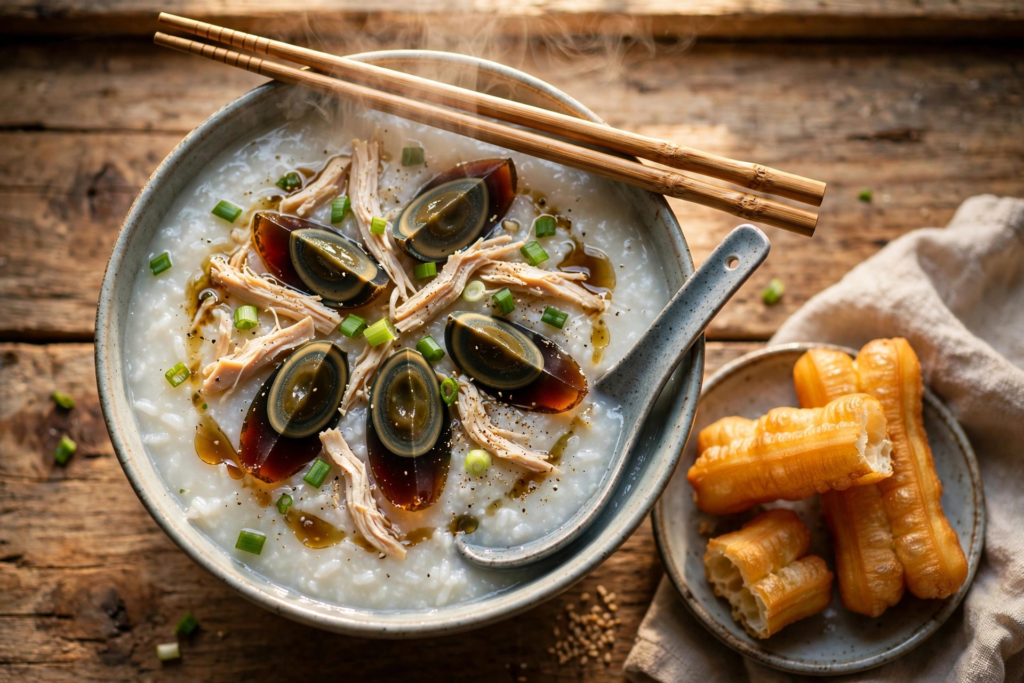
There’s a dish that has fed emperors and famine survivors, soothed fevers, and stretched a single cup of rice into dinner for six — and it asks almost nothing of you. Rice. Water. Time. That’s congee: the silky, savory rice porridge that might be the most comforting bowl in all of Chinese cooking.
If you’ve only ever met rice as fluffy grains beside a stir-fry, congee will surprise you. Cooked long and slow in a generous bath of water or broth, the grains surrender completely, dissolving into something thick, creamy, and spoonable. Plain, it’s a blank canvas. Dressed up with century egg, shredded chicken, pork floss, or a handful of crispy fried shallots, it’s a full meal. This is the story of what congee is, where its strange name came from, and how it’s traditionally made — plus how to make a proper bowl at home.
What Is Congee, Exactly?
At its simplest, congee is rice porridge: rice boiled in a large amount of liquid until the grains break down and thicken everything into a creamy, porridge-like consistency. The Chinese call it zhou (粥, pronounced “joe”), or juk in Cantonese — the version most Westerners meet first, in Hong Kong-style restaurants and Chinatown breakfast spots.
But “rice porridge” undersells it. Oatmeal is porridge. Congee is something else: savory, deeply soothing, endlessly adaptable. It can be whisper-thin or spoon-standing thick. It shows up at breakfast, at midnight, at the sickbed, and at banquets. And unlike most dishes with this much history, it never got fancy. A bowl of congee today looks much like a bowl from a thousand years ago — which is exactly the point.
What’s in a Name? The Strange Journey of “Congee”
Here’s a piece of trivia your dinner companions won’t know: the English word “congee” isn’t Chinese at all. It comes from the Tamil word kanji (கஞ்சி), meaning boiled rice. Portuguese traders picked it up as canje — the dish and the word first appear in a Portuguese document from 1563 — and English later borrowed it from them. So when you order “congee” at a Chinese restaurant, you’re using a Tamil word, via Portuguese, to describe a Chinese dish. Food history is never tidy.
In China itself, the dish is zhou, and it’s old — the first recorded reference traces back to around 1000 BC, during the Zhou dynasty. That’s three thousand years of rice porridge, which makes congee one of the oldest continuously cooked dishes on the planet. Wikipedia’s overview of rice congee traces the name’s journey and the dish’s spread across Asia, where nearly every rice-growing culture developed its own version.
A 3,000-Year-Old Bowl: Why Congee Endures
Congee survived three millennia for brutally practical reasons. First, it stretches food. When rice is scarce — in famine years, in wartime, in poor households — boiling it into porridge feeds far more mouths than serving it as grains. Vivid accounts of thin congee as survival food run through Chinese diaries and chronicles; it was quite literally the difference between eating and not.
Second, it’s gentle. Sick? Stomach upset? Teething baby? Elderly grandparent? Congee is warm, soft, easy to digest, and hydrating — the Chinese equivalent of chicken soup as a cure-all. Ask anyone who grew up in a Chinese household what they ate with a fever, and the answer is congee, usually plain, maybe with a little salt.
Third, it’s a canvas. A pot of plain congee costs almost nothing and takes almost no skill, but the toppings are where personality lives. That combination — humble base, infinite variation — is why congee never died out even as China got rich. It graduated from necessity to comfort food without changing a thing.
How Congee Is Traditionally Made
The traditional method is almost aggressively simple, which is why the details matter so much.
Start with the right ratio. The classic proportion is about 1 part rice to 8–10 parts water for a medium porridge, up to 1:12 for a thinner, more soup-like bowl. The Kitchn’s congee method uses 1 cup of rice to 8 cups of water and lands in about 35–40 minutes — a good weeknight baseline. Cantonese-style jook, the silkiest version, often goes longer: 1.5 to 2 hours of lazy simmering.
Wash the rice. Rinse until the water runs mostly clear. This isn’t fussy tradition — surface starch makes congee gummy and gluey instead of silky. Washed rice gives you that clean, creamy mouthfeel.
Boil, then barely simmer. Bring everything to a rolling boil, then drop to the gentlest simmer, partially covered. Here’s what’s happening in the pot: as the grains cook, they release starch into the liquid, and the starch thickens it. Stir occasionally, scraping the bottom — congee loves to catch and scorch if you ignore it.
Wait for the breakdown. You’re done when the individual grains have mostly surrendered — soft, swollen, dissolving into the porridge. Some cooks like distinct grains still visible; Cantonese masters cook until the rice is a smooth, homogenous cream. Neither is wrong. It’s your bowl.
Season at the end. Salt, a drizzle of sesame oil, white pepper — added after cooking, not before. Salting early is fine too, but most cooks season to taste at the finish, since toppings bring their own salt.
The Great Texture Debate: Regional Styles
Ask five Chinese people what congee should look like and you’ll get five answers — and possibly an argument. Texture is regional identity in a bowl:
| Style | Texture | Typical toppings | Where you’ll find it |
|---|---|---|---|
| Cantonese jook | Silky-smooth, grains fully broken down | Century egg & pork, fish slices, youtiao | Hong Kong, Guangdong |
| Teochew (Chaozhou) | Thinner, grains still distinct | Served plain beside salty side dishes | Coastal Guangdong, Fujian |
| Northern zhou | Thick, hearty, often mixed-grain | Pickled vegetables, peanuts | Beijing and the north |
| Vietnamese cháo | Medium, ginger-forward | Shredded chicken, fried shallots, herbs | Vietnam |
| Thai jok | Thick porridge, pork meatballs | Soft egg cracked on top, ginger | Thailand |
The Teochew approach deserves a special note: there, congee is deliberately plain and watery, because it’s not the main event — it’s the backdrop for intensely salty, flavorful side dishes. The bland porridge cools and balances everything else on the table. Once you understand that, the “watery” bowl makes perfect sense.
Toppings: Where Congee Becomes a Meal
Plain congee is comfort. Topped congee is dinner. The classics:
- Century egg & pork — the iconic Cantonese combo: creamy preserved egg and tender minced pork stirred through silky jook.
- Youtiao (fried dough sticks) — golden, airy, made for dunking. The crunch-against-cream contrast is unbeatable.
- Rousong (pork floss) — sweet-savory dried pork threads that melt on contact.
- Pickled vegetables — salted mustard greens, pickled radish, or fermented bean curd for sharp, salty punch. Here’s how quick pickles earn their place beside the bowl.
- Crispy shallots or fried wonton skins — crunch is the textural counterpoint congee craves.
- Ginger, scallions, white pepper, sesame oil — the finishing quartet. Never skip the white pepper.
There’s no wrong answer here. Congee is also the world’s best leftover vehicle: yesterday’s roast chicken, leftover rice from the fridge (which actually breaks down faster — the freezing damages the grain structure), a heel of ham. If it was good yesterday, it’s good in congee today.
Modern Shortcuts (No Shame)
Traditional congee takes an hour or more of stovetop babysitting. Modern life gets shortcuts, and honestly, they’re excellent:
- Pressure cooker: 15–20 minutes at high pressure does what 90 minutes does on the stove. RecipeTin Eats covers all three methods — stove, slow cooker, and pressure cooker — with honest timings for each.
- The frozen-rice trick: freeze washed rice overnight, then cook straight from frozen. The ice crystals fracture the grains, so they break down dramatically faster. This one actually works.
- Rice cooker porridge mode: set it, walk away, come back to congee. Many Asian rice cookers have a dedicated setting.
- Leftover cooked rice: simmer day-old rice in broth for 20 minutes. Less silky than from-scratch, ready in a fraction of the time.
For the base itself, start with good properly cooked jasmine rice technique in reverse — here you want the grains to fall apart, not stay distinct. And if congee is your introduction to Chinese breakfast culture, you’ll find it in good company with the rest of Asia’s morning foods.
The Congee Shop Experience
If you ever find yourself in Hong Kong at 7 a.m., do what the locals do: find a congee shop. Not a restaurant with congee on the menu — a dedicated shop, steam fogging the windows, where the menu is basically porridge in twenty variations and the whole operation runs on one giant pot.
Ordering is half the fun. The classics are always there: pork and century egg, fish fillet, sampan congee (ting zai zhou — the “boat congee” loaded with seafood, peanuts, and fried wonton skins, named for the boat-dwelling Tanka people who invented it). Everything is cooked to order, which means your bowl arrives fifteen minutes later, volcanic and steaming, with the toppings still distinct — nothing like the homogenous pot you’d make at home. The classic set is congee, youtiao, and a cup of hot soy milk, and it costs less than a fancy coffee.
A few rules of the shop, learned the hard way:
- Don’t blow on it dramatically — stir it gently with your spoon first. Stirring releases the heat evenly and cools the bowl faster than blowing ever will.
- Say yes to the extras. The fried wonton skins, the extra century egg, the side of pickles — this is where the shop makes its money and where your bowl gets interesting.
- Breakfast is the main event, but the best shops run late. A bowl of congee at midnight after a long night out is a Hong Kong institution.
You can’t fully replicate the shop at home — their pots are bigger, their turnover faster, their broth deeper from sheer volume. But now you know what you’re aiming for.
Frequently Asked Questions
Is congee the same as jook?
Yes — jook (or juk) is just the Cantonese pronunciation of the same dish the Mandarin-speaking world calls zhou. “Congee” is the English catch-all. Same bowl, three names.
What rice is best for congee?
Jasmine or any medium/short-grain white rice breaks down beautifully. Long-grain works but takes longer. Brown rice can work but needs much more time and never gets quite as silky. Avoid parboiled or converted rice — it resists breaking down, which defeats the purpose.
Why is my congee gluey instead of creamy?
Almost always unwashed rice, or heat that’s too high. Rinse until the water runs clear, keep the simmer gentle, and stir — don’t whisk aggressively, which can make it pasty.
Can you make congee ahead of time?
Absolutely — it keeps 4–5 days refrigerated and freezes well for a month. It thickens considerably as it sits (the starch keeps absorbing liquid), so loosen it with water or broth when reheating, a quarter cup at a time.
Is congee healthy?
Plain congee is gentle, hydrating, low-fat, and easy to digest — genuinely good sick-day food. But it’s mostly refined carbohydrate, so the nutritional story depends entirely on the toppings: load it with protein and vegetables and it’s a balanced meal; eat it plain three times a day and it’s just starch.
Congee is proof that the greatest dishes are often the simplest — and that “simple” and “easy” aren’t the same thing. The ingredient list fits on a Post-it. The technique takes a lifetime to perfect. Start with rice, water, and patience this weekend; the century egg can wait until you’re hooked. And once you’ve had a proper bowl — silky, steaming, scattered with scallions and white pepper — you’ll understand why three thousand years of cooks never bothered to improve it.
[…] home, it belongs in the weeknight rotation next to congee and simple stir-fries — the kind of cooking that leans on technique instead of ingredients. Among […]