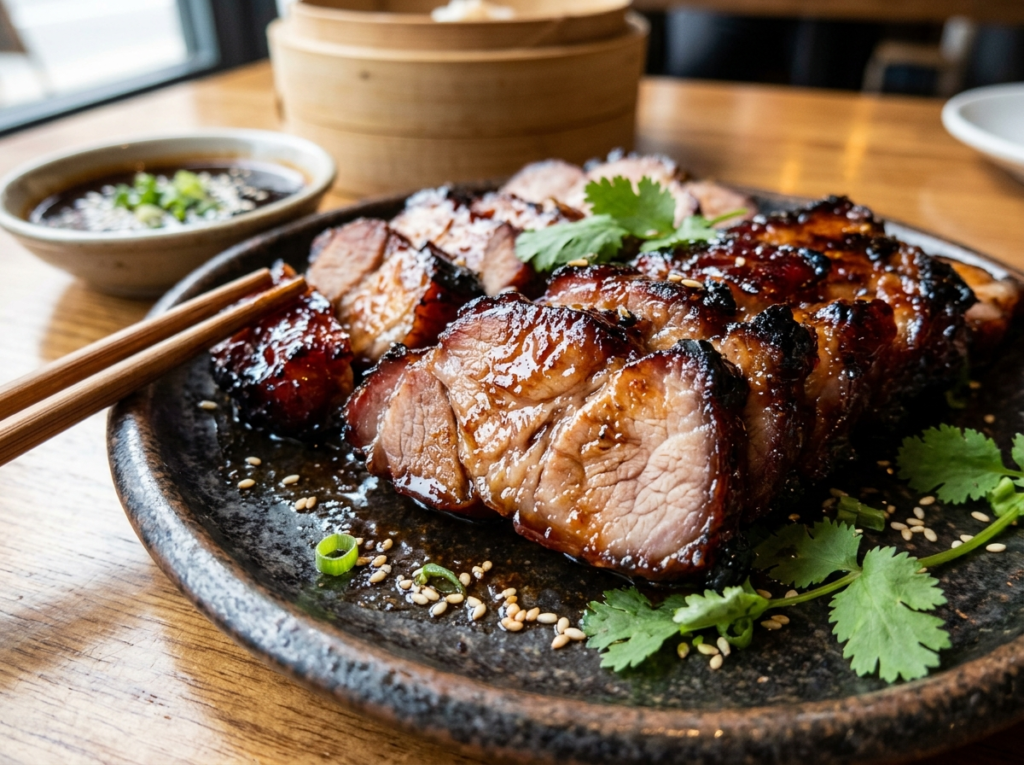
The sticky, lacquered char siu pork you see hanging in Cantonese barbecue shop windows didn’t get that way by accident. That glossy red-tinged exterior and tender, almost pull-apart interior come down to two things most home cooks underestimate: temperature control and technique. Get those right, and you’re genuinely close to what the best Cantonese BBQ masters produce. Get them wrong, and you end up with dry, tough, flavorless meat — no matter how good your marinade is.
Chinese char siu pork (叉燒) is one of the most iconic dishes in Cantonese cuisine, and it’s been that way for centuries. The name literally translates to “fork roasted,” a reference to the traditional method of skewering marinated pork on long forks and roasting it over an open fire. Today, most of us don’t have a commercial BBQ oven hanging in our kitchen, so we need to adapt. And that’s exactly what this article is about — the specific temperatures, timing, and methods that’ll help you make char siu pork that actually delivers.
Why Temperature Matters More Than Your Marinade
Here’s something that might surprise you: a mediocre marinade with perfect temperature management will beat a world-class marinade with sloppy cooking every time. That’s because the magic of char siu isn’t just flavor — it’s texture. You’re aiming for meat that’s caramelized and slightly charred on the outside while staying juicy and tender inside.
That contrast only happens within a narrow window of heat. Too low, and you basically braise the pork — moist, sure, but no char. Too high for too long, and you blow past the sweet spot into dry, overcooked territory. The sugars in your glaze burn instead of caramelizing, and the whole thing tastes bitter.
So before you obsess over whether to use maltose or honey (we’ll get to that), lock in your temperature game. It’s the foundation everything else sits on.
Choosing the Right Cut of Pork
Not all pork cuts are created equal for char siu, and picking the wrong one is probably the most common mistake home cooks make. Traditional Cantonese BBQ shops use pork butt (also called Boston butt or pork shoulder), specifically the section closer to the loin known as the “mei tou” (梅头肉) or collar butt. Why? It has the ideal fat-to-lean ratio — enough intramuscular fat to keep things moist during high-heat roasting, but not so much that the texture feels greasy.
If you’ve ever wondered about the differences between various pork cuts, understanding what pork cushion meat is can actually help you appreciate why specific cuts behave differently under heat.
Pork Butt vs. Pork Tenderloin vs. Pork Belly
Pork butt (shoulder) is the gold standard. Aim for a piece with visible marbling running through it. The fat renders during cooking, essentially self-basting the meat from the inside. You can cook it to a slightly higher internal temperature without it drying out, which gives you more room for error.
Pork tenderloin is what many Western recipes call for because it’s lean and cooks fast. And honestly? It can work, but it’s much less forgiving. Since there’s almost no fat, you’re dealing with a very tight window between “done” and “overdone.” If you go this route, expect to watch it carefully and pull it earlier than you think.
Pork belly makes an incredibly rich version of char siu — fatty, indulgent, and a bit different from the classic. If you can find good pork belly, it’s worth trying at least once. Just know that the technique changes a bit: you’ll want to render some of that fat first, and the cooking time extends.
How to Prep the Meat
Cut your pork into strips roughly 1.5 to 2 inches thick and about 6 to 8 inches long. This isn’t arbitrary — thinner strips cook too fast and dry out, while thicker chunks won’t develop that characteristic char-to-tender ratio. You want maximum surface area for the glaze to cling to, while keeping enough mass to stay juicy inside.
Some cooks poke small holes in the meat with a fork before marinating. This actually helps. It lets the marinade penetrate deeper, especially into leaner cuts. Don’t go overboard — you’re not tenderizing a steak. Just a dozen or so pokes per strip will do.
The Char Siu Marinade: What Goes In and Why
A traditional char siu marinade is a balancing act between salty, sweet, savory, and aromatic. Here’s what a classic Cantonese version looks like and why each ingredient matters:
Soy sauce (both light and dark) provides the salty backbone and gives the meat its deep brown color. Light soy is for flavor; dark soy is mainly for color. If you only have one, go with light.
Hoisin sauce adds a thick, slightly sweet base with fermented soybean complexity. It also helps the glaze stick.
Five-spice powder is the signature aromatic — a blend of star anise, cloves, cinnamon, Sichuan peppercorns, and fennel seeds. Use it sparingly. A teaspoon for about two pounds of meat is plenty. Too much and it overwhelms everything.
Honey or maltose is where the caramelization comes from. Traditional recipes use maltose (麦芽糖), which creates a more controlled, glossy caramelization because it doesn’t burn as easily as honey. If you can find maltose at an Asian grocery store, use it. If not, honey works — you’ll just need to watch your broiler more closely at the end.
Shaoxing wine adds depth and helps tenderize the meat slightly. If you’re curious about how to work with this ingredient across different dishes, there’s a helpful breakdown on cooking with Chinese cooking wine.
Fermented red bean curd (南乳, nam yue) is the secret weapon that gives char siu its distinctive reddish tint and a subtle funky sweetness. Not every recipe includes it, but the best ones do. Two to three cubes mashed into the marinade will do the trick for about two pounds of pork. If you can’t find it, a tiny bit of red food coloring handles the color, though you’ll miss the flavor.
Garlic and sesame oil round things out. A couple of minced cloves and a teaspoon of toasted sesame oil add aroma without dominating.
Marinating Time
Minimum: 4 hours. Ideal: overnight (12–24 hours). Anything under 4 hours and the marinade sits on the surface like a coat of paint rather than absorbing into the meat. Overnight is best because the salt and sugar have time to work their way into the muscle fibers through osmosis, seasoning the pork all the way through.
Keep the pork in a sealed zip-lock bag or covered container in the fridge. Turn it once or twice if you remember.
⚠️ Food Safety Note: Always marinate pork in the refrigerator, never at room temperature. Pork left in the danger zone (40°F–140°F / 4°C–60°C) for more than two hours can develop harmful bacteria. If you plan to use leftover marinade as a basting sauce, bring it to a rolling boil for at least one minute first to kill any pathogens from the raw meat.
Cooking Temperatures and Methods: The Heart of Char Siu
This is where most articles fall short — they give you a recipe but skip the why behind the temperatures. Let’s fix that.
Oven-Roasted Char Siu (Most Common Home Method)
The oven method is the most practical approach for home cooks, and it can produce results that rival a proper BBQ shop if you follow two stages: roast, then broil.
Stage 1 — Roasting: Set your oven to 325°F (165°C). Place your marinated pork strips on a wire rack set over a baking sheet lined with foil (to catch drips). The wire rack is important — it lets hot air circulate under the meat, preventing the bottom from steaming in its own juices.
Roast for approximately 25 to 30 minutes, then flip the strips and baste generously with reserved marinade. Continue roasting for another 20 to 25 minutes. You’re aiming for an internal temperature of around 145°F (63°C) at this stage — not fully done yet, because the broiler step will push it further.
Stage 2 — Broiling (the char): Switch your oven to broil on high. Mix a quick glaze: equal parts honey (or maltose melted with a splash of warm water) and reserved marinade. Brush a thick coat on the pork.
Broil for 2 to 3 minutes per side, watching it like a hawk. Seriously — don’t walk away. The sugars go from caramelized to charcoal in about 60 seconds. You want dark, sticky, slightly blistered edges with some blackened spots. That’s char siu’s signature look.
Final internal temperature: 150°F–155°F (65°C–68°C) for pork shoulder, measured with an instant-read thermometer at the thickest part.
Pro Tip: The USDA updated its pork guidelines back in 2011, lowering the safe minimum internal temperature for whole cuts of pork from 160°F to 145°F (63°C) with a 3-minute rest. This means you no longer need to cook pork until it’s gray and dry. At 145°F–155°F, pork butt will be slightly pink inside — and that’s perfectly safe and exactly what you want for char siu.
If you’re using pork tenderloin, reduce your total roasting time by about 10 minutes and pull it at 145°F (63°C) internal. Tenderloin dries out fast past 150°F because it has almost no fat.
Grilling Char Siu Over Charcoal or Gas
This method is closest to the traditional approach and produces the best flavor, thanks to the smoke and direct flame. It does require more attention, though.
Set up your grill for two-zone cooking: one side with direct high heat (around 400–450°F / 200–230°C) and one side with indirect, lower heat. Start by searing the marinated strips over direct heat for about 2 to 3 minutes per side to build color and char. Then move them to the indirect side, close the lid, and let them cook through at around 325°F (165°C) for another 15 to 20 minutes, basting with glaze every 5 minutes or so.
If you enjoy grilling pork, you’ll find some useful crossover techniques in this guide on grilling pork chops perfectly.
Same target internal temp: 145°F–155°F (63°C–68°C) depending on cut.
Air Fryer Char Siu
The air fryer has become a popular shortcut, and it actually works surprisingly well for char siu — especially if you’re cooking for one or two people. The rapid circulating heat mimics a convection oven and creates good caramelization.
Set the air fryer to 375°F (190°C). Cook the pork strips for 12 to 15 minutes, flipping halfway through and basting at each flip. For the final 2 to 3 minutes, brush on a thick layer of glaze and bump the temperature to 400°F (200°C) to get that charred finish.
The main limitation? Size. Most air fryers can only handle two to three strips at a time without overcrowding, and overcrowding kills the crispness.
Sous Vide Then Sear
This is the precision route, and it’s a bit of a cheat code for tenderness. Vacuum-seal your marinated pork and cook it in a water bath at 145°F (63°C) for 4 to 6 hours (for shoulder) or 135°F (57°C) for 2 hours (for tenderloin). This gives you meat that’s cooked edge-to-edge to exactly the doneness you want, with zero guesswork.
After the bath, pat the pork dry, brush on your glaze, and finish under a broiler or with a kitchen torch until charred and sticky. The result is almost unnervingly tender — restaurant-quality without the stress.
The Glaze: Building Those Sticky, Lacquered Layers
If you’ve ever eaten great char siu, you know that glaze is everything. It’s not a single coat — it’s built up in layers during the last phase of cooking.
The base of a good char siu glaze is maltose or honey thinned with a bit of the marinade. Some cooks add a splash of soy sauce and a pinch of five-spice. The key technique is basting every 2 to 3 minutes during the final high-heat stage — whether that’s under the broiler, over the grill, or in the air fryer.
Each coat caramelizes before the next one goes on, building up that thick, shiny, almost candy-like shell. Three to four coats is the sweet spot. You’ll know it’s right when the surface looks like dark, shiny lacquer with patches of slight char.
Why maltose beats honey for glazing: Maltose has a higher caramelization point than honey (around 356°F / 180°C vs. 320°F / 160°C for most honeys). That means it stays in the “caramelized” zone longer before burning. It also dries to a firmer, glossier finish. You can find maltose in most Asian grocery stores — it comes in a jar and looks like thick, pale amber syrup. It’s sticky and hard to work with at room temperature, so warm it slightly before using.
Resting and Slicing: Don’t Skip This
After you pull the pork from the heat, let it rest for at least 10 minutes before slicing. I know it’s tempting to cut into it right away, especially when it smells that good. But resting allows the muscle fibers to relax and reabsorb some of the juices that got pushed to the center during cooking. Cut too soon and those juices run out onto your cutting board instead of staying in the meat.
Slice against the grain into pieces about ¼ to ⅜ inch thick. Cutting against the grain shortens the muscle fibers in each slice, making every bite more tender. If you look at the surface of the meat, you’ll see lines running in one direction — that’s the grain. Cut perpendicular to those lines.
Drizzle a bit of the pan drippings mixed with extra glaze over the sliced pork. This is what Cantonese BBQ shops do, and it adds one more layer of flavor and moisture.
What to Serve With Char Siu
Char siu pork is incredibly versatile. The most classic pairing is simply steamed jasmine rice — if you want tips on getting that right every time, check out this guide on cooking perfect jasmine rice. The sweetness of the pork against plain rice is one of those combinations that’s hard to beat.
Beyond rice, char siu is the traditional filling for bao (叉燒包), those fluffy steamed buns you see at dim sum. If you’re curious about what makes bao special, there’s a great overview of what bao is and how it’s made.
Other popular uses include topping ramen bowls (char siu ramen is a staple in Japanese-style shops), stir-frying with vegetables, adding to fried rice, or just eating cold straight from the fridge at 2 AM. No judgment.
You can also pair it with quick pickled vegetables for a bright, acidic contrast that cuts through the richness of the glaze.
Storing and Reheating Leftovers
Char siu pork keeps well, which is part of why it’s such a practical thing to make at home.
In the fridge: Store sliced or whole strips in an airtight container for up to 4 days. If you’re storing it with leftover glaze, pour it right over the pork — it acts as a flavor-preserving blanket. For general tips on storing cooked foods in the fridge safely, similar principles apply across proteins and starches.
In the freezer: Wrap individual portions tightly in plastic wrap, then place them in a freezer bag. Frozen char siu stays good for up to 3 months. Thaw overnight in the fridge before reheating.
Reheating: The best method is a quick stint under the broiler or in a hot oven (400°F / 200°C) for 5 to 7 minutes, brushed with a bit of fresh glaze. Microwaving works in a pinch but won’t give you that re-crisped exterior. If you microwave, cover the pork loosely and add a splash of water to the container to create steam and prevent drying.
⚠️ Food Safety Note: Reheat leftover pork to an internal temperature of 165°F (74°C) to ensure safety, per USDA guidelines. Use a thermometer rather than guessing.
FAQ
What internal temperature should char siu pork be?
For whole cuts of pork like shoulder or butt, aim for a final internal temperature of 145°F to 155°F (63°C to 68°C), followed by a 3-minute rest. The USDA’s safe minimum for whole pork cuts is 145°F with a 3-minute rest. Char siu made from shoulder can comfortably go up to 155°F and still be juicy thanks to its fat content. For pork tenderloin, stick closer to 145°F to avoid dryness.
Can I make char siu pork without an oven?
Absolutely. A charcoal or gas grill using two-zone cooking works beautifully and gives you smoky flavor the oven can’t replicate. An air fryer at 375°F is another solid option for smaller batches. You can also use the sous vide method — cook the pork at 145°F for 4 to 6 hours, then finish with a quick broil or kitchen torch for char.
Why is my char siu pork tough and dry?
The two most common culprits are wrong cut and overcooking. If you’re using a very lean cut like tenderloin, the margin for error is razor-thin — even 5 to 10 degrees above 150°F can make it dry. Switch to pork butt or shoulder for a much more forgiving cook. Also make sure you’re slicing against the grain. Cutting with the grain leaves long muscle fibers intact, which makes each bite feel chewy and tough even if the pork is technically cooked correctly.
What’s the red color in char siu pork?
Traditional char siu gets its reddish hue from fermented red bean curd (nam yue), which naturally tints the meat. Some commercial shops also use red food coloring or red yeast rice powder. If your homemade version doesn’t look as vibrant as what you’d buy at a Cantonese BBQ shop, that’s totally normal — and it doesn’t affect the flavor.
How long should I marinate char siu pork?
A minimum of 4 hours and ideally 12 to 24 hours in the refrigerator. Overnight marinating gives the best results because the salt and sugar have time to penetrate deep into the meat through osmosis, seasoning it throughout rather than just on the surface.
Your Next Move
Making char siu pork at home isn’t hard — it just rewards you for paying attention to the details that matter. Get a well-marbled cut of pork shoulder. Marinate it overnight. Roast it at a controlled temperature with a thermometer nearby. And build that glaze in layers during the last few minutes of high heat.
Once you’ve nailed it once, you’ll find yourself making it regularly. A batch on Sunday means char siu rice bowls for lunch, bao filling for dinner, and midnight fridge raids for the rest of the week. And honestly, that’s exactly how it should be.