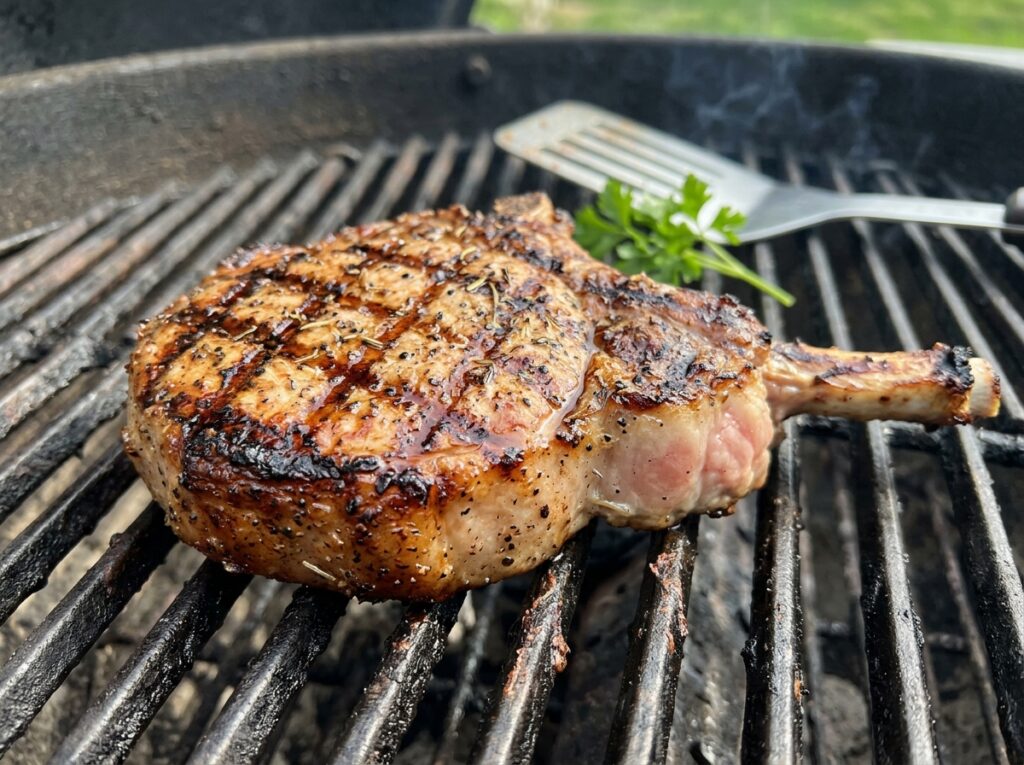
I want you to forget everything you think you know about how to grill pork chops. Forget the 7-minute-per-side rule. Forget the “pork must be white as snow” myth your grandmother taught you. Most importantly, forget the idea that a great marinade can save a bad chop. I learned this the hard way, early in my career, while working a station at a high-volume steakhouse. We’d go through hundreds of chops a night, and the inconsistency drove the head chef insane.
That single lesson unlocked everything. Grilling a perfect pork chop isn’t about a recipe; it’s about solving a thermal puzzle. It’s about understanding how heat moves through muscle, fat, and bone. Today, I’m going to give you the code to that puzzle. This is the definitive guide on how to grill pork chops, broken down by the principles that actually matter, not by a list of ingredients.
The Foundation: Your Chop is Your Destiny
Before we even talk about heat, we have to talk about the canvas. You cannot create a masterpiece on a flimsy, flawed piece of meat. The single most important decision you make happens at the butcher counter, not at the grill. The question of the best way to grill pork chops begins with this: what chop are you grilling?
Let’s be brutally honest. Most supermarket pork chops are terrible for grilling. They’re too thin, too lean, and often pumped full of a salt solution that makes them watery and hammy. You must seek out something better.
| Chop Type | Grill-ability | The Insider’s Take |
|---|---|---|
| Bone-In Rib Chop | ⭐⭐⭐⭐⭐ | The Champion. Thick, well-marbled, with a curved bone that insulates the meat. It’s forgiving, flavorful, and the gold standard for a reason. |
| Bone-In Loin Chop (Center-Cut) | ⭐⭐⭐⭐ | The Contender. The “T-bone” of pork. Two distinct muscles (loin and tenderloin) offer two textures. The bone is a huge plus. Can be slightly less forgiving than a rib chop. |
| Boneless Loin Chop | ⭐⭐ | The Challenge. Lacks the flavor and thermal protection of the bone. Cooks through in a flash. Prone to drying out. Requires absolute precision. |
| Thin-Cut (< 1 inch) | ⭐ | Avoid for Grilling. This isn’t grilling; it’s a sear. You will create a tough, overcooked product every time. Save these for pan-frying. |
The non-negotiable rule is this: Always choose a thick-cut, bone-in chop. I’m talking a minimum of 1.5 inches. This thickness is your thermal buffer. It gives you the time needed to develop a deep, dark crust on the outside without turning the inside into leather. The bone acts as a heat sink, slowing the transfer of heat to the meat right next to it, ensuring that part stays juicy while the rest of the chop catches up.
When you’re armed with a proper chop, you’ve already won 80% of the battle. The rest is just technique.
The Thermal Insurance Policy: Why You Must Brine
Even with the perfect chop, there’s a margin for error. The single best tool to narrow that margin is a brine. I think of a brine as thermal insurance. It gives you a larger safety net, ensuring that even if you overshoot your target temperature by a few degrees, the chop will still be moist.
We covered the science before, but it’s worth repeating. A brine is a saltwater solution (typically 4 tablespoons of kosher salt and 2 tablespoons of sugar per quart of water). Through osmosis, the muscle fibers absorb this liquid. The salt denatures the proteins, allowing them to trap more water during the cooking process. The result is a chop that is seasoned from the inside out and is significantly more resistant to drying out.
For a truly next-level experience, try a buttermilk brine. The lactic acid in buttermilk works as a gentle tenderizer, and the result is an incredibly tender chop with a subtle, pleasant tang. Simply swap the water for full-fat buttermilk and add the same ratio of salt.
Whichever brine you choose, submerge your chops for 1-4 hours. Pat them completely dry with paper towels before they hit the grill. This is a critical step. A wet surface will steam, not sear, and you’ll never get that desirable crust.
The Core Principle: Mastering the Two-Zone Fire
This is the heart of the matter. This is the technique my chef was trying to teach me. A single-zone fire—where the entire grill is one temperature—is the enemy of the thick-cut pork chop. You need two zones: one for high, direct searing heat, and one for low, indirect cooking heat.
This method allows you to get the best of both worlds: the Maillard reaction and crust of a hot sear, and the gentle, even cooking of an oven.
Setting up your Two-Zone Fire:
- For a Charcoal Grill: Pile all your lit coals on one half of the grill. This creates a hot zone (direct heat) and a cool zone (indirect heat). Simple and effective.
- For a Gas Grill: Turn on the burners on one half of the grill to medium-high or high. Leave the burners on the other half off. This achieves the same direct/indirect setup.
The Two-Zone Cooking Method:
- Sear (Direct Heat): Place your well-dried, brined chop on the hot side of the grill. Sear for 2-3 minutes per side. Don’t move it around. Let it develop a deep, dark, beautiful crust. This is where the flavor is born.
- Cook (Indirect Heat): Move the seared chop to the cool side of the grill. Close the lid. Now, you’re essentially roasting the chop. The heat will circulate, cooking it gently and evenly from all sides.
- Flip and Finish: After about 6-8 minutes (depending on thickness), flip the chop once. Close the lid again. You’re now in the home stretch.
This method works for all types of grills. When you’re figuring out how to grill pork chops on a gas grill, this two-zone method is the key. It gives you the same control as a charcoal grill, just with the convenience of gas.
The Million-Dollar Question: What Temp to Grill Pork Chops?
This is where most recipes fail you. They give you a time. “Grill for 6 minutes per side.” This is useless. The how long to grill pork chops question is the wrong question. The right question is, “What temperature to grill pork chops to?”
The answer is 145°F (63°C). This is the USDA-recommended temperature for cooked pork, followed by a 3-minute rest. At this temperature, the pork is safe, juicy, and tender, with a beautiful rosy-pink center. Cooking it to the old 160°F+ standard is a one-way ticket to Dry City.
To hit this target, you need an instant-read digital thermometer. It is the single most important tool you can own for grilling. It removes all the guesswork.
Here’s the professional technique for using it:
- Start checking the temperature towards the end of the estimated cooking time.
- Insert the thermometer horizontally into the thickest part of the chop, making sure not to touch the bone.
- Pull the chop off the grill when it reaches 140-142°F (60-61°C).
- Tent it loosely with foil and let it rest for 5-10 minutes.
Why pull it early? Because of carryover cooking. The residual heat on the exterior of the chop will continue to travel inward, raising the internal temperature by another 5-10 degrees while it rests. This brings it right up to the perfect 145°F. If you pull it at 145°F, by the time you eat it, it will be overcooked.
So, how long do you grill pork chops? As long as it takes to reach 140°F. For a 1.5-inch thick chop, this is typically 12-18 minutes total using the two-zone method. But don’t watch the clock. Watch the thermometer.
Grill-Specific Strategies: Gas, Charcoal, and Pellet
While the two-zone method is universal, each type of grill has its own personality.
Gas Grill: The King of Convenience
Gas grills are fantastic for the two-zone method. The main drawback is a lack of smoke flavor. To combat this, you can use a smoker box filled with wood chips or create a foil pouch with soaked wood chips poked with holes. Place it directly on the heat diffusers above the burners. This will give you a subtle smoke infusion that elevates the final product.
Charcoal Grill: The Purist’s Choice
This is where you get that primal, smoky flavor. The key is managing your fuel. Use a chimney starter to get your coals uniformly hot. When they’re ashed over, dump them into a pile on one side. Hardwood lump charcoal will burn hotter and give a cleaner flavor than briquettes. The challenge here is maintaining a consistent temperature, but the flavor payoff is immense.
Pellet Grill Pork Chops: The Reverse Sear Champion
Pellet grills are amazing for the indirect phase of cooking. They act like a wood-fired convection oven, infusing the meat with incredible smoke flavor. However, they often struggle to get hot enough for a hard sear. This is where the “reverse sear” method becomes your best friend.
- Smoke First: Set your pellet grill to a low temperature, around 225°F (107°C). Place the chops directly on the grates and smoke them until they reach an internal temperature of about 110°F (43°C).
- Sear Last: Remove the chops from the pellet grill. Crank it up to its highest setting (usually 450-500°F) or, even better, sear them on a screaming hot cast-iron skillet or on a preheated gas grill. Sear for 60-90 seconds per side to create the final crust.
- Rest: They’ll already be close to their target temp, so a short rest of 5 minutes is all they need.
This reverse sear method for pellet grill pork chops gives you the best of both worlds: unparalleled smoke flavor and a perfect crust. It’s a foolproof way to get incredible results.
The Final Act: Resting and Finishing
You’ve managed the heat, you’ve nailed the temperature. Don’t ruin it now. The rest is not optional. It’s a mandatory part of the cooking process. As the chop rests, the muscle fibers, which have tensed up during cooking, relax. This allows them to reabsorb the juices that have been pushed to the center. If you cut into it immediately, all that moisture will spill out onto your cutting board.
After resting, this is your moment to add a final flourish. A simple pat of compound butter (softened butter mixed with herbs like thyme, rosemary, and garlic) placed on top of the hot chop will melt into a delicious, savory sauce. Or, you can use the fond left in the pan (if you did a final stovetop sear) to create a quick pan sauce with a splash of wine, stock, or butter.