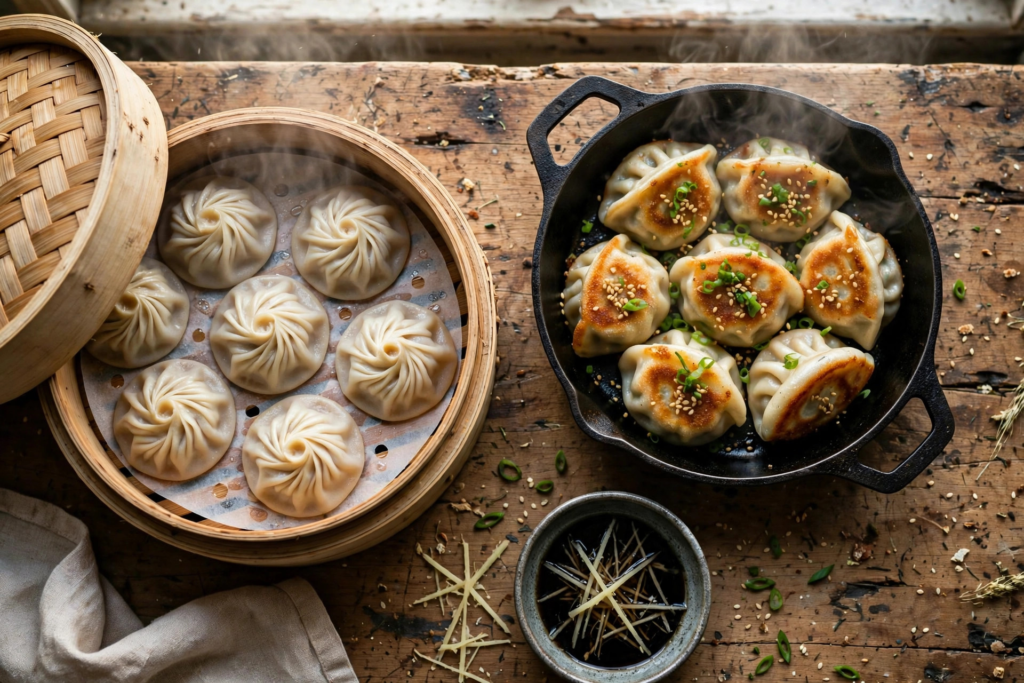
Order the wrong one and nobody will laugh at you. But you’ll know.
You’ll be sitting there with a basket of delicate, trembling soup dumplings when what you really wanted was something you could eat with your hands on the way to work. Or you’ll grab four pan-fried buns expecting a dainty little bite and end up with a mouthful of bread and a lap full of scalding soup. Both mistakes are survivable. Both are also completely avoidable, because once you see the difference between xiaolongbao and shengjian bao, you can’t unsee it.
They’re both from Shanghai. They both hide hot soup inside pork. And that’s about where the family resemblance ends. One is steamed silk. The other is fried comfort. This is the full breakdown: the dough, the cooking, the soup, how locals actually eat each one — and which to order depending on your mood.
The 30-Second Version
Xiaolongbao (小笼包, “small steamer basket buns”) are thin-skinned soup dumplings, steamed in bamboo baskets, eaten delicately with a spoon. Shengjian bao (生煎包, “raw-fried buns”) are bigger, breadier buns with a crispy fried bottom and a soft, fluffy top, cooked in a pan and eaten by hand like street food.
Think of it this way: xiaolongbao is the dumpling you sit down for. Shengjian bao is the dumpling you grab on the go. One rewards patience and a steady hand. The other rewards hunger.
If you’ve already fallen for soup dumplings, here’s the full story of xiaolongbao — where they came from and how the soup gets inside. This one’s about the sibling rivalry.
| Xiaolongbao | Shengjian Bao | |
|---|---|---|
| Name means | “Small steamer basket buns” | “Raw-fried buns” |
| Dough | Thin, unleavened wheat | Thick, yeasted bread dough |
| Cooking | Steamed in bamboo baskets | Pan-fried, then steamed under a lid |
| Texture | Delicate, silky, translucent skin | Crisp golden bottom, fluffy chewy top |
| Size | Golf-ball small | Small-fist hearty |
| Soup inside | Yes — sip from a spoon | Yes — poke a hole and slurp |
| How you eat it | Sit down, chopsticks and spoon | By hand, on the go |
| Where locals eat it | Teahouses, dumpling restaurants | Street stalls, breakfast shops |
The Dough Is the Real Divide
Everything about these two starts with the dough, and the doughs have almost nothing in common.
Xiaolongbao uses an unleavened wheat dough — flour, warm water, a pinch of salt, no yeast. It’s rolled paper-thin, pleated a dozen or more times, and twisted shut. The whole point is delicacy: the wrapper should be translucent enough that you can see the filling’s shadow through it, yet strong enough to hold a spoonful of hot broth without tearing. Among China’s dumplings, it’s the thinnest skin in the game, and there’s no room for error. Too thick and the dumpling eats doughy. Too thin and it bursts in the steamer.
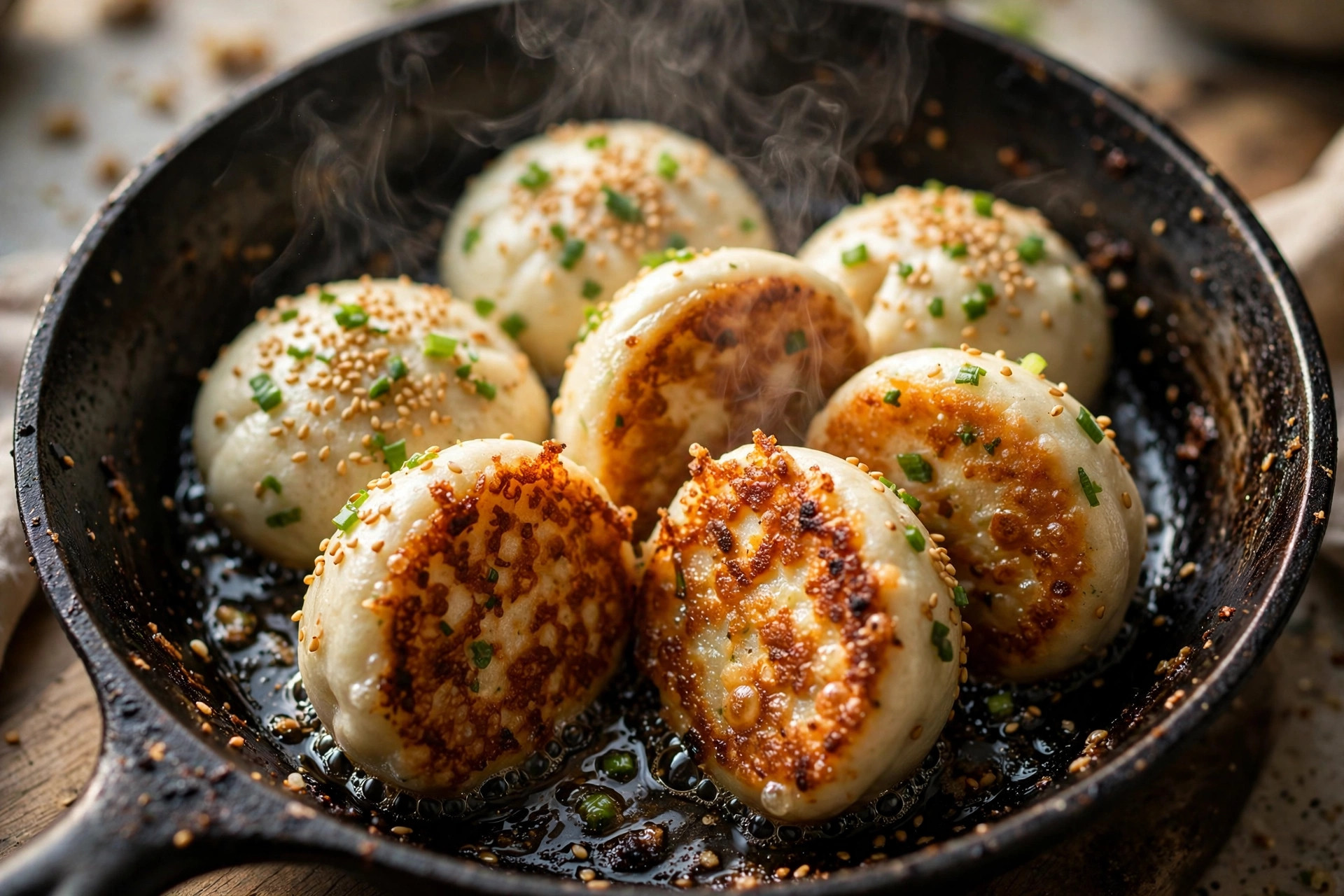
Shengjian bao goes the opposite direction. The dough is yeasted — a soft, slightly sweet bread dough that rises before it’s filled. It puffs in the pan into something closer to a dinner roll with a dumpling’s soul. The wrapper is thick and chewy, built to soak up soup from the inside without falling apart in your hands.
And here’s a detail most guides skip: Shanghai locals argue about shengjian dough the way other cities argue about barbecue. There are two warring schools. One camp wants an unleavened, thin-skinned bun (the style associated with the famous Xiao Yang shops). The other wants a fully leavened, fluffy, bread-like bun (the Da Hu Chun style). The most beloved shops, like the 24-hour institution Dong Tai Xiang, split the difference with a semi-leavened dough — puffy but still chewy, crisp-bottomed, sesame-flecked on top. As SmartShanghai’s deep dive on the city’s shengjian scene puts it, the texture of the dough is what separates the great shops from the merely good ones — not the soup, not the meat.
Steamed Silk vs. the Sizzle Pan
The names tell you exactly how each one cooks. You just have to translate them.
Xiaolongbao are pure steam. The pleated dumplings sit in stacked bamboo baskets over boiling water for about eight minutes, served still trembling in the basket they cooked in. Nothing touches them but vapor. That’s why the skins stay glassy and the pleats stay crisp — steam is gentle, and gentleness is the entire aesthetic.
Shēngjiān literally means “raw-fried”: the raw buns go into a wide, oiled pan — traditionally cast iron — and fry uncovered for a few minutes until the bottoms turn deep golden brown. Then water gets splashed in, a lid slams down, and the buns steam in their own pan until the water evaporates. Uncover, let the bottoms re-crisp for a minute, and they’re done. Fry and steam, one pan, about ten minutes. The Institute of Culinary Education describes the technique in its dumpling guide as producing “a crispy bottom and tender top” — which undersells it a little. What you actually get is three textures at once: shattering crust underneath, chewy bread in the middle, soupy pork at the center.
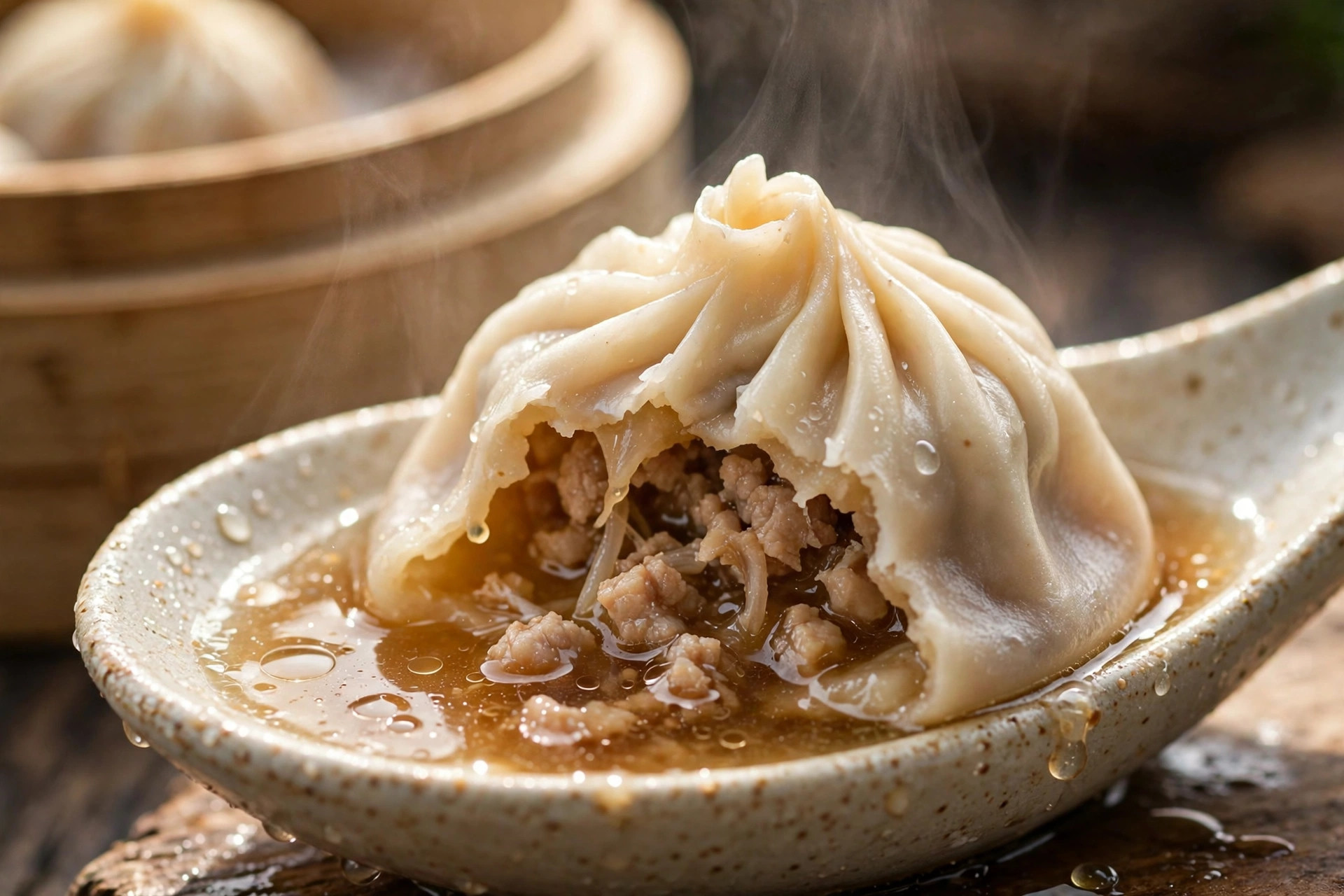
Here’s the part that surprises people: both dumplings hide soup, and they hide it the same way. The filling mixes ground pork with diced aspic — chilled, jellied stock made from collagen-rich pork skin and bones. Solid going in, liquid coming out. Heat melts the jelly back into broth during cooking, whether that’s in a bamboo steamer or a lidded frying pan. If someone tells you only xiaolongbao are “soup dumplings,” they’ve never been scalded by a shengjian bao. The soup is real, it’s hot, and it does not care about your schedule.
Size, Soup, and How You Actually Eat Them
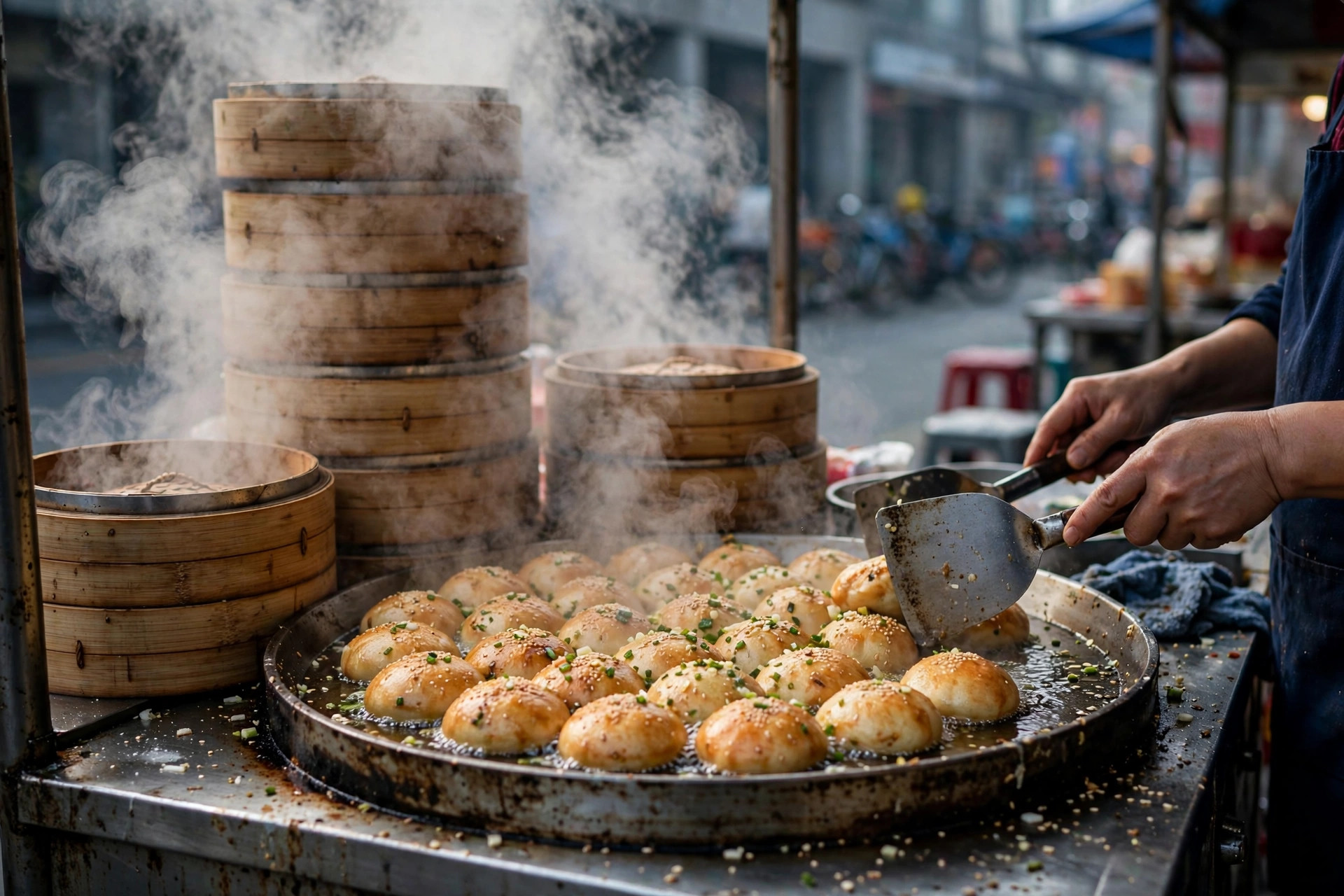
A xiaolongbao is about the size of a golf ball, maybe a touch bigger. A shengjian bao is closer to a small fist — substantially heftier, built from that risen dough. An order of xiaolongbao might be eight little parcels in a basket. Shengjian bao traditionally come four to an order, fresh off the flat-top griddle, dusted with sesame seeds and chopped scallions.
The eating rituals are completely different, and this is where visitors most often go wrong.
Xiaolongbao demands the full ceremony: lift from the twisted knot with chopsticks, park it in a Chinese soup spoon, nibble a small hole, sip the broth, then dip the rest in black vinegar with shredded ginger. The spoon isn’t optional — it’s your safety net for a wrapper thinner than paper.
Shengjian bao is street food, so the ritual is street-simple. Pick one up with your chopsticks (or your fingers — nobody judges at a breakfast stall), poke a small hole in the side with a chopstick or your teeth, and slurp the soup out first. Then eat the bun, ideally with a dab of black vinegar or chili oil. Chef James Ho, speaking to Tasting Table, puts it plainly: pierce, slurp, then pop it in your mouth. Same soup-safety principle as xiaolongbao, minus the spoon and the ceremony. Want the vinegar part down before you go? Here’s an easy dumpling dipping sauce to practice with.
Where Locals Actually Eat Each One
This is the difference no comparison chart captures, because it’s about culture, not cooking.
Shengjian bao is Shanghai breakfast. Morning crowds queue at stalls and tiny shops, buns come sizzling off enormous flat pans, and people eat standing up or walking to the subway. It’s cheap, fast, filling — working-class fuel. The great shengjian shops do staggering volume; turnover is the whole business model, which is also why the best ones taste best at 7 a.m. and merely good by afternoon.
Xiaolongbao lives a dressier life. In Shanghai it’s eaten for breakfast and lunch too, but in a sit-down setting — teahouses, dumpling restaurants, the famous old shops in Nanxiang. Outside China, it’s become the star of the dim sum-adjacent restaurant meal, the thing you order a basket of to share while everything else arrives. Chef Kathy Fang told Tasting Table that two to three dumplings per person is a realistic minimum order, which tells you something about the vibe: this is food you linger over, not food you inhale between train stops.
Price follows the same split. Shengjian bao is pocket change — a few yuan for four at a street stall in Shanghai, a few dollars at a shop abroad. Xiaolongbao costs more, partly from the labor (those eighteen pleats don’t pleat themselves) and partly from the setting. One is a snack. The other is an occasion.
If you’re curious how these fit into the bigger picture, both belong to the bao family — and shengjian’s role as morning fuel makes more sense once you see what breakfast looks like across Asia.
So Which One Should You Order?
Honest answer? Both. But if you’re choosing, let the moment decide.
- Bringing someone new to Shanghai food? Xiaolongbao — it’s the showpiece.
- Cold morning, empty stomach, ten minutes to spare? Shengjian bao — it was built for exactly that.
- Want to try making one at home? Shengjian bao — a heavy skillet and a lid are all you need.
- Truly can’t decide? Order both: xiaolongbao first while it’s at its most delicate, then shengjian bao while the bottoms still crackle.
Pick xiaolongbao when you want the experience: a sit-down meal, something to talk about, the delicate end of Chinese cooking. It’s the one to order on a first date, with visiting parents, or when you’re introducing someone to Shanghai food for the first time. It shows off technique — the thin skin, the pleats, the hidden soup — in a way nothing else quite does.
Pick shengjian bao when you’re hungry. Properly hungry. When you want crunch and chew and a bun that fights back a little. It’s the better cold-weather food, the better hangover food, the better “I just need something great right now” food. And if you find a shop that does the semi-leavened style — crisp bottom, puffy chew, scalding soup — you’ve found something most tourists walk straight past.
Can’t decide? Order both and eat them side by side. Start with the xiaolongbao while it’s at its most delicate, then move to the shengjian bao while the bottoms are still crackling. That progression — silk, then sizzle — is one of the great cheap thrills in all of Chinese food. For context on the regional cooking behind both, China’s major regional cuisines explain why Shanghai ended up with two soup dumplings instead of one.
Frequently Asked Questions
Do shengjian bao have soup inside too?
Yes — and this is the single biggest misconception. Like xiaolongbao, shengjian bao are filled with pork mixed with aspic (jellied stock) that melts into hot broth during cooking. Bite into one carelessly and you’ll get scalded just as fast. Always poke a hole and let steam escape first.
Which one is older?
Xiaolongbao, by most accounts — its popularization traces to 19th-century Nanxiang, near Shanghai, while shengjian bao grew out of the same soupy-bun tradition as a humbler, pan-fried street adaptation. Neither has a clean birth certificate; both evolved from the Jiangnan region’s love of soup-filled wheat parcels.
Can I make shengjian bao at home without special equipment?
Absolutely — that’s the beauty of them. A heavy skillet with a tight-fitting lid is all you need: fry the bottoms, add water, cover to steam, uncover to re-crisp. No bamboo steamers required, which makes shengjian bao the more approachable weekend project of the two.
Are shengjian bao the same as potstickers?
Close cousins, not twins. Potstickers (guo tie) use thin unleavened wrappers and a fry-then-steam technique, but they have no soup inside and no yeasted dough. Shengjian bao’s puffy bread-like wrapper and hidden broth put it in a different category — think of it as sitting halfway between a potsticker and a steamed bao.
The rivalry is friendly, but now you know which is which. Next time you’re staring at a menu with both names on it, you won’t have to guess — you’ll order the silk when you want delicacy, the sizzle when you want comfort, and you’ll poke the hole before the soup pokes back.
[…] yeasted dough — you poke a hole with a chopstick and slurp, no spoon required. Here’s the full xiaolongbao vs shengjian bao breakdown if you’re deciding between […]