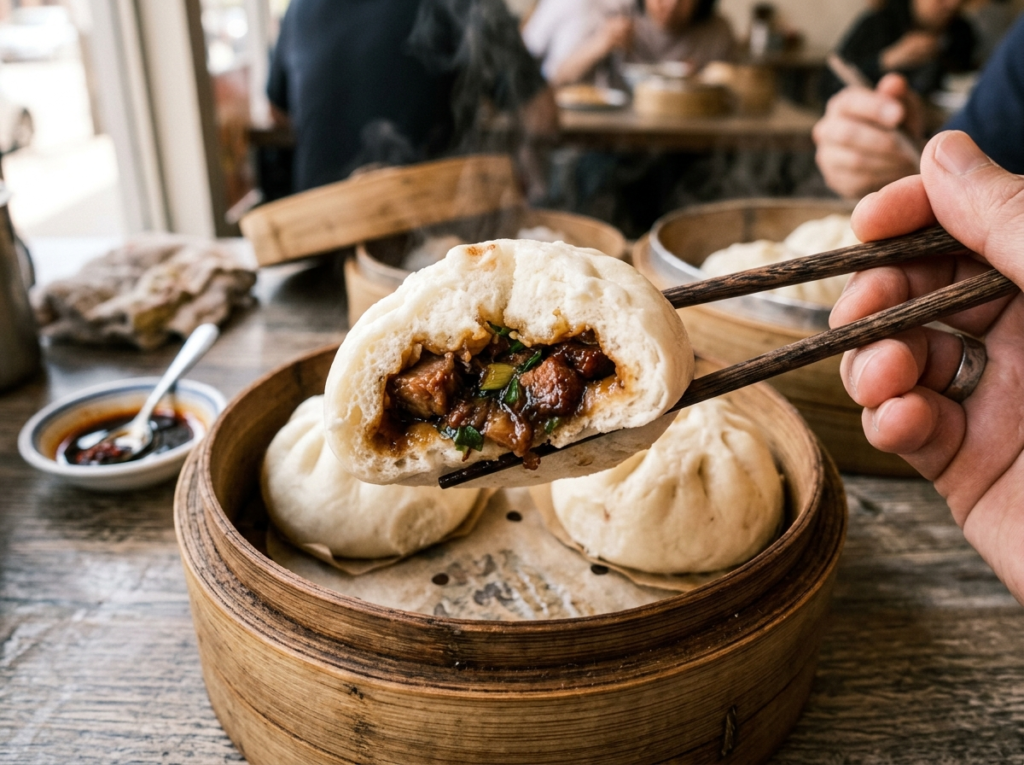
A single steamed bun, split open and releasing a curl of fragrant steam, has turned into one of the most recognizable street foods on the planet. That bun is bao — and whether you’ve grabbed one from a Chinatown bakery, spotted it on a trendy restaurant menu, or watched it star in Pixar’s 2018 short film Bao, chances are you’ve been curious about it.
But what exactly is bao? Is it the same thing as a dumpling? Are all those different-looking buns you see at dim sum the same food? And can you actually make them at home without a culinary degree?
Let’s sort it all out. By the time you’re done reading, you’ll know the history behind bao, the most popular types, what goes inside them, and how to enjoy them like someone who’s been eating them their whole life.
The Basics: What Is Bao, Really?
At its simplest, bao (包, pronounced “bow” as in “take a bow”) is a Chinese steamed bun made from a soft, leavened dough. The word “包” literally translates to “wrap” or “package,” which makes sense — bao wraps a filling inside a pillowy blanket of dough.
The dough itself is typically made from wheat flour, water, sugar, yeast, and sometimes milk or baking powder. It’s the steaming process that gives bao that signature cloud-like texture: soft, slightly springy, and almost impossibly white. Unlike baked bread, steamed bao doesn’t develop a crust. The entire surface stays tender.
Some bao are filled with savory ingredients like pork, chicken, or vegetables. Others are sweet, stuffed with red bean paste or custard. And some are served completely plain — just the fluffy dough by itself, meant to be eaten alongside other dishes the way you’d use bread to soak up a stew.
Here’s the thing that trips people up: “bao” is actually a broad category, not a single dish. Saying “I had bao” is a bit like saying “I had a sandwich.” It could mean a dozen different things. The specific type depends on the shape, filling, cooking method, and regional tradition behind it.
A Brief History of Bao
The story of bao stretches back roughly 2,000 years in Chinese culinary history, though the exact origin is — like most ancient food stories — a blend of fact and legend.
The most popular tale credits Zhuge Liang, a military strategist during the Three Kingdoms period (around 220–280 AD). According to the legend, Zhuge Liang’s army needed to cross a river plagued by rough waters. Local custom called for human heads to be offered as sacrifice to the river spirits. Instead, Zhuge Liang ordered his cooks to shape dough around meat fillings to resemble human heads, and the buns were tossed into the river. The crossing succeeded, and the “mántóu” (蛮头, meaning “barbarian head”) was born.
Over time, the term evolved. Today, mantou (馒头) refers specifically to plain, unfilled steamed buns, while baozi (包子) is the proper term for filled steamed buns. But in casual conversation — especially outside China — people just say “bao” for both, and everyone knows what you mean.
What’s genuinely documented is that steamed bread and filled buns became dietary staples across northern China, where wheat farming dominated. As trade routes expanded and populations migrated, bao traveled south, east, and eventually across the globe. Each region adapted the concept, creating the wide variety of bao we see today.
The Most Popular Types of Bao
This is where it gets fun. The world of bao is surprisingly diverse, and once you know the major types, ordering at dim sum or browsing a Chinese bakery becomes a lot more exciting.
Char Siu Bao (BBQ Pork Buns)
If there’s one bao that most people outside Asia have tried, it’s probably char siu bao (叉烧包). These are filled with sweet, sticky char siu pork — Cantonese-style barbecued pork that’s been diced and mixed with a sauce made from oyster sauce, hoisin, sugar, and sometimes a touch of sesame oil.
Char siu bao comes in two forms. The steamed version has a bright white exterior that splits open slightly at the top during cooking, revealing the reddish filling inside. The baked version — sometimes called 餐包 — has a golden, slightly shiny top with a soft, almost cake-like texture. Both are dim sum staples.
Quick fact: Char siu bao is one of the “Big Three” dim sum dishes in Cantonese cuisine, alongside shrimp dumplings (har gow) and siu mai. If you visit a dim sum restaurant and you’re not sure what to order, starting with these three is a solid move.
Xiaolongbao (Soup Dumplings)
Wait — aren’t xiaolongbao dumplings? Technically, yes and no. Xiaolongbao (小笼包) literally translates to “small basket bao,” and they sit right at the intersection of bao and dumpling. The dough is thinner and more delicate than a typical baozi, and the filling contains meat (usually pork) along with a rich, savory broth that turns liquid during steaming.
You eat them carefully: pick one up with chopsticks, place it on a soup spoon, nibble a small hole in the wrapper, and sip the hot broth before eating the rest. Rushing this process will guarantee a burned tongue.
Xiaolongbao originated in Nanxiang, a suburb of Shanghai, in the mid-1800s. Today, they’re synonymous with Shanghainese cuisine, and chains like Din Tai Fung have turned them into a global phenomenon.
⚠️ Warning: The soup inside xiaolongbao is extremely hot. Always let them cool for a moment after they arrive at your table. The broth can easily reach temperatures above 200°F (93°C) right out of the steamer.
Gua Bao (Taiwanese Pork Belly Buns)
Gua bao (割包) is the open-faced, taco-shaped bao that’s taken the Western food scene by storm. A flat, folded steamed bun cradles a slab of braised pork belly, topped with crushed peanuts, pickled mustard greens, cilantro, and sometimes a dusting of sugar.
This Taiwanese street food classic is sometimes called the “Taiwanese hamburger,” and once you try one, you’ll understand why the comparison works. The combination of rich, fatty pork belly against tangy pickled vegetables and crunchy peanuts hits every taste and texture note.
Gua bao is also the style most commonly adapted by Western chefs. You’ll see versions filled with fried chicken, pulled pork, tofu, and even lobster at fusion restaurants. The folded bun shape works as a vessel for just about anything. If you’re looking for ideas for finding quality pork belly for your own gua bao, check out this guide on where to buy pork belly.
Sheng Jian Bao (Pan-Fried Pork Buns)
Think of sheng jian bao (生煎包) as xiaolongbao’s bolder, crispier cousin. These are pan-fried on the bottom so they develop a golden, crunchy crust, while the top stays soft and is sprinkled with sesame seeds and chopped scallions.
Like xiaolongbao, they contain soup inside. But sheng jian bao are bigger, sturdier, and have a more substantial dough. They’re a classic Shanghai breakfast food — you’ll find long lines outside the best shops as early as 6 a.m.
Lotus Paste and Red Bean Bao (Sweet Buns)
Not all bao is savory. Sweet versions are popular throughout China and Southeast Asia. Dousha bao (豆沙包) is filled with sweetened red bean paste — earthy, subtly sweet, and surprisingly smooth. Lotus paste bao uses lian rong, made from dried lotus seeds ground into a velvety, aromatic filling.
These sweet bao are often eaten as a snack or dessert, and they pair surprisingly well with unsweetened tea. You’ll also find modern variations filled with custard (the bright yellow liu sha bao, or “lava bao,” is a particular crowd-pleaser, with its runny, salted egg yolk custard that oozes out when you bite into it).
Bao vs. Dumplings: What’s the Difference?
This question comes up constantly, and it makes sense — bao and Chinese dumplings share a lot of DNA. Both are dough-wrapped packages with fillings. Both can be steamed. So what actually separates them?
The biggest difference is the dough. Bao dough is leavened, meaning it uses yeast or baking powder to rise. That’s what gives it that fluffy, bread-like texture. Dumpling dough — for jiaozi, wontons, or har gow — is unleavened. It’s rolled thin and stays dense, chewy, or translucent depending on the type.
Shape and size also matter. Baozi are generally larger than dumplings, with a round, pleated top that twists into a pinch. Dumplings tend to be smaller, with crescent or wrapped shapes.
Then there’s the cooking method. While steaming is the classic bao preparation, dumplings might be boiled, steamed, pan-fried, or even deep-fried.
The one exception that blurs the line? Xiaolongbao. They use a partially leavened (or sometimes completely unleavened) dough, they’re small, and they look more like dumplings than buns. But they’re still called “bao” because of tradition and their steaming basket (“xiaolong”) presentation. Honestly, don’t lose sleep over the classification — they taste great either way.
What Goes Inside a Bao?
Traditional fillings reflect the flavors of the region where the bao was born. But modern cooks have expanded the possibilities to the point where almost anything is fair game.
Classic Savory Fillings
The most common savory fillings you’ll encounter include ground pork seasoned with ginger, scallion, soy sauce, and sesame oil. Char siu pork is another big one. Chicken and mushroom combinations are popular too, especially with shiitake mushrooms that add a deep umami backbone. Vegetarian versions often feature cabbage, glass noodles, tofu, and wood ear mushrooms.
Some recipes call for Chinese cooking wine in the meat filling, which adds a subtle depth that’s hard to replicate with any other ingredient. A small splash mixed into your pork filling before wrapping can elevate a homemade bao from good to genuinely impressive.
Sweet Fillings
Sweet bao fillings lean toward pastes and custards. Red bean (adzuki bean) paste is the most traditional. Lotus seed paste, black sesame paste, taro paste, and salted egg custard round out the classics. In Southeast Asia and parts of southern China, you’ll also find bao filled with coconut and pandan — fragrant, tropical, and just sweet enough.
Modern and Fusion Fillings
Step into a modern bao spot in London, New York, or Melbourne, and you’ll see fillings that would baffle a 19th-century Shanghainese street vendor. Fried chicken with spicy mayo. Pulled jackfruit with pickled slaw. Korean short rib with gochujang. Duck confit with hoisin. If it tastes good in a taco, someone has probably tried it in a bao — and honestly, the pillow-soft bun works as a delivery vehicle for bold flavors just as well as a tortilla does.
How Bao Is Made
Making bao from scratch isn’t as intimidating as it looks. The process is straightforward: make the dough, prepare the filling, shape the buns, and steam them. The tricky part is getting the dough texture right and nailing the pleating technique.
The Dough
A basic bao dough combines all-purpose flour (some recipes use a mix of all-purpose and cake flour for extra softness), instant yeast, sugar, a pinch of salt, warm water or milk, and a small amount of oil. Everything gets kneaded until smooth and elastic, then left to rise for about an hour until it doubles in size.
Pro Tip: Add half a teaspoon of baking powder along with the yeast. The baking powder gives the bao an extra lift and that pure-white color you see in restaurant-quality buns. Some traditional recipes also use a small amount of vinegar or lye water to keep the dough bright white.
After the first rise, you punch the dough down and divide it into small balls — usually around 50 grams each for standard-size baozi. Each ball gets flattened into a disc that’s thicker in the center and thinner at the edges.
The Filling
Whatever filling you’re using should be prepared and chilled before you start assembling. Cold filling is much easier to work with because it holds its shape and doesn’t make the dough soggy. For pork filling, mix ground pork with minced ginger, soy sauce, sesame oil, scallions, a pinch of white pepper, and a small splash of cooking wine. Let it rest in the fridge for at least 30 minutes.
⚠️ Food Safety Note: If your filling contains raw meat, make sure the bao is steamed thoroughly. Internal temperatures should reach 165°F (74°C) for pork and chicken fillings. Use an instant-read thermometer if you’re unsure, especially when making bao for the first time. And if you have leftover cooked rice to serve alongside, make sure it’s been properly stored before reheating.
Pleating and Shaping
Pleating is the part that takes practice. You hold the dough disc in one hand, place a spoonful of filling in the center, and use your other hand to pinch and fold the edges together in a spiral pattern, eventually twisting the top shut. It’s a bit like closing a drawstring bag made of dough.
Your first few bao will look rough. That’s completely fine. Even wonky-looking bao taste exactly the same as the pretty ones. After a dozen or so, your hands start to develop muscle memory, and the pleats get neater.
Steaming
Once shaped, the bao need a second, shorter rise — about 15 to 20 minutes — before steaming. Place them on individual squares of parchment paper inside a bamboo steamer, leaving about two inches of space between each bun because they’ll puff up.
Steam over boiling water for 12 to 15 minutes (for standard-size bao with pork filling). When they’re done, turn off the heat but don’t lift the lid immediately. Let them sit for 2 to 3 minutes first. Opening the steamer too fast exposes the bao to a sudden temperature change, which can cause them to wrinkle and deflate. Nobody wants wrinkly bao.
Did you know? Bamboo steamers aren’t just for show. Bamboo absorbs excess moisture during steaming, which prevents water from dripping onto your bao and making the tops soggy. Metal steamers work too, but you’ll want to wrap the lid in a clean kitchen towel to catch the condensation.
How to Eat Bao (and What to Pair It With)
Eating a standard baozi is pretty intuitive — pick it up and take a bite. But a few of the more specialized types deserve a quick heads-up on technique.
For xiaolongbao, the soup spoon method mentioned earlier is your best friend. Place the dumpling on the spoon, make a small opening with your teeth or chopsticks, and sip the broth first. Then dip the rest in a mix of black vinegar and julienned ginger. That vinegar-ginger combination is the traditional pairing, and it cuts through the richness beautifully.
For gua bao, just eat it like a taco. Hold it with both hands, bite from one end, and try not to lose the peanuts. A napkin is strongly recommended.
As for dipping sauces, bao pairs well with a simple dumpling dipping sauce made from soy sauce, rice vinegar, chili oil, and a touch of sugar. Sweet bao, though, doesn’t need a sauce — it’s already a complete package.
Drinks-wise, unsweetened Chinese tea (jasmine or oolong) is the classic accompaniment. The tea’s lightness balances the richness of the bao filling, which is exactly why dim sum restaurants always start by asking what tea you’d like.
Where to Find Great Bao
If you’re lucky enough to live near a Chinatown or a neighborhood with a strong Chinese, Taiwanese, or Southeast Asian community, bakeries and dim sum restaurants are your best starting points. Look for places that steam their bao fresh throughout the day rather than reheating pre-made ones — you can usually tell by whether there’s an active steamer setup behind the counter.
For sit-down dim sum, weekend brunch service is traditionally the busiest (and often the freshest) time. Carts will roll by with stacks of bamboo steamers, and you just point at what you want. If char siu bao, har gow, and siu mai are all on one cart, grab all three. You won’t regret it.
If you don’t have access to a local spot, frozen bao is widely available at Asian grocery stores. Brands like Wei-Chuan, Chimei, and Trader Joe’s (which carries a surprisingly decent frozen gua bao) can tide you over. Frozen bao steams up in about 10 to 15 minutes from frozen, and the quality is honestly better than you’d expect.
Bao Around the World
While bao is unmistakably Chinese in origin, variations exist across Asia and beyond.
In the Philippines, you’ll find siopao — larger steamed buns typically filled with pork asado (sweet braised pork) or chicken. Siopao is a beloved street food that arrived with Chinese immigrants centuries ago and has become a thoroughly Filipino staple.
Japan has nikuman (肉まん), which are sold at convenience stores like 7-Eleven and Lawson during the colder months. They’re usually filled with seasoned ground pork and are an incredibly popular grab-and-go winter snack.
In Vietnam, bánh bao is a steamed bun often filled with pork, quail egg, Chinese sausage, and sometimes mushrooms. The filling is heartier and more complex than many Chinese versions, reflecting the Vietnamese love of layered flavors. If you enjoy exploring Vietnamese cooking, you’ll find plenty of approachable recipes to try at home.
Across Southeast Asia more broadly — in Malaysia, Singapore, Indonesia, and Thailand — you’ll find local interpretations of bao in hawker centers and morning markets, filled with everything from kaya (coconut egg jam) to curry chicken.
And in Western countries, the gua bao format has inspired entire restaurant concepts. London’s Bao (the restaurant) helped spark a bao craze across the UK in the mid-2010s. New York, Los Angeles, and Melbourne followed suit. The folded bun has become a canvas for global flavors, which is exactly the kind of cross-cultural cooking that makes food exciting.
FAQ
Is bao the same as a dumpling?
Not exactly. Bao uses leavened (risen) dough, giving it a fluffy, bread-like texture, while dumplings are typically made with thin, unleavened wrappers. Both can be steamed and filled, but the dough is what sets them apart. Xiaolongbao blurs this line because of their thin wrappers, but they’re traditionally classified as bao.
Are bao buns healthy?
Bao can be part of a balanced diet, but they’re not exactly a health food. A single char siu bao contains roughly 250 to 350 calories, with moderate fat and carbohydrates. The nutritional profile depends heavily on the filling — steamed vegetable bao will be lighter than pork belly gua bao. Steamed bao is generally a better option than fried or baked versions if you’re watching your calorie intake.
Can you make bao without a bamboo steamer?
Absolutely. You can use a metal steamer, a steamer insert that fits inside a regular pot, or even a colander set over a pot of boiling water with a lid on top. The key is making sure steam circulates evenly. Line whatever you’re using with parchment paper so the bao doesn’t stick. A bamboo steamer is ideal because it manages moisture better, but it’s not required.
How do you store leftover bao?
Cooked bao keeps well in the fridge for 3 to 4 days in an airtight container. For longer storage, freeze them on a baking sheet first (so they don’t stick together), then transfer to a freezer bag. They’ll last 2 to 3 months frozen. Reheat by steaming for 5 to 8 minutes — microwaving works in a pinch, but it can make the dough tough if you overdo it.
What’s the difference between baozi and mantou?
Mantou is plain steamed bread with no filling. Baozi has a filling. Both use the same basic dough, but mantou is often served as a side dish alongside savory mains, while baozi is a self-contained snack or meal component. Think of mantou as the dinner roll of Chinese cuisine.
Your Next Step
Bao is one of those foods that rewards curiosity. The more types you try, the more you appreciate the craft behind something that looks so simple. A pillowy shell of dough, a carefully seasoned filling, a burst of steam when you break it open — that’s a lot of satisfaction packed into a small package.
If you’ve only ever had one type, branch out. Try the soup dumplings if you’ve only had char siu bao. Grab a gua bao if you’ve been sticking to the round, closed kind. Or pick up some frozen bao from an Asian grocery store and steam them at home this weekend with a pot of jasmine tea on the side. If you need tips on getting that rice just right as a companion, here’s a guide on how to cook perfect jasmine rice.
Once you’ve had a really good bao — one where the dough is impossibly soft, the filling is deeply seasoned, and the whole thing comes apart in your hands like a warm cloud — you’ll understand why this humble steamed bun has been making people happy for two thousand years.