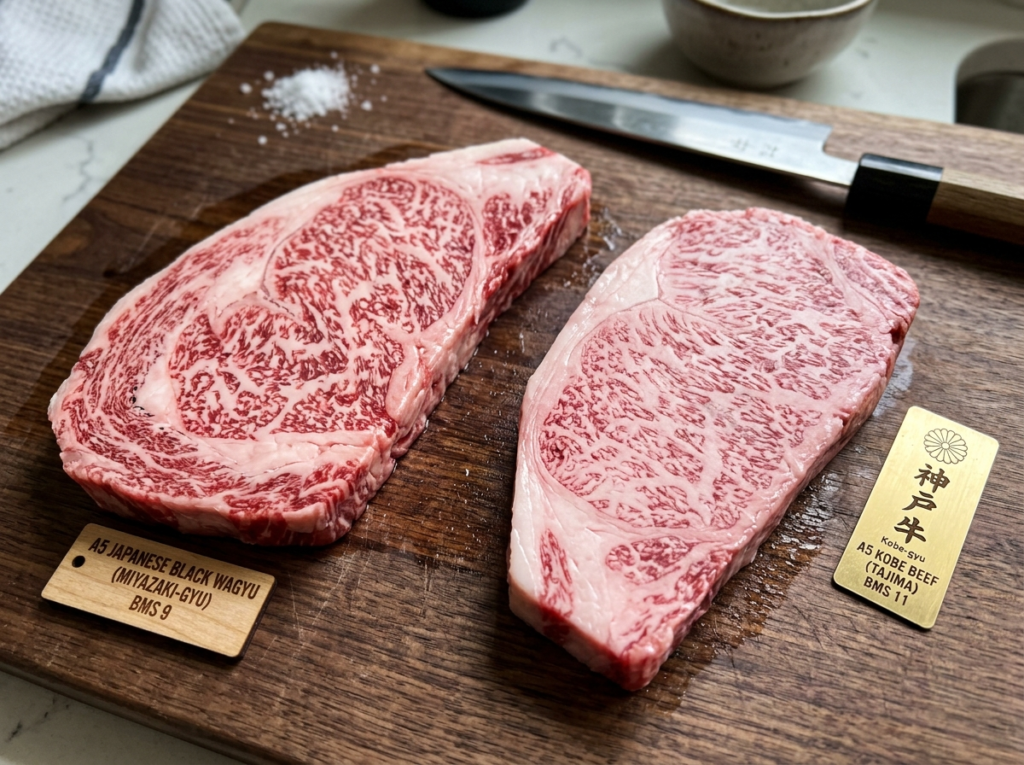
Only about 3,000 to 5,000 cattle per year qualify as authentic Kobe beef — out of the roughly 2.5 million cattle raised across Japan. That’s a tiny fraction, and it tells you something right away: Kobe beef isn’t just a fancy label. It’s earned through some of the strictest grading standards in the meat world.
But here’s the thing that trips most people up. Walk into a high-end steakhouse or scroll through a restaurant menu, and you’ll see “Wagyu” and “Kobe” used almost interchangeably. They’re not the same thing. Not even close. One is a broad category. The other is a very specific product within that category. Think of it like champagne and sparkling wine — all champagne is sparkling wine, but not all sparkling wine is champagne.
If you’ve ever stood at a butcher counter wondering whether that $120-per-pound steak is worth it, or if you’re being sold a story instead of a steak, this breakdown is for you. Let’s sort out what Wagyu actually means, what makes Kobe so special, and how to tell if you’re getting the real deal.
What Does “Wagyu” Actually Mean?
The word Wagyu is Japanese, and it translates simply to “Japanese cow.” Wa means Japanese, and gyu means cow or cattle. So at its most basic level, Wagyu refers to beef from Japanese cattle breeds.
But not just any cattle raised in Japan count. There are four specific Japanese cattle breeds recognized as Wagyu:
- Japanese Black (Kuroge Washu) — by far the most common, making up about 90% of all Wagyu cattle
- Japanese Brown (Akage Washu) — sometimes called Japanese Red
- Japanese Shorthorn (Nihon Tankaku Washu)
- Japanese Polled (Mukaku Washu) — the rarest of the four
The Japanese Black breed is the one most people picture when they think of Wagyu. It’s the breed responsible for that intense, web-like marbling that makes Wagyu steaks look almost pink-white rather than red.
Here’s where it gets interesting, though. “Wagyu” as a term has expanded far beyond Japan. Countries like Australia, the United States, and the United Kingdom now raise their own Wagyu cattle. American Wagyu, for instance, is typically a crossbreed — often Japanese Black genetics crossed with Angus cattle. Australian Wagyu programs have been running since the 1990s and produce some seriously high-quality beef.
So when you see “Wagyu” on a menu, your first question should be: where is it from? Japanese Wagyu, American Wagyu, and Australian Wagyu are all real products, but they’re quite different in flavor, marbling, and price.
What Makes Kobe Beef So Special?
Kobe beef is Wagyu, but it’s a very specific type of Wagyu. Think of it as the inner circle.
To carry the Kobe name, beef must meet a set of requirements that would make most cattle farmers wince. The rules are set by the Kobe Beef Marketing and Distribution Promotion Association, and they don’t bend for anyone.
Here’s what a cow has to check off to produce certified Kobe beef: it must be a purebred Tajima strain of Japanese Black cattle. It must be born in Hyōgo Prefecture (the region where the city of Kobe is located). It must be raised in Hyōgo Prefecture. It must be slaughtered at approved slaughterhouses within Hyōgo Prefecture. And the meat must hit a BMS (Beef Marbling Standard) score of 6 or higher on Japan’s 12-point scale, along with meeting specific yield and quality grade requirements.
That’s a lot of boxes to tick, and it’s why so few cattle make the cut each year.
The Tajima strain is known for a genetic predisposition to intense intramuscular fat — the marbling that runs through the muscle fibers rather than sitting around the outside. This marbling is what gives Kobe its almost buttery texture and a rich, sweet flavor that’s genuinely unlike any other beef you’ll taste.
Quick fact: Authentic Kobe beef wasn’t even exported outside Japan until 2012. Before that, if you saw “Kobe beef” on a menu in New York or London, it wasn’t the real thing. Period.
The Grading Systems: How Quality Is Measured
Understanding beef grading is key to understanding why Wagyu and Kobe command the prices they do. Japan and the United States use very different systems, and Japan’s is significantly more detailed.
Japan’s Beef Grading (JMGA)
The Japan Meat Grading Association evaluates beef on two main scales. The first is a yield grade from A to C, where A means the carcass produces an above-average amount of usable meat. The second is a quality grade from 1 to 5, based on marbling, color, firmness, and fat quality.
So A5 is the highest possible grade — excellent yield, exceptional quality. Within that quality grade, the BMS (Beef Marbling Standard) goes from 1 to 12, with 12 being the most marbled meat you’ll ever see. Kobe beef requires at least a BMS of 6, but many Kobe cuts score 10, 11, or even 12.
To put this in perspective, USDA Prime — the highest grade in the American system — roughly corresponds to a BMS of 4 or 5. That’s considered entry-level by Japanese Wagyu standards.
USDA Grading
The USDA grades beef as Select, Choice, or Prime (from lowest to highest marbling). Prime is excellent beef and represents roughly the top 2-3% of all American beef. But even USDA Prime doesn’t come close to the marbling levels found in Japanese A4 or A5 Wagyu.
This is why American Wagyu and Japanese Wagyu can’t really be compared on a straight line. They’re graded on different scales, raised under different conditions, and they taste noticeably different.
How They Taste: Flavor and Texture Differences
Let’s talk about what actually matters when the steak hits your plate.
Japanese Wagyu (Including Kobe)
The fat in Japanese Wagyu has a lower melting point than regular beef fat — around 77°F (25°C), which is actually below body temperature. That’s why a slice of A5 Wagyu literally starts to dissolve on your tongue. The texture is incredibly soft, almost creamy, and the flavor is rich, sweet, and deeply savory with a clean, beefy finish.
Kobe, specifically, tends to have a slightly more delicate sweetness compared to other Japanese Wagyu regions. Fans of Kobe often describe a subtlety and refinement that sets it apart from, say, Matsusaka or Ōmi beef — two other highly prized regional Wagyu brands.
Because the fat content is so high, you don’t eat Japanese Wagyu the way you’d eat a 16-ounce ribeye. A few ounces is a full serving. Eating a large portion of A5 Wagyu would be overwhelming — almost like eating a stick of the world’s most flavorful butter.
American Wagyu
American Wagyu is typically a cross between Japanese Black genetics and domestic breeds like Angus. The result is beef that’s more marbled than standard USDA Prime but less intensely fatty than full-blood Japanese Wagyu. It’s a middle ground, and honestly, many people prefer it for everyday eating.
You get that extra richness and tenderness from the Wagyu genetics, but you can still eat a full-sized steak without feeling like you’ve consumed a week’s worth of fat. The flavor leans more toward what Americans recognize as “beefy,” with added butteriness from the enhanced marbling.
If you enjoy exploring different premium proteins, you might also appreciate learning about cuts like the tomahawk steak or the classic Delmonico steak — both are worth knowing about when you’re shopping for something special.
Australian Wagyu
Australian Wagyu programs, particularly from producers like David Blackmore or some of the larger operations, produce full-blood Japanese genetics raised on Australian land. Quality can be genuinely outstanding, and some Australian Wagyu scores in the BMS 9-12 range. It’s often more accessible price-wise than Japanese imports while delivering similar marbling levels.
Price: Why Does It Cost So Much?
Let’s be honest — this is what most people want to know. Why is Wagyu so expensive, and why is Kobe even more expensive than that?
Japanese A5 Wagyu typically runs between $100 and $300 per pound in the United States, depending on the cut and the seller. A ribeye will cost more than a chuck flat, just like with any beef.
Authentic Kobe beef is even pricier, often $200 to $500+ per pound at retail, and a Kobe steak at a high-end restaurant in Tokyo or New York can easily run $300 to $600 for a modest portion.
Why so much? Several reasons stack on top of each other. The genetics are carefully controlled — Tajima bloodlines are tracked meticulously. The cattle are raised for longer periods (around 26-32 months, compared to 15-18 months for typical U.S. beef cattle). Feed costs are high because Japanese cattle are often given specialized grain-based diets. And the supply is genuinely limited. You can’t scale up Kobe beef production without breaking the rules that make it Kobe.
American Wagyu is far more affordable, typically $30 to $80 per pound depending on the cut and grade. It’s a fraction of the price of Japanese Wagyu, and for many home cooks, it represents a more practical way to experience enhanced marbling without spending a mortgage payment.
Pro tip: If you see “Kobe beef” on a menu at a surprisingly low price — say, a $25 Kobe burger — it’s almost certainly not authentic Kobe. More on that below.
How to Know If You’re Getting the Real Thing
This is where things get tricky, and where a lot of people get burned.
Authentic Kobe Beef Verification
Real Kobe beef comes with paperwork. Each certified Kobe cut can be traced back to the individual animal using a 10-digit identification number. The Kobe Beef Marketing and Distribution Promotion Association maintains a list of authorized retailers and restaurants outside Japan on their official website. As of recent years, only a handful of restaurants in the United States are certified to serve genuine Kobe beef.
If a restaurant claims to serve Kobe beef, you should be able to ask for the certification or the animal’s ID number. If they can’t provide it, you’re probably eating something else — likely American Wagyu labeled loosely as “Kobe-style.”
The Labeling Problem
Here’s the uncomfortable truth: “Kobe” is not a legally protected term in the United States. Unlike in Japan, where misusing the name can get you in serious trouble, American restaurants and retailers can use “Kobe” on their menus with very little oversight. This has led to widespread mislabeling.
A 2016 investigation by Inside Edition found that many restaurants selling “Kobe beef burgers” were actually serving conventional beef. Other investigations have found similar results across the industry. The lack of U.S. trademark protection means you, the consumer, need to do your own homework.
Warning: If you’re paying premium prices for what’s labeled as Kobe, always ask where the beef was sourced, whether it’s certified, and whether they can provide traceability information. A reputable seller will be happy to share these details.
What About “Wagyu” Labels?
“Wagyu” labeling in the U.S. is also imperfect. American Wagyu can range from cattle that are 50% Wagyu genetics (crossed with Angus) all the way up to full-blood Wagyu with 100% Japanese genetics. The term “full-blood” means the animal has a verified, unbroken lineage of purebred Japanese cattle. “Purebred” means at least 93.75% Japanese genetics. “Crossbred” or “percentage” Wagyu can be anywhere below that.
The higher the percentage of Wagyu genetics, the more marbling you’ll generally see — and the higher the price. Look for sellers who specify the genetic percentage or use terms like “full-blood” if you want the closest experience to Japanese Wagyu without importing it.
Cooking Wagyu and Kobe Beef at Home
If you’re spending serious money on Wagyu or Kobe, you don’t want to ruin it. The good news is that cooking it well doesn’t require chef-level skills. It requires restraint.
Keep It Simple
The biggest mistake home cooks make with high-end Wagyu is doing too much. This isn’t the time for heavy marinades, barbecue sauce, or elaborate spice rubs. You want to taste the beef, not mask it.
For Japanese A5 Wagyu, all you need is salt. That’s it. Some purists add a tiny touch of freshly ground black pepper, but salt alone is the traditional approach.
Temperature and Technique
Because of the high fat content, Japanese Wagyu cooks differently than regular beef. The fat renders quickly, so you want high heat for a short time. A cast iron pan or a very hot grill works best. If you’re working with a cast iron pan, make sure it’s properly seasoned — the same principles that apply to seasoning a wok apply to building a good nonstick surface on cast iron.
Sear each side for about 60 to 90 seconds for thin-cut strips (the way Wagyu is often served in Japan). For thicker steaks, you can sear and then finish at a lower temperature to reach your desired doneness.
Did you know? Many Japanese chefs serve A5 Wagyu sliced very thin — almost like thick-cut sashimi — and sear each piece individually on a hot stone or teppanyaki grill. Eating it this way lets you appreciate the marbling without being overwhelmed by richness.
For American Wagyu, you can treat it more like a traditional steak but with a gentler hand. Because the fat content is higher than regular beef, it stays juicier and more forgiving of slight overcooking. Still, aim for medium-rare to medium to keep the fat properly rendered and the meat tender.
Food safety note: The USDA recommends cooking whole cuts of beef to a minimum internal temperature of 145°F (63°C) followed by a three-minute rest. Ground beef, including Wagyu, should reach 160°F (71°C). Use a reliable meat thermometer — with beef this expensive, guessing isn’t worth it. For more guidance on hitting the right internal temperatures, a thermometer is your best friend in the kitchen.
Portion Sizes
With Japanese A5 Wagyu, think 3 to 5 ounces per person. Seriously. It’s incredibly rich, and you’ll feel satisfied with less than you’d expect. Serve it alongside something clean and light — steamed rice, a simple salad, or pickled vegetables. If you like Japanese-style accompaniments, a bowl of perfectly cooked jasmine rice pairs beautifully.
With American Wagyu, standard steak portions of 8 to 12 ounces work just fine.
Other Japanese Regional Wagyu Brands Worth Knowing
Kobe gets all the international attention, but it’s not the only elite Wagyu brand in Japan. Beef enthusiasts in Japan would tell you that some of these others are equally impressive — and some argue they’re even better.
Matsusaka beef comes from Mie Prefecture and is sometimes called the “king of Wagyu” within Japan. Only virgin female cattle qualify, and they’re raised on carefully managed diets. Matsusaka can be even more expensive than Kobe.
Ōmi beef from Shiga Prefecture is one of the oldest branded beefs in Japan, with a history stretching back over 400 years. It’s known for a delicate, refined fat flavor.
Miyazaki beef from Miyazaki Prefecture on the island of Kyushu has won Japan’s national Wagyu competition (the “Wagyu Olympics,” held every five years) multiple times. It’s gaining international recognition quickly.
Each of these brands has its own set of certification requirements, its own regional character, and its own passionate following. If you ever visit Japan and have the chance to try a side-by-side comparison, it’s an experience you won’t forget.
Is Wagyu or Kobe Worth the Price?
This is a personal question, and the honest answer is: it depends on what you’re looking for.
If you’re a food lover who wants to experience something truly unlike any other beef you’ve eaten, a small portion of authentic Japanese A5 Wagyu is worth trying at least once. The texture and flavor are genuinely unique — there’s nothing else like it. You don’t need to buy a whole steak. Many reputable online sellers offer 3 to 4-ounce portions that let you experience it without spending hundreds of dollars.
Authentic Kobe specifically is worth it if you care about provenance, tradition, and the story behind your food. The flavor difference between Kobe and other top-tier Japanese Wagyu (like A5 Miyazaki) is subtle. You’re partly paying for the strict certification, the traceability, and the heritage.
American Wagyu is probably the best value for most people. You get noticeably better marbling and flavor than conventional beef, you can eat it in normal-sized portions, and it won’t require a second mortgage. It’s become easier to find, too — many specialty butchers and online retailers stock it regularly.
If you enjoy cooking premium meats at home, you might also love working with Korean short ribs (kalbi) or traditional Chinese char siu pork. Both offer a deeply satisfying cooking experience without the price tag of imported Wagyu.
Frequently Asked Questions
Is all Kobe beef Wagyu?
Yes. Kobe beef is a specific type of Wagyu. It comes from the Tajima strain of Japanese Black cattle raised, processed, and certified in Hyōgo Prefecture, Japan. So Kobe is always Wagyu, but the vast majority of Wagyu is not Kobe.
Can you buy real Kobe beef in the United States?
You can, but it’s rare and expensive. Japan began exporting Kobe beef in 2012, and only a small number of authorized retailers and restaurants in the U.S. are certified to sell it. Always check the Kobe Beef Marketing and Distribution Promotion Association’s official list if you want to verify a seller’s legitimacy.
What’s the difference between A5 Wagyu and Kobe beef?
A5 is a quality grade assigned by the Japan Meat Grading Association — it means the beef scored the highest possible marks for marbling, color, firmness, and fat quality. A5 Wagyu can come from any region of Japan. Kobe beef, on the other hand, refers specifically to A4 or A5 beef from certified Tajima cattle in Hyōgo Prefecture. So “A5 Kobe” means it’s the highest quality grade and from the Kobe-certified program.
Why is Wagyu beef so marbled?
The intense marbling in Wagyu comes from genetics and feeding practices. Japanese cattle breeds, particularly the Japanese Black, have a genetic tendency to deposit fat within the muscle fibers rather than just around them. This is enhanced by long feeding periods (often 26-32 months on grain-based diets), low-stress raising environments, and careful breeding selection over generations.
Is American Wagyu real Wagyu?
It depends on how strictly you define the term. American Wagyu contains genetics from Japanese Wagyu breeds, but it’s usually crossbred with domestic cattle like Angus. Full-blood American Wagyu (100% Japanese genetics raised in the U.S.) does exist and can be excellent, though it’s less common. The quality varies widely, so look for sellers who specify the genetic percentage and provide transparency about their breeding programs.
Your Next Move
The difference between Wagyu and Kobe really comes down to specificity. Wagyu is the family. Kobe is one very exclusive member of that family. Both can deliver an extraordinary eating experience, and both can be misrepresented if you’re not paying attention.
Whether you’re planning a special dinner at home, choosing from a steakhouse menu, or just satisfying your curiosity, knowing what these terms actually mean puts you in control. You’ll order with confidence, spend your money wisely, and — most importantly — enjoy every single bite of whatever lands on your plate. Start with a small cut of the real thing, keep the seasoning minimal, and let the beef do the talking.