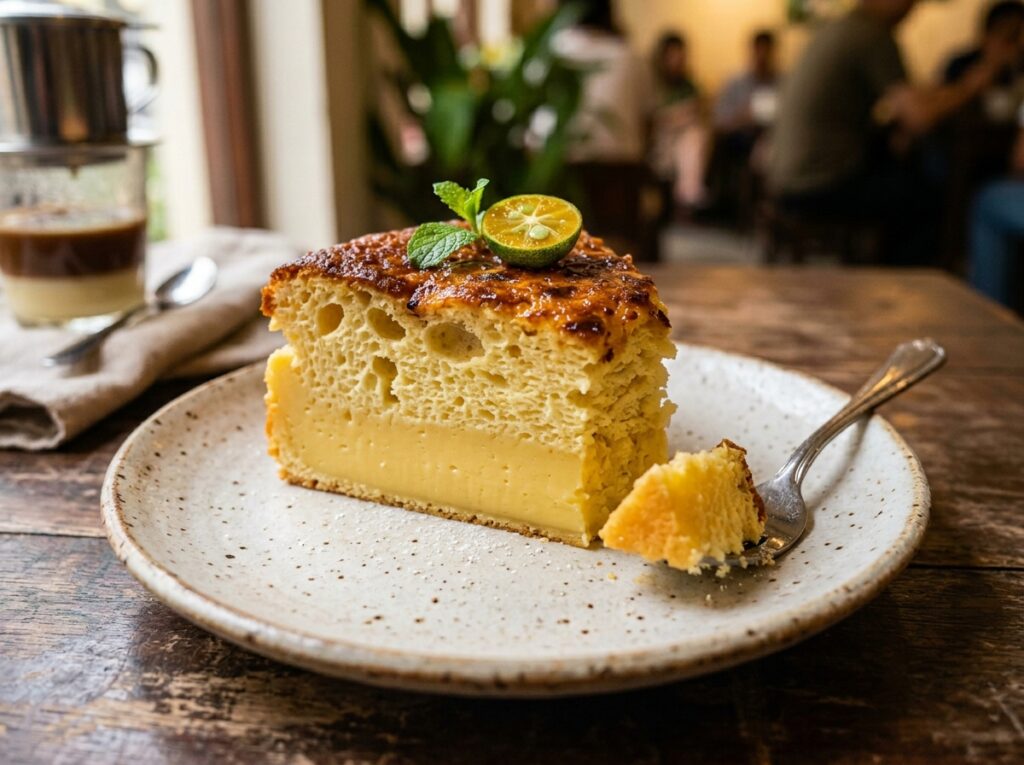
I can still picture the stall. It was a tiny, metal cart tucked under a tattered blue tarp on a bustling Saigon street, shielded from the relentless midday sun. The woman running it had a face etched with kindness and hands that moved with an economy of motion born from a thousand repetitions. She wasn’t selling a complex dish. She was selling small, square slices of golden cake from a large, shallow aluminum pan. It was my first encounter with what the sign called “Bánh Bò Nướng,” though my guide just called it Vietnamese egg cake.
I bought a piece, expecting something light and airy, like a Western sponge cake. What I tasted was a revelation. It was chewy, soft, and impossibly moist, with a delicate, slightly sweet flavor and a texture unlike anything I’d ever had. The most stunning part was the interior, a web of irregular, tunnel-like pockets—a perfect honeycomb. It wasn’t just a cake; it was a textural marvel.
That single slice sent me on a years-long quest. I tried dozens of Vietnamese egg cake recipes online, and they all failed. They were dense, rubbery, or worse, tasted like a sweet, omelet-y pancake. They were all missing the point. The problem, I realized, was a fundamental misunderstanding of what this cake is. It’s not an “egg cake.” It’s an alchemical creation of starch, leavening, and heat. This guide is the culmination of that journey. It’s not just a recipe; it’s the key to unlocking the secrets of the true Bánh Bò Nướng.
It’s Not an Egg Cake: Decoding the Identity of Bánh Bò Nướng
Let’s start by correcting the biggest misconception. The name “Vietnamese egg cake” is a misleading translation that sets you up for failure. While eggs are an important ingredient, they are not the star. The true star of this show is starch. Specifically, tapioca starch.
This is the single most important distinction. Western cakes are built on a foundation of wheat flour and rely on the gluten structure and the creaming of butter and sugar for their lift. Bánh Bò Nướng has no butter and very little, if any, wheat flour. Its structure comes from the gelatinous properties of tapioca starch combined with the chemical leavening of baking powder and baking soda.
The name itself is a clue. “Bánh” means cake. “Nướng” means baked or grilled. But “Bò”? It literally means “cow.” This is where it gets interesting. It’s not a “cow cake.” The name refers to the way the batter “crawls” or “creeps” up the sides of the pan as it bakes, a visual sign that the chemical reaction is working and the honeycomb structure is forming. It’s a cake that is alive in the oven.
To understand how to make Vietnamese egg cake, you must first shift your thinking from “baking” to “chemistry.” You are not just mixing ingredients; you are creating a precise environment for a reaction to occur. The three pillars of this reaction are:
- The Starch Base (The Structure): A combination of tapioca starch and rice flour. Tapioca provides the signature chewy, bouncy, gelatinous texture. Rice flour adds softness and prevents it from being purely rubbery. The ratio is critical.
- The Leavening System (The Lift): This is a dual-acting system of baking powder and baking soda, activated by an acid. This is what creates the explosive bubbles that form the honeycomb.
- The Hydration & Fat (The Medium): A combination of water (or coconut water), sugar, eggs, and a neutral oil. This hydrates the starches, provides sweetness, richness, and helps carry the flavors.
Forget everything you know about creaming butter and sifting flour. We’re in a new world now.
The Honeycomb Mystery: The Science of the Rise
The honeycomb is the holy grail. It’s the sign that you’ve achieved Bánh Bò Nướng nirvana. And it’s not magic; it’s pure, beautiful chemistry. Getting it right is about understanding the role of each player in the leavening reaction.
Let’s break it down.
| Ingredient | Role in the Honeycomb | Insider’s Note |
|---|---|---|
| Tapioca Starch | Forms a stretchy, gel-like network that traps the expanding air bubbles. | Use a good quality, fine starch. Coarse starch can lead to a gritty texture. |
| Rice Flour | Provides structure and softness, balancing the chewiness of the tapioca. | Use regular (not glutinous) rice flour for the best results. |
| Baking Powder | The primary leavener. It’s a double-acting agent, releasing gas when mixed and again when heated. | Use a fresh, aluminum-free baking powder for the cleanest taste. |
| Baking Soda | The powerhouse. It requires an acid to activate and creates a much more vigorous, immediate reaction. | This is crucial for the large, irregular bubbles of the honeycomb. |
| Acid (Vinegar/Lime Juice) | The catalyst. It reacts with the baking soda to create an immediate burst of carbon dioxide gas. | Don’t skip this! It’s the spark that ignites the reaction. |
| Coconut Water/Soda | The secondary leavener. The carbonation provides extra lift and a subtle flavor. | Using fresh coconut water is traditional and adds a wonderful aroma. |
The process is a delicate dance. You first create a smooth, hydrated batter with the starches, sugar, eggs, and liquids. Then, at the very last minute, you add your chemical leaveners—the baking powder, baking soda, and acid. This is the point of no return. The reaction begins instantly.
Here’s the insider secret that most recipes miss: Do not overmix once the leaveners are in. You want to fold them in just until combined. Overmixing at this stage will deflate all the tiny bubbles you’ve just created, resulting in a dense, flat cake. You want those bubbles to be intact when the batter hits the hot pan. The heat of the oven then causes the remaining gas in the leaveners to expand, blowing these tiny starter bubbles into the large, dramatic tunnels of the honeycomb.
The Street Food Blueprint: A Master Recipe for Vietnamese Egg Cake
This is the Vietnamese egg cake recipe I’ve refined over years of trial and error. It’s built on the principles we’ve just discussed. Follow the steps, respect the science, and you will be rewarded.
Yields: One 9×9 inch cake
Pan: A light-colored aluminum pan is best. Dark non-stick pans can cause the edges to over-brown before the center is set.
Ingredients:
- 1 cup (120g) tapioca starch
- ½ cup (60g) rice flour
- 1 cup (200g) granulated sugar
- 2 large eggs, room temperature
- 1 cup (240ml) coconut water (or regular water), room temperature
- ½ cup (120ml) neutral vegetable oil
- 1 tsp vanilla extract
- 1 tsp double-acting baking powder
- ½ tsp baking soda
- 1 tbsp apple cider vinegar (or fresh lime juice)
Instructions:
- Prep and Preheat: Preheat your oven to 350°F (175°C). Grease your 9×9 inch pan with oil and line it with parchment paper.
- Create the Base: In a large bowl, whisk together the tapioca starch, rice flour, and sugar. In a separate bowl, whisk the eggs until light and frothy. Add the coconut water, oil, and vanilla to the eggs and whisk to combine.
- Combine: Pour the wet ingredients into the dry ingredients. Whisk vigorously until you have a completely smooth, thin, and homogenous batter. There should be no lumps. Let this batter rest for 20-30 minutes. This allows the starches to fully hydrate, which is key to a smooth, not gritty, texture.
- The Alchemy: In a small bowl, mix the baking powder and baking soda together. Sprinkle this mixture evenly over the surface of the rested batter. Immediately pour the vinegar over the baking soda. You will see it fizz and bubble.
- The Final Fold (Crucial Step!): Using a spatula, gently and quickly fold the leavening mixture into the batter. Don’t whisk, don’t stir. Fold. Use as few strokes as possible, just until you no longer see visible streaks of white powder. The batter will be slightly bubbly.
- Bake: Pour the batter into the prepared pan. It will be thin. Don’t worry. Bake for 45-55 minutes. The cake is done when the top is a deep golden brown and a toothpick inserted into the center comes out clean. The top should look slightly cracked and uneven, not smooth and domed like a Western cake.
- The Cooling: Let the cake cool completely in the pan on a wire rack before attempting to slice it. This is very important. The starch structure needs time to set. Slicing it warm will result in a gummy mess.
The Art of Variation and Serving
Once you’ve mastered the master recipe, you can start to play. The most common and beloved variation is the coconut Vietnamese egg cake. To make this, simply swap ½ cup of the coconut water for ½ cup of full-fat, unsweetened coconut milk and fold in ½ cup of sweetened shredded coconut along with the leaveners. This creates an even richer, more fragrant cake.
For those looking for a plant-based version, a vegan Vietnamese egg cake is a challenge but possible. You’ll need to replace the eggs with a commercial egg replacer designed for baking (like Bob’s Red Mill) that provides both leavening and binding. The results will be good, but the texture will be slightly different—less rich and a bit more bouncy.