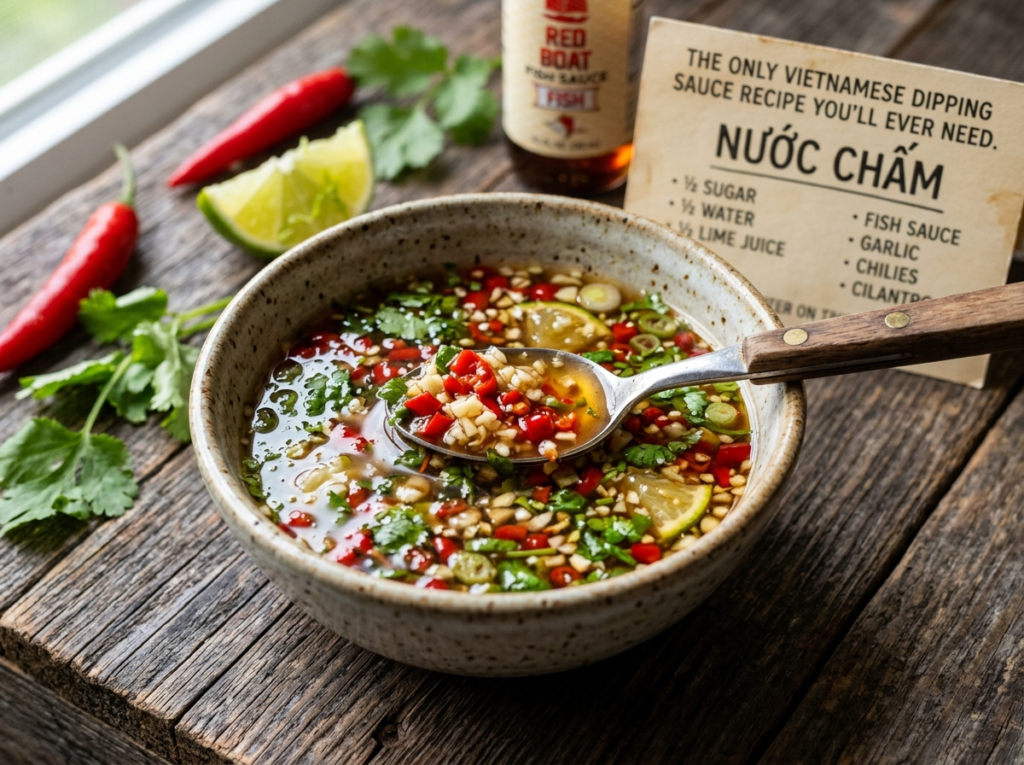
If you’ve worked in a Vietnamese kitchen long enough—and I’ve had nearly three decades inside fish-scented prep stations, five-star hotel line kitchens, and roadside noodle stalls—you begin to see a pattern. No dish feels complete until there’s a bowl of nước chấm on the table.
Outsiders might call it Vietnamese dipping sauce, but that label undersells it. In truth, it’s a living system—a delicate emulsion of taste memory, regional dialect, and chemistry. It’s the one liquid thread connecting grilled pork in a Saigon alley, fresh spring rolls in Little Saigon, and bun cha lunches in Hanoi’s chaotic alleys.
To us, nước chấm doesn’t simply “go with” food; it translates Vietnamese flavor logic:
Salty must have sweet, sour must have heat, fat must meet acid.
Professionals describe that balance as hài hòa vị giác—harmonized gustation. The bowl of sauce at the center of the table is both boundary and bridge; it equalizes bold marinades, bright herbs, and smoky char. And it’s taught, not scripted—you taste, you instinctively adjust; there’s no measuring cup in a real craft kitchen, only intuition honed by repetition.
This article isn’t a surface-level “recipe for Vietnamese dipping sauce.” You’ll find that here too, but wrapped in the deeper anatomy of how seasoned chefs construct and manipulate it.
1. What Is Vietnamese Dipping Sauce?
At its simplest, Vietnamese dipping sauce—nước chấm (pronounced nook-chum)—is a mixture of fish sauce (nước mắm), lime juice or vinegar, sugar, garlic, chili, and water. But that’s like calling espresso “just coffee.”
Historically, nước chấm evolved as a democratizing flavor—salted essence extended by water and sugar so that even modest households could stretch a drop of precious fish sauce over an entire meal. Over generations, it became not a budget substitute, but a standard of culinary ethics: finding balance despite scarcity.
A skilled cook can tell where you’re from by how your nước chấm tastes:
- Northerners lean savory with restrained sweetness.
- Southerners (like in Saigon) crave pronounced sugar and bright garlic-chili aroma.
- Central Vietnamese favor bold saltiness and aggressive chili heat.
When I ran a restaurant in District 1, we kept three versions ready on the pass daily—for staff, for tourists, for traditionalists. Because if you serve the wrong nước chấm to the wrong diner, you risk momentary pause—a polite but unmistakable glance meaning, “This tastes like the wrong region’s air.”
2. Vietnamese Dipping Sauce Ingredients – Balancing the Quadrant
Vietnamese flavor design always revolves around four interlocking pillars: mặn (saltiness), chua (acidity), ngọt (sweetness), and cay (heat).
Here’s how these translate into your liquid formula.
| Component | Ingredient | Function | Insider Tip |
|---|---|---|---|
| Base umami | Fish sauce (nước mắm) | Salty foundation, marine depth | Use aged, first-press Phú Quốc or Phan Thiết brands for clarity |
| Sweetener | Cane sugar or palm sugar | Counterbalances fish salt, softens acid | Dissolve sugar first in hot water to prevent grit |
| Acid | Lime juice or rice vinegar | Adds lift and freshness | Lime is sharp (instant pop); vinegar is mellow (for balancing fried items) |
| Heat | Bird’s eye chili (ớt hiểm) | Kinetic contrast; wakes sweetness | Slice thin across fibers to release maximum spice oil |
| Aroma | Garlic | Texture, perfumed bite | Pound garlic and chili together for uniform dispersion |
| Dilution | Hot water | Adjust intensity | Warm water helps sugar dissolve and aroma bloom |
Secret #1: Fish sauce chooses its sugar partner.
A high-nitrogen premium fish sauce (e.g., Red Boat 40°N) pairs with plain granulated sugar—the cleaner sweetness preserves its umami. Cheaper or darker blends benefit from caramelized palm sugar, adding depth to mask sharper edges.
3. The Classic Nước Chấm Ratio—A Chef’s Template
While home recipes sprawl in tablespoons, Vietnamese professionals think in ratios by volume and by taste phase. A good starting point—called “Ba Ba Một Một” (3–3–1–1) among line cooks—goes:
3 parts water : 3 parts fish sauce : 1 part sugar : 1 part lime juice
From that base, you tweak by context:
- For spring rolls (Gỏi cuốn): add extra sugar + garlic = crowd-friendly, vibrant.
- For grilled meats (Bún thịt nướng): reduce sugar, boost lime + chili = contrasts fat.
- For seafood fry: replace lime with rice vinegar to mellow oil residuals.
Pro Workflow (Observed at My Saigon Kitchen Station):
- Dissolve sugar in warm water first.
- Add fish sauce next; stir gently, never shake—it clouds the liquid.
- Add lime juice last (acids become bitter if heated).
- Drop in hand-crushed garlic-chili mix right before service—fresh oils elevate aroma.
- Let stand 10 minutes before pouring into ramekins—flavors settle, brine clarifies.
4. How to Make Vietnamese Dipping Sauce at Home (Step-by-Step Professional Method)
Think of this as the foundation recipe; everything else is a variation.
Base Vietnamese Dipping Sauce Recipe
Ingredients:
- 3 tbsp Vietnamese fish sauce (e.g., Phú Quốc type)
- 3 tbsp warm water
- 1 tbsp sugar
- Juice of ½ lime (roughly 1 tbsp)
- 1 small bird’s eye chili, finely sliced
- 1 small clove garlic, minced
Instructions:
- Dissolve sugar into the warm water completely.
- Add fish sauce gradually, taste as you go.
- Stir in lime juice.
- Mix in chili and garlic.
- Let rest 5–10 minutes before serving—it tastes different after settling.
Chef’s note: If your fish sauce is above 35° N (high concentration), dilute with extra tablespoon water; otherwise, guests find it “shocked salty.”
5. Signature Variations: The Adaptable Nature of Nước Chấm
Every household guards its twist, and chefs develop “proprietary” blends. Here are some insider constructions beyond the classic.
a) Northern-Style Nước Chấm (Hà Nội)
- Use quất (calamansi) or mild vinegar instead of lime.
- Minimize sugar (half usual).
- Add slivered carrot or unripe papaya for crunch; often served with grilled pork skewers (nem nướng).
The northern palate emphasizes tinh tế (subtlety). The goal isn’t shock or intensity, but the quiet precision of salt and acid harmony, never too sweet.
b) Southern-Style Nước Chấm (Sài Gòn)
- Base: fish sauce + warm water (1:1).
- Double sugar.
- Add both garlic and chili generously—almost spoonful-level at bottom of bowl.
Saigonese diners expect visual fire—floating red seeds, shards of garlic, a glowing amber hue. When I opened my first stall in District 3, we would blend 10 L of this type daily; customers judged by smell before the food even arrived.
c) Nước Mắm Gừng (Ginger Fish Sauce)
Used for poultry, duck, or offal dishes.
- Substitute half garlic with minced ginger.
- Include a few crushed roasted peanuts if serving cold dishes; this mimics Bắc region small-town style.
This dipping sauce tames the gaminess of duck and innards with ginger’s antiseptic spice.
d) Vegetarian Nước Chấm Chay
For Buddhist diners or vegan menus:
- Replace fish sauce with soy sauce or seaweed–miso blend (dashi-style).
- Keep sugar and lime proportion.
- Add grated ginger for complexity.
No, it won’t taste identical to nước mắm, but textural aroma (ginger-lime-salt triad) triggers similar neural “balance perception.”
6. Vietnamese Dipping Sauce for Spring Rolls & Egg Rolls
For Fresh Spring Rolls (Gỏi Cuốn)
Goal: brightness and refreshment—accent herbs and shrimp’s sweetness.
- Favor lime juice over vinegar.
- Emphasize garlic and sugar; keep chili moderate.
- Dilute more (1 tbsp extra water) for lighter viscosity—spring rolls should glide, not clump.
For Fried Egg Rolls (Chả Giò)
Here acid carries heavier responsibility—cutting grease.
- Boost vinegar instead of lime for sustained tang.
- Reduce sugar by 25%.
- Optional: Drop a few pickled carrot shreds (đồ chua) for texture relief.
Professional plating trick: serve egg rolls over lettuce and herbs, drizzle núoc chấm tableside for showmanship; the aromatic steam flare signals freshness.
7. How to Read Bottled Vietnamese Dipping Sauces
Many international markets now sell Vietnamese dipping sauce bottles, pre-mixed for convenience. Having demo-tested dozens for consulting clients, I can say: none equals fresh—but some are passable short-term.
Look for labels listing only: fish sauce, water, sugar, vinegar, garlic, chili. Avoid those with “flavor enhancer” (MSG) or “colored caramel”—these dull brightness over time.
Best bottled lines often stem from authentic Vietnamese fish sauce brands, not fusion manufacturers. Red Boat Nước Chấm does seasonal small batches now, and Three Crabs markets a sweeter overseas blend (very Saigon-style).
But if you notice heavy sediment or extra thick syrup, it’s likely shelf-stabilized with cornstarch—avoid for fine dining or craft recipes.
8. The Hidden Science: Why Nước Chấm Feels “Light” Despite Sodium
Culinary chemists often ask why Vietnamese fish sauce dipping feels gentle, though chemically salty.
It’s the interplay of acids and sugars:
- Acid reduces perception of saltiness.
- Sugar rounds harsh edges.
- Garlic and chili stimulate saliva, dispersing brine quicker.
That synergy is why nước chấm can appear in such vast amounts on the Vietnamese table—what would seem overpowering elsewhere becomes refreshing.
In our professional testing kitchen, we aimed to recreate that palate cleansing property and found the critical sodium-to-acid ratio hovers around 2.8 : 1. Lower and it feels flat; higher and it dominates. The human tongue handles Vietnamese balance better than pure salt-sour because sugar acts as ballast.