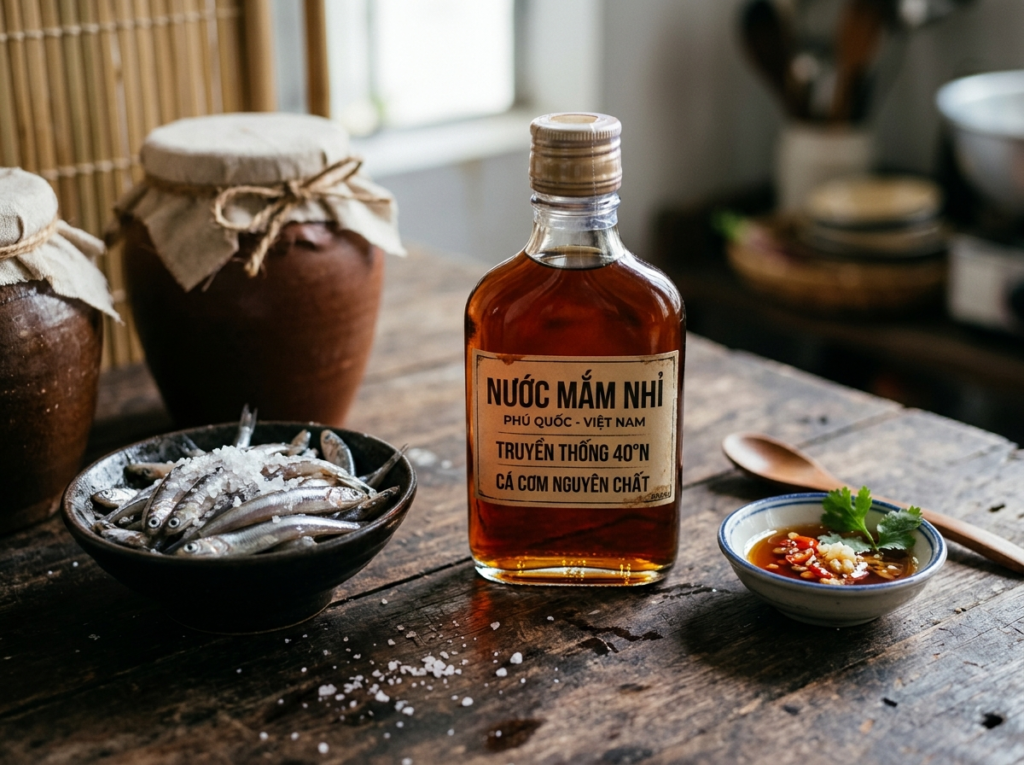
Every Vietnamese cook—whether a Hanoi grandmother or a Michelin-star chef in Saigon—knows one truth: without Vietnamese fish sauce (nước mắm), the food doesn’t just taste different; it loses its soul.
To outsiders, fish sauce might seem like a pungent condiment. To those of us who’ve worked in real Vietnamese kitchens for decades, it’s far more than seasoning. It’s infrastructure. It’s what stitches together every contrast in our cooking—sweet and salty, sour and spicy, fresh and fried.
When I trained under Chef Nguyễn Thị Hường, an old Huế traditionalist known for her imperial recipes, she told me, “A Vietnamese dish without fish sauce is like a body without bones.”
So today, I’ll take you deep inside the barrels, the chemistry, the regional rivalries, and the refined techniques behind Vietnamese fish sauce—from the docks of Phú Quốc to the backrooms of street cafés. By the end, you’ll understand not just how to use fish sauce, but how to read it.
1. What Is Vietnamese Fish Sauce and Why It Matters
At its essence, Vietnamese fish sauce is pure fermented anchovy extract—fish and salt, aged under compression for months or years until liquid umami gold seeps free. But defining it that way betrays the magic; this is an ancient biological ritual disguised as pantry staple.
The Simple Formula:
- Fish: Usually cá cơm (anchovy species found along Vietnam’s southern coast).
- Salt: Sea-harvested, sun-crystallized, added in specific ratios.
- Time & Pressure: The real craftsmen let fermentation dictate the speed, not temperature control or industrial shortcuts.
The best Vietnamese fish sauce brands—like Red Boat or Khải Hoàn from Phú Quốc—still use 200-liter wooden barrels made from rosewood or jackfruit wood. These woods breathe; they allow slow oxidation that deepens flavor. The salt seeps into flesh, collapsing cell walls and freeing amino acids—particularly glutamates—that form fish sauce’s velvet umami.
What results is not “fishy,” as many Western palates fear, but essentially savory—a marine perfume that amplifies the brightness of herbs and acid, the sweetness of caramelized meats, and the depth of soups like phở and bún bò Huế.
2. The Science of Fermentation: Controlled Decomposition as Art
When I first visited Phú Quốc’s oldest fermentation house in 2002, I expected an industrial operation. What I found instead was poetic choreography: sunlight streaking through slats, the fragrance of ocean decay turning inexplicably appetizing, artisans listening for the quiet gurgle as salt brine rose and fell with the day’s humidity.
What’s happening inside those barrels is pure enzymatic theater.
- Salt inhibits harmful bacteria but lets Halophilic Lactobacillus and endogenous fish enzymes do their work.
- Proteins degrade into amino acids (glutamic acid = umami).
- Fats oxidize gently, creating faint sweetness.
True nước mắm isn’t brewed—it emerges. It’s the product of autolysis: proteins digesting themselves into flavor.
The first draw liquid, called nước mắm nhĩ, is the prized fraction—natural, uncut, like the first pressing of olive oil. Later extractions, diluted with saline, become lower-grade. When tasting, chefs often check nitrogen levels (°N)—a quantifiable measure of amino acid concentration.
- 35°N+: Premium artisanal
- 25–30°N: Common household quality
- <25°N: Economical blends
That’s the secret behind why some fish sauces taste like caramel seas and others like saltwater.
3. Regional Character: The Flavors of Phú Quốc, Phan Thiết, and Nha Trang
Vietnam’s coastline stretches 3,000 km, so naturally, fish sauces differ like dialects. Each region’s water salinity, anchovy species, and production tradition create unique flavor “accents.”
| Region | Key Characteristics | Flavor Profile |
|---|---|---|
| Phú Quốc | Traditional wooden-barrel aging, long fermentation | Deep amber, sweet aftertaste, rich umami |
| Phan Thiết | Slightly lighter, higher salt ratio | Bright, clean, briny |
| Nha Trang | Blend of small fish varieties, less aging | Sharper, more aromatic |
Phú Quốc holds D.O.P. (Protected Designation of Origin) status under EU regulation—meaning only sauce brewed on the island from local anchovies qualifies as authentic “Phú Quốc fish sauce.”
In blind tastings, Phú Quốc versions generally exhibit subtle caramelized notes—what professionals call ngọt hậu, or “sweet finish.” That natural sweetness (never added sugar) differentiates it from Thái nam pla or Filipino patis, which rely more on salt forwardness.
4. Vietnamese Fish Sauce Ingredients: Simplicity with Precision
What always amazes foreign chefs is how something so profound comes from just two raw materials: fish and salt. But not all salt—or anchovy—is equal.
| Ingredient | Role | Pro Tip |
|---|---|---|
| Anchovy (Cá Cơm) | Source of umami | Use fresh catch; oxidized fish adds sharp bitterness |
| Coarse Sea Salt | Osmotic regulator, antibacterial agent | Must be aged 12+ months to reduce harshness |
| Time | Catalyst of flavor | Typical cycle: 12 to 18 months, sometimes up to 24 |
| Wooden Barrels | Slow oxygen exchange | Rosewood or jackfruit wood preferred for neutrality |
Salt’s age matters more than most recipes reveal. Fresh salt carries magnesium and calcium chlorides that taste bitter. Aging salt under sheds for a year “softens” it through atmospheric washing—a detail you’ll only learn if you step into a Phan Thiết processing yard.
5. How to Make Vietnamese Fish Sauce: The Traditional Craft
Step-by-Step (Observed in Phú Quốc)
- Fish–Salt Layering: Fresh anchovies are mixed with salt at a 3:1 ratio by weight inside wooden tanks.
- Pressing and Covering: A bamboo mat is placed atop the pile, then weighted with heavy stones.
- Fermentation: Over the next months, fish decompose naturally. Saline brine forms, gradually percolating through layers.
- Aging: Liquid is periodically drained and poured back over to ensure uniform enzymatic activity.
- First Draw: Around month 12–14, the first pressed extract flows out—the prized nước mắm nhĩ.
- Grading: Secondary draws are diluted for mass-market versions.
The old masters monitor fermentation not by machine, but by scent and color. They dip bamboo ladles into barrels, observe viscosity, and even listen—the bubbling whisper of gas releasing indicates biological rhythm. It’s instinct guided by generations.