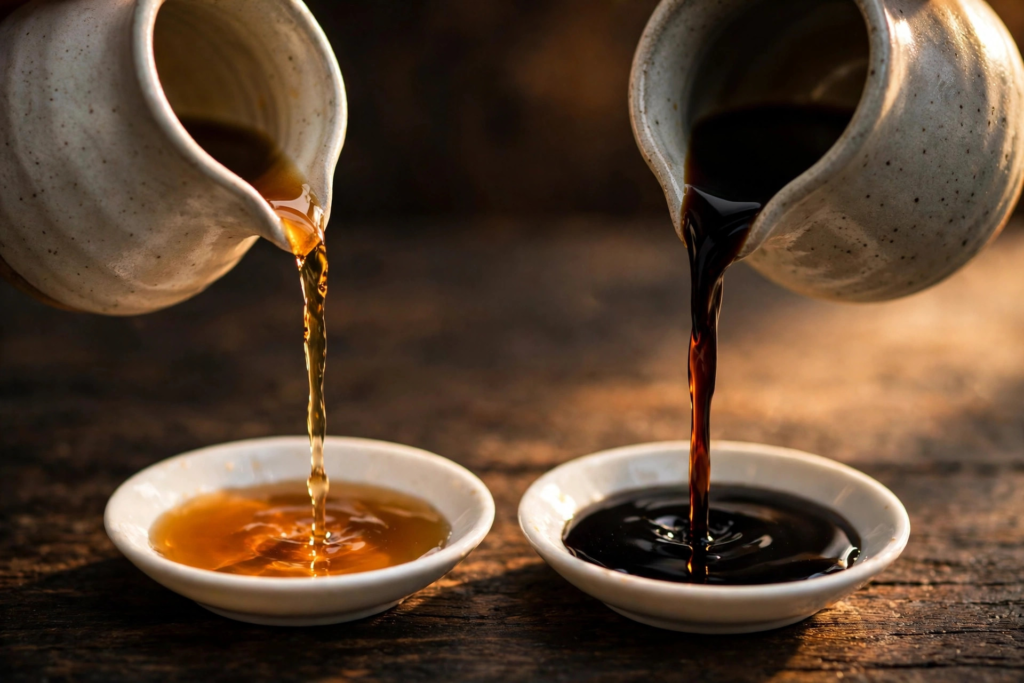
Open any Chinese pantry and you’ll find two bottles that look almost the same but do completely different jobs. One is thin, reddish-brown, and salty — the everyday seasoning behind a thousand stir-fries. The other is thick, nearly black, and faintly sweet — the reason red-braised pork glows like mahogany. Mix them up and your cooking suffers in ways that are hard to diagnose but easy to taste. Here’s how to tell light and dark soy sauce apart, and exactly when to reach for each.
The 10-Second Answer
If you’re in a hurry, this is the whole story:
| Light Soy Sauce (生抽) | Dark Soy Sauce (老抽) | |
|---|---|---|
| Color | Reddish-brown, translucent | Nearly black, opaque |
| Thickness | Thin, pours like water | Thicker, slightly syrupy |
| Saltiness | Saltier | Less salty |
| Flavor | Savory, bright, umami-rich | Mellow, faintly sweet, deep |
| Main job | Seasoning — adds salt and savor | Color and gloss — makes food look rich |
| Used raw? | Yes — dipping sauces, dressings | No — too harsh uncooked |
The one-line version, courtesy of cookbook author Hetty McKinnon: light soy sauce is for flavor, dark soy sauce is for color. Everything below is the detail behind that line.
What Is Light Soy Sauce?
Light soy sauce (生抽, shēngchōu — “fresh extract”) is the workhorse of Chinese cooking. It’s the first extraction from fermented soybeans and wheat, thin and reddish-brown, with a clean salty savoriness that reads almost like salt with extra depth.
This is the bottle you reach for without thinking: stir-fries, steamed fish, noodle seasoning, marinades, soups, salad dressings, dipping sauces. If a savory Chinese dish needs seasoning and you don’t want to change its color, light soy sauce is the answer. When a Chinese recipe simply says “soy sauce” with no qualifier, it means this one — close to 100% of the time. That’s the single most useful rule in this whole article.
And clear up the most common confusion right now: “light” describes the color, not the salt. Light soy sauce is actually saltier than dark. If you need less sodium, look for a bottle explicitly labeled low-sodium or reduced-salt — that’s a separate product, usually a lighter version of light soy sauce.
What Is Dark Soy Sauce?
Dark soy sauce (老抽, lǎochōu — “old extract”) starts from the same fermented base but is aged longer, then blended with molasses or caramel. That aging-plus-sweetener treatment gives it three unmistakable traits: a color so deep it’s nearly black, a thicker almost syrupy body, and a mellow, faintly sweet flavor that’s much less salty than light.
Its job is visual as much as culinary. A spoonful transforms a pale braise into the glossy, mahogany-dark dish you picture when someone says “red-cooked pork.” It adds a gentle caramel depth too, but seasoning is not its department — that’s why braised dishes almost always call for both dark soy (for color) and light soy (for salt).
As Red House Spice’s detailed soy sauce guide notes, dark soy is for cooked dishes — braises, stews, dark noodle sauces — where a small amount dramatically deepens color and gloss. It never goes into a dipping sauce; raw, it’s too intense and one-dimensional.
How They’re Actually Made
Both start the same way: soybeans and roasted wheat are inoculated with koji mold, mixed with salt water, and left to ferment for months. The mash is pressed, and the liquid that runs off becomes light soy sauce — the primary, everyday product.
Dark soy sauce comes later in the process. A portion of soy sauce is aged further and blended with caramel color or molasses, which darkens it, thickens it, sweetens it slightly, and mellows the sharp saltiness. So they’re not two grades of “better and worse” — they’re two different tools made from the same raw material, the way butter and ghee are related but not interchangeable.
This is also why substituting blindly fails. Swap dark for light in a dipping sauce and it’s harsh and muddy. Swap light for dark in a braise and the dish tastes fine but looks anemic — pale where it should glow. RecipeTin Eats’ soy sauce guide describes the professional approach well: use dark soy for color and body, then top up the saltiness with light soy, which adds seasoning without much extra color.
When to Use Which: A Practical Cheat Sheet
Tape this to the inside of your cupboard door:
- Reach for LIGHT soy sauce when: seasoning a stir-fry · making dipping sauces (try this dumpling dipping sauce) · steaming fish · seasoning clear soups · fried rice (keeps the grains pale gold, not brown) · salad dressings and cold dishes · any marinade where the ingredient’s color should show through.
- Reach for DARK soy sauce when: red-braising pork or chicken · making dark, glossy noodle sauces (lo mein, not chow mein) · adding appetizing color to a stir-fry sauce at the end · any dish where “rich brown and shiny” is the goal.
- Reach for BOTH when: braising anything — dark for the mahogany color, light for the actual salt. Hot and sour soup. Many restaurant-style stir-fry sauces. This combo is the quiet secret behind a lot of takeout flavor.
Notice the pattern: light soy seasons, dark soy paints. Once you see it, you can’t unsee it — and your cooking gets noticeably better within a week.
3 Mistakes Everyone Makes
- Thinking “light” means low-sodium. It means light-colored. Light soy sauce is the saltier of the two. This mix-up leads people to pour freely and then wonder why the dish is a salt bomb. Want less salt? Buy the bottle that says so.
- Dipping things in dark soy sauce. Uncooked, dark soy is harsh, flat, and oddly sweet — all the subtlety comes from heat and blending. Dipping sauces want light soy’s bright savoriness every time.
- Adding dark soy sauce like it’s light. A tablespoon of light soy seasons; a tablespoon of dark soy turns the whole wok black and slightly bitter. Start with a teaspoon, stir, look, then decide. You can always add color — you can’t take it away.
How to Read the Label Before You Buy
Not all bottles with the same name are equal. Two minutes in the aisle saves you from a disappointing bottle:
- Check the ingredients. A good light soy sauce lists soybeans, wheat, salt, and water — that’s it. If you see caramel color in a light soy sauce, it’s been doctored to look darker than it is; put it back.
- Look for “naturally brewed” or “first extract.” Both signal traditional fermentation rather than fast chemical hydrolysis. The flavor difference is real — brewed soy sauce has a rounder, more aromatic savoriness that the quick-made kind can’t fake.
- Don’t overpay for mystique, but don’t buy the cheapest. The mid-priced bottles from established brands (Pearl River Bridge, Lee Kum Kee, Haday) hit the sweet spot. Ultra-cheap soy sauce is often chemically produced and tastes harshly salty with no depth.
- Glass over plastic when you can. It doesn’t change the flavor, but soy sauce degrades faster in heat and light — and glass bottles tend to signal a producer that cares about the product inside.
Beyond the Big Two: Other Bottles Worth Knowing
Light and dark cover 95% of home cooking, but the soy sauce aisle goes deeper. A few you’ll meet:
- Steamed fish soy sauce (蒸鱼豉油) — a seasoned, slightly sweetened light soy made for Cantonese steamed fish. Delicate and purpose-built.
- Seafood soy sauce — similar idea, with seafood extracts for extra complexity. Usable anywhere you’d use light soy.
- Mushroom dark soy sauce — dark soy infused with straw mushrooms. Same job as regular dark, with an earthier edge.
- Double-fermented light soy (双璜生抽) — fermented twice for deeper aroma. A noticeable step up for dipping and cold dishes.
- Tamari — Japanese, mostly soy with little or no wheat. Richer, less salty, and the standard gluten-free stand-in (check the label).
- Sweet soy sauce / kecap manis — Indonesian, syrupy-sweet. A different ingredient entirely — don’t substitute it for dark soy.
You don’t need all of these. Master light and dark first; the rest are upgrades and specialties for later.
Frequently Asked Questions
Can I substitute light soy sauce for dark, or vice versa?
With adjustments. Light instead of dark: add a small pinch of sugar or a few drops of molasses per tablespoon, and accept a paler dish. Dark instead of light: use about half the amount, then add salt separately if needed — and never in raw applications like dipping sauces.
Does soy sauce go bad? Should I refrigerate it?
It’s fermented, so it keeps a very long time in a cool, dark cupboard — most Chinese home cooks never refrigerate it. If you use it rarely, the fridge preserves its aroma longer. Either way, it won’t make you sick sitting in the pantry for a year.
Is Chinese soy sauce the same as Japanese shoyu?
Related but different. Japanese shoyu typically uses roughly equal parts soybeans and wheat (Chinese uses more soy), giving it a slightly sweeter, more rounded flavor. Kikkoman-style shoyu works fine as a stand-in for Chinese light soy in most dishes, though the taste won’t be identical.
Which brand should I buy?
Stick with established Chinese brands: Pearl River Bridge, Lee Kum Kee, and Haday are the names that come up consistently among Chinese recipe developers. “Premium” or “first extract” on the label is a good sign for light soy sauce. For everyday cooking, any of these will serve you well — the bigger leap is simply owning both bottles.
Your move: buy the bottle you’re missing — most likely dark — and cook one braise and one steamed dish this week, using each where it belongs. It’s the cheapest upgrade in Chinese cooking, and you’ll taste the difference immediately.
[…] soy like a sponge, and the piece will disintegrate in the dish. (Not sure which bottle to grab? Our light vs dark soy sauce guide sorts it out — for sushi and sashimi you want […]
[…] as a cold dipping sauce. The soy sauce choice matters more than you’d think — our light vs dark soy sauce guide explains why the pale stuff belongs here, not the […]
[…] with salt and fermented depth; oyster sauce adds body, gloss, and a rounded savory-sweetness. Light and dark soy sauce have their own split personality, but neither does what oyster sauce does. And hoisin — sweeter, […]
[…] mein sauce is soy-based with sesame oil, maybe oyster sauce, a little sugar, sometimes a splash of dark soy for color — tossed through the noodles so they glisten. The vegetables stay crisp-tender: cabbage, carrots, […]