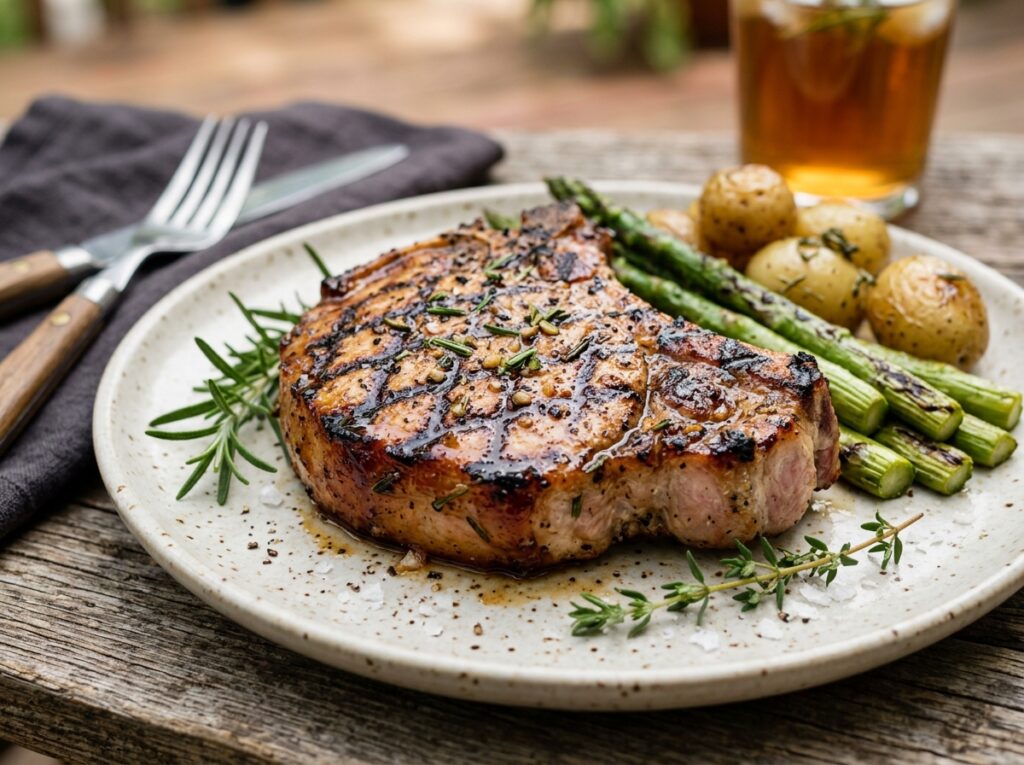
I’m going to tell you a story that will change how you grill forever. Early in my career, I worked under a French-trained chef who was a tyrant in the kitchen but a poet when it came to ingredients. One Saturday, the grill station was churning out tough, dry pork chops. The line was getting slammed, and the chef was fuming. He finally stomped over, grabbed a raw chop, held it up to the young, terrified grill cook, and said, “You are fighting the chop. You are trying to force it. This chop has a story. Your job is to let it tell it.”
He then took another chop, seasoned it simply, and cooked it himself. He used a different part of the grill, he flipped it only once, and he rested it while he plated the rest of the dish. The result was a thing of beauty: a deep, mahogany crust giving way to blushing, juicy meat that tasted profoundly of pork, not just charcoal and disappointment.
That day, I learned the most important lesson about grilled pork chop recipes: the recipe is the least important part. The magic lies in understanding the chop itself. The internet is flooded with a million variations on a theme—easy grilled pork chop recipes promising tender, flavorful results. But they all miss the point. They give you a list of ingredients without giving you the knowledge. Today, we fix that. This isn’t just a collection of recipes; it’s a manifesto. This is the insider’s guide to mastering the grilled pork chop, ensuring you never serve a dry, disappointing chop again.
It Starts with the Butcher, Not the Grill
Before you even think about your grilled pork chop seasoning or marinade, you need to win the battle at the butcher counter. This is where 90% of home cooks fail. They grab a pre-packaged, thin, boneless, pale-looking chop from the supermarket and wonder why it tastes like a shoe. You cannot create greatness from a flawed foundation.
Let’s deconstruct the chop. You need to understand what you’re looking for.
| Chop Type | Characteristics | The Verdict |
|---|---|---|
| Rib Chop | Cut from the rib section. Contains a piece of the tenderloin and the loin, with a curved bone. More fat marbling. | Excellent. The bone adds flavor and acts as an insulator. The extra fat makes it forgiving and flavorful. |
| Loin Chop (Center-Cut) | Looks like a T-bone steak. Has a T-shaped bone with loin on one side and tenderloin on the other. Leaner than a rib chop. | Very Good. The dual-muscle structure is interesting. The bone is a huge plus. |
| Boneless Loin Chop | Just the loin muscle, with the bone removed. Very lean, uniform shape. | Use with Caution. Prone to drying out. Lacks the flavor and insulation of the bone. Best for very quick cooking methods like brining and pan-searing. |
| Thin-Cut “Breakfast” Chops | Any of the above, but sliced thin (under ½ inch). | Avoid for Grilling. They cook through before you can develop a proper crust, resulting in a tough, dry product. |
Here’s the insider secret you need to tattoo on your brain: Always choose a thick-cut, bone-in chop. I’m talking at least 1.5 inches thick. Anything less is a recipe for disaster. Why? The bone is your best friend. It not only imparts incredible flavor during cooking but also acts as a heat shield, allowing the meat next to it to cook more gently and evenly. The thickness is crucial because it gives you a large temperature window. You can develop a deep, dark crust on the outside without overcooking the interior. With a thin chop, the moment you get color, the chop is already overcooked.
When I see a recipe for a best grilled pork chop recipe that calls for 1-inch boneless chops, I know the author doesn’t understand the fundamental principles of heat and meat. Go to a real butcher, not just the refrigerated aisle. Ask for a thick-cut rib or loin chop. If they don’t have it, they can cut it for you. This single step will elevate your grilling game more than any marinade ever could.
The Brine: The Real Secret to Juiciness
Forget everything you think you know about marinades for a moment. A marinade is a surface treatment. It adds flavor to the outer eighth of an inch of the meat. It cannot make a dry chop juicy. The real secret weapon, the one that restaurants use to guarantee perfectly succulent meat every single time, is the brine.
Brining is the process of submerging meat in a saltwater solution. Through the science of osmosis, the muscle fibers absorb the seasoned liquid. This does two critical things:
- It seasons the meat from the inside out. Every cell is infused with saltiness, so you don’t just get a salty crust.
- It changes the protein’s structure. The salt denatures the proteins, allowing them to retain more moisture during cooking. This means the chop can lose up to 30% less moisture in the cooking process. The result is a plump, incredibly juicy chop that is forgiving to slight overcooking.
A basic brine is simple. For every quart of water, you need 4 tablespoons of kosher salt and 2 tablespoons of sugar. The sugar is not for sweetness; it’s to balance the salt and aid in browning. You can add aromatics like smashed garlic, bay leaves, black peppercorns, or a sprig of thyme. Simply dissolve the salt and sugar in warm water, add your aromatics, let it cool completely, then submerge your pork chops and refrigerate for at least one hour, and no more than four. Pat them completely dry before they hit the grill. This is the non-negotiable first step to a perfect grilled pork chop.
The Two-Zone Fire: Your Grilling Command Center
Now we get to the grill itself. The biggest amateur mistake is dumping the coals or cranking all the gas burners to high and throwing the chop on. You’re creating a blast furnace. This guarantees a burnt exterior and a raw interior. You must create a two-zone fire.
This is the single most important grilling technique you can learn.
- For a Charcoal Grill: Pile all your hot coals on one side of the grill. This creates a direct heat zone (for searing) and an indirect heat zone (for gentle cooking). The side without coals is your safety zone.
- For a Gas Grill: Turn on half the burners to high and leave the other half off. Again, you have a direct side and an indirect side.
Here’s how we use it to cook our thick, brined chop:
- Sear (Direct Heat): Place the chop on the hot, direct-heat side of the grill. Sear it for 2-3 minutes per side. Don’t touch it. Let it develop a deep, beautiful crust. This is where you get that smoky, grilled flavor.
- Cook (Indirect Heat): Move the seared chop to the cool, indirect-heat side. Close the lid. Now you’re essentially turning your grill into an outdoor oven. The chop will cook through gently and evenly, without the risk of burning.
- Flip and Finish: After about 5-7 minutes, flip the chop once. Close the lid again. This is where the magic happens. The rendered fat and juices are working their magic inside the chop.
The Temperature: The Moment of Truth
This is where fear takes over. People grew up being told pork had to be cooked to a shoe-leather 165°F (74°C). That’s old, outdated advice from an era of trichinophobia. Modern pork production is incredibly safe. The USDA now recommends cooking pork to an internal temperature of 145°F (63°C) followed by a 3-minute rest.
This is your target. 145°F.
At this temperature, the pork will be perfectly cooked, juicy, tender, and safe. It will have a beautiful, rosy pink hue in the middle. If you cook it to 165°F, you will have squeezed out every last drop of moisture. You will have defeated the purpose of the brine and the two-zone fire.
How do you know when you’re at 145°F? You don’t guess. You don’t poke it with your finger. You use an instant-read digital thermometer. This is the single most important tool in your grilling arsenal. Insert it into the thickest part of the chop, making sure not to touch the bone. When it reads 140-142°F, pull it off the grill.
Why pull it early? Because of carryover cooking. The residual heat will continue to cook the chop for another 5-10 degrees as it rests, bringing it right up to the perfect 145°F. This is the secret of every great steakhouse and grill master in the world.
Putting It All Together: Recipes as a Blueprint
Now that you have the foundational knowledge, these recipes aren’t just instructions; they’re applications of the principles.
The Perfect “Control” Grilled Pork Chop
This recipe has no bells and whistles. It’s designed to prove that technique trumps everything.
- The Chop: Two 1.5-inch thick, bone-in rib chops.
- The Prep: Brine for 2 hours. Pat completely dry. Rub lightly with a neutral oil, then season generously with coarse black pepper and garlic powder. No salt needed—the brine handled that.
- The Cook: Use the two-zone fire method. Sear 2-3 mins/side on direct heat. Move to indirect heat, close the lid, and cook for about 7-10 minutes per side, or until the internal temp hits 142°F.
- The Rest: Pull it off, tent loosely with foil, and let it rest for 5-10 minutes.
- The Finish: Serve as is, or with a dollop of compound butter (softened butter mixed with herbs like parsley and chives).
Deconstructing the Thai Grilled Pork Chop (Inspired by Yard House)
I’ve seen the search queries for “thai grilled pork chop yard house.” It’s a popular dish for a reason. That flavor profile—sweet, salty, sour, spicy—is addictive. You can achieve this at home by understanding the balance of flavors. This is a post-brine marinade.
- The Chop: Same as above. Brine first, then pat dry.
- The Marinade: In a bowl, whisk together:
- ¼ cup fish sauce (the salty, umami base)
- 2 tbsp palm sugar or brown sugar (the sweet)
- Juice of 2 limes (the sour)
- 1 tbsp soy sauce (depth)
- 2-3 minced Thai chilies or a dash of sriracha (the spicy)
- 2 minced garlic cloves and 1 tsp grated ginger (aromatics)
- The Prep: Marinate the brined chops for 30-60 minutes. Don’t go longer, as the acid can start to “cook” the meat.
- The Cook: Grill using the two-zone method. The sugar in the marinade will cause it to brown quickly, so watch it closely on the direct heat side—maybe only 90 seconds per side. Then move to indirect to finish.
- The Rest & Finish: Rest as usual. Garnish with fresh cilantro and chopped peanuts.
The Smoky BBQ Grilled Pork Chop
This is for the classicist. It’s all about the smoke and the sauce.
- The Chop: Same as above. Brine first.
- The Prep: Pat dry. Apply a generous layer of your favorite BBQ dry rub. Make sure it covers the entire chop. Let it sit for 30 minutes to let the rub adhere.
- The Cook: Grill using the two-zone method. If you’re using charcoal, add a couple of chunks of hickory or apple wood to the coals for smoke. Sear, then move to indirect.
- The Saucing Trick: This is key. Do not sauce the chop from the beginning. The sugar in the sauce will burn into a black, bitter mess. During the last 5 minutes of cooking on the indirect side, brush the chop with a layer of your favorite BBQ sauce. Close the lid. The sauce will set and become tacky and flavorful without burning. Flip, sauce the other side, and cook for another 2 minutes.
- The Rest: Rest. Then serve with extra sauce on the side.