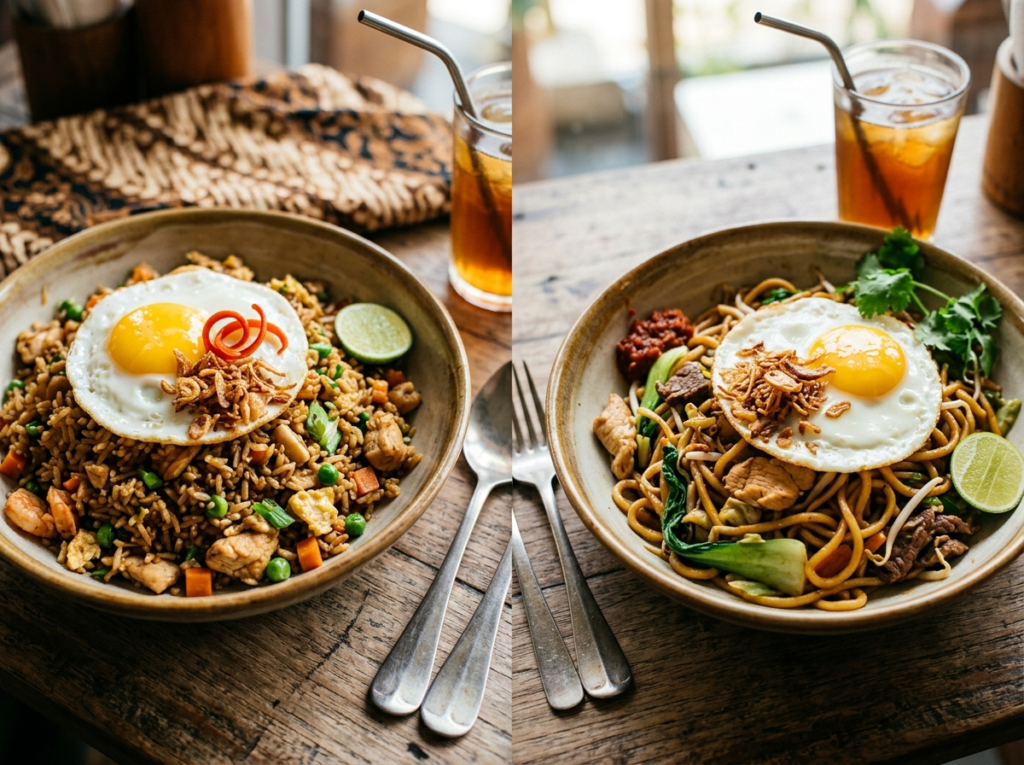
Two dishes sit on nearly every Indonesian restaurant menu, and they look almost like siblings. Same smoky wok aroma, same dark soy glaze, same scattering of crispy shallots on top. But bami goreng and nasi goreng aren’t the same meal — one is built around noodles, the other around rice. That single swap changes the texture, the cooking technique, and even how you eat it. If you’ve ever stared at a menu wondering which one to order (or which to cook at home), this breakdown covers everything you actually need to know — flavor, ingredients, history, and when to choose one over the other.
What Are Bami Goreng and Nasi Goreng, Exactly?
Let’s start with the names, because they tell you almost everything.
In Bahasa Indonesia and Malay, goreng means “fried.” Nasi means “rice.” Bami (also spelled bakmi, bahmi, or bami) means “noodles.” So you’re looking at fried noodles versus fried rice — two stir-fried dishes that share the same culinary DNA but take different paths on the plate.
Both are considered national street foods across Indonesia, and they’ve spread across Southeast Asia, the Netherlands, Suriname, and beyond. Nasi goreng is so deeply embedded in Indonesian identity that it was recognized by CNN Travel as one of the world’s 50 best foods in their reader polls. Bami goreng doesn’t carry quite the same celebrity status internationally, but it’s just as beloved in homes and warung (street-side food stalls) throughout Java, Sumatra, and Bali.
Think of them as two members of the same family. Same pantry, same wok, same cook — different star ingredient.
The Core Difference: Rice vs. Noodles
This is the obvious part, but it matters more than you might think.
Nasi Goreng: Day-Old Rice Is the Secret
Nasi goreng uses cooked rice — and not just any rice. The best versions start with rice that’s been cooked and then refrigerated for at least several hours, ideally overnight. Cold rice has less surface moisture, which means each grain fries separately instead of clumping into a sticky mass. If you’ve ever tried to stir-fry freshly steamed rice and ended up with a mushy pan, you already know why this step matters.
Most Indonesian cooks use long-grain white rice or jasmine rice. The grains should be firm, dry, and individual. If you’re curious about getting rice ready for frying, learning how to cook perfect jasmine rice and then properly storing cooked rice in the fridge will set you up well.
Bami Goreng: Egg Noodles Take Center Stage
Bami goreng swaps out the rice for egg noodles — usually thin, yellow wheat noodles that you’ll find fresh in Asian grocery stores or dried on the shelf. Some cooks use rice noodles or even instant noodles in a pinch, but the classic choice is egg-based wheat noodles.
The noodles need to be cooked (boiled briefly, then drained and sometimes tossed with a touch of oil) before they hit the wok. They absorb sauce differently than rice grains do. Where rice soaks up flavor on its surface, noodles pull sauce into every strand, creating a slightly slicker, chewier eating experience.
Quick fact: The word bami itself has roots in Hokkien Chinese (bak mi, meaning “meat noodles”), reflecting the centuries-old Chinese culinary influence on Indonesian cooking.
Flavor Profiles: Same Family, Different Personality
Here’s where people get confused. Both bami goreng and nasi goreng use a very similar flavor base. Walk into a kitchen where someone’s making either dish, and your nose won’t immediately tell you which one it is. The sauce backbone typically includes:
- Kecap manis (Indonesian sweet soy sauce — thick, syrupy, and deeply caramelized)
- Sambal or chili paste for heat
- Garlic and shallots
- Shrimp paste (terasi/belacan) for that signature funky, savory depth
- Salt and sometimes a pinch of white pepper
So yes, the seasonings overlap heavily. But the way those flavors land on your palate is different.
With nasi goreng, each rice grain gets coated in that sweet-savory-spicy glaze. The flavor is more dispersed, a bit drier, and often smoky from the wok’s high heat caramelizing the kecap manis directly against the rice. You get individual pops of flavor with every bite.
With bami goreng, the sauce clings to and pools between noodle strands. The result feels saucier, more concentrated, and the chewiness of the noodles gives each bite a longer, more textured experience. The noodles also tend to carry more wok char on their surface, which adds a faint bitterness that balances the sweetness of the kecap manis.
Pro tip: If you love smoky, charred flavor (what Indonesians and Chinese cooks call wok hei), a well-seasoned wok makes all the difference. A properly seasoned carbon steel wok reaches higher temperatures and gives both dishes that authentic street-stall taste you can’t get from a nonstick pan.
Common Add-Ins and Toppings
Both dishes are incredibly flexible. A home cook in Jakarta and a home cook in Amsterdam will make them differently, and both versions are “right.” That said, there’s a shared roster of add-ins that shows up again and again.
Proteins
Chicken, shrimp, and egg are the most common proteins for both dishes. Sliced chicken thigh (more forgiving than breast in a hot wok), peeled shrimp, and a fried egg on top — that combination is practically the default.
You’ll also see Chinese-style lap cheong sausage, tofu, and tempeh (a fermented soybean cake native to Java). In the Netherlands, where both dishes are hugely popular thanks to Indonesia’s colonial history, you might find versions made with pork or even char siu — something you’d almost never see in Indonesia, where the majority Muslim population avoids pork.
Vegetables
Cabbage, carrots, scallions, and bean sprouts are the workhorses. Bami goreng sometimes includes more vegetables than nasi goreng, partly because shredded cabbage and julienned carrots mix naturally with noodle strands. But this isn’t a hard rule — it depends entirely on the cook.
The Fried Egg
A fried egg on top of nasi goreng is practically mandatory. The runny yolk breaks into the rice and creates an extra layer of richness. You’ll see fried eggs on bami goreng too, but it’s less universal. Some stalls and restaurants scramble the egg directly into the noodles instead.
Garnishes
Fried shallots, sliced cucumber, tomato wedges, and a side of prawn crackers (kerupuk) finish both dishes. The kerupuk adds a crunch that contrasts with the soft rice or slippery noodles — it’s not just decoration.
A Quick History of Both Dishes
Nasi goreng and bami goreng both trace their roots to the intersection of Chinese cooking techniques and Indonesian ingredients. Chinese traders and immigrants brought wok frying and noodle-making to the Indonesian archipelago centuries ago, and those techniques blended with local spices, shrimp paste, and sweet soy sauce to create something distinctly Indonesian.
Nasi goreng likely started as a practical way to use up leftover rice. In a tropical climate without refrigeration, frying yesterday’s rice with strong seasonings was a smart preservation strategy. Over generations, it evolved from humble leftovers into a dish served everywhere — from sidewalk carts at 2 a.m. to five-star hotel breakfast buffets.
Bami goreng followed a similar path but stayed a bit closer to its Chinese noodle ancestry. The noodles themselves were a Chinese import, and many early versions of bami goreng were sold by ethnically Chinese vendors in Indonesian port cities. Today, both dishes are fully Indonesian, claimed with equal pride regardless of their multicultural origins.
Did you know? When Indonesia declared nasi goreng its unofficial national dish, it beat out rendang, satay, soto, and dozens of other iconic foods. The reasoning? It’s eaten across every island, every ethnic group, and every social class — from street stalls to state dinners.
How They’re Cooked: Technique Differences
If you’re cooking at home, the technique is similar but not identical.
The Wok Setup
Both dishes demand screaming-hot heat. You want your wok or large skillet as hot as it can safely go before adding oil. This is what creates that smoky, slightly charred flavor. A standard home stovetop won’t match the BTU output of a street vendor’s gas burner, but you can compensate by cooking in small batches and not overcrowding the wok.
Nasi Goreng Method
You start by frying aromatics — garlic, shallots, chili paste — in oil until fragrant. Protein goes in next and gets cooked through. Then the cold rice hits the wok. You break up any clumps, toss everything aggressively, and add kecap manis and any other sauces. The goal is to coat every grain evenly and get some light browning on the rice itself. The whole active cooking time is about 5–7 minutes.
Bami Goreng Method
The process is nearly the same, but you need to handle the noodles differently. After cooking your aromatics and protein, the pre-boiled noodles go in. Noodles are more delicate than rice — if you stir too aggressively, they break. Most experienced cooks use a combination of tossing and gentle lifting with tongs or chopsticks. Vegetables like bean sprouts often go in at the very end, since they wilt fast and you want them to keep some crunch.
⚠️ Food safety note: Whether you’re working with rice or noodles, don’t leave cooked starches sitting at room temperature for extended periods. Cooked rice in particular can harbor Bacillus cereus bacteria if left out for more than two hours. Cool leftovers quickly and refrigerate them promptly.
The Seasoning Moment
Here’s a small but meaningful difference. With nasi goreng, you can be fairly aggressive with liquid seasonings (kecap manis, fish sauce, soy sauce) because rice absorbs moisture quickly. With bami goreng, you want to go easier on liquid additions because noodles can become soggy fast. Many cooks add the kecap manis to the wok’s surface first, letting it caramelize slightly before tossing the noodles through it.
If you’re curious about incorporating fish sauce into your cooking, understanding how to cook with fish sauce will help you get the umami balance right without over-salting your dish.
Regional Variations Worth Knowing
One of the things most articles skip is just how varied these dishes are across Indonesia and beyond. There isn’t a single “correct” version of either dish.
Nasi Goreng Kampung
This is the rustic, village-style version that uses petai (stink beans), small dried anchovies (ikan bilis), and a heavier dose of chili. It’s earthier and funkier than the restaurant version.
Nasi Goreng Jawa (Javanese Style)
Sweeter, because Javanese cooking generally leans into kecap manis more heavily. The rice often has a darker color and a more pronounced caramel note.
Nasi Goreng Seafood
Coastal variations pile on prawns, squid, and crab. You’ll find these especially in Bali and along Java’s northern coast.
Bami Goreng Jawa
Similar to regular bami goreng but with a stronger sweet soy profile and sometimes a thicker noodle. Some Javanese versions also add a splash of tamarind for tartness.
Dutch-Indonesian Versions
In the Netherlands, both dishes have been part of the national food culture since the colonial era. The Dutch versions tend to be milder (less chili), and they’re often served as part of a rijsttafel (“rice table”) — a colonial-era meal format with many small dishes served together. You’ll find bami goreng and nasi goreng in virtually every Dutch supermarket as ready-made meals, and both are standard items on the menus of Chinese-Indonesian restaurants across the country.
Surinamese Takes
Suriname, a former Dutch colony in South America with a large Javanese diaspora community, has its own spin. Surinamese bami goreng often uses Chinese-style lo mein noodles and includes pom (a Surinamese root vegetable dish) on the side. It’s a fascinating cultural mashup.
Bami Goreng vs Nasi Goreng: When to Choose Which
So which one should you order — or cook?
This mostly comes down to personal preference, but here are a few real-world factors that might tip the scale.
Choose nasi goreng if you have leftover rice in the fridge and want a quick, satisfying meal. Rice also makes a better base if you’re topping with a runny fried egg — the yolk pools into the grains beautifully. Nasi goreng is also generally a bit more filling per portion, since rice is denser than noodles.
Choose bami goreng if you’re in the mood for something chewier and slightly saucier. Noodles also reheat better than fried rice (which can dry out), so bami goreng makes great next-day leftovers. If you’re feeding kids, many tend to gravitate toward noodles over rice, too.
Pro tip: Can’t decide? Many Indonesian restaurants and street stalls will make you a combined plate — half nasi goreng, half bami goreng. It’s not unusual at all. In Dutch-Indonesian restaurants, this combo plate is practically a menu standard.
Making Either Dish at Home: What You’ll Need
You don’t need a trip to Jakarta to make a solid bami goreng or nasi goreng. A reasonably stocked Asian pantry gets you 90% of the way there.
The Pantry Essentials
Kecap manis is non-negotiable. Regular soy sauce won’t give you the same result — kecap manis is thicker, sweeter, and has a molasses-like depth. If you absolutely can’t find it, you can improvise by mixing dark soy sauce with brown sugar, but the flavor won’t be identical.
Sambal oelek or another chili paste provides the heat. Sriracha works in a pinch but changes the flavor profile.
Shrimp paste (terasi) adds an umami backbone. It smells strong on its own, but a small amount transforms the dish. If you’re making a vegan version, skip it and add extra soy sauce or miso instead.
Fried shallots — buy them pre-made in a jar at any Asian grocery store. Making them from scratch is rewarding, but the jarred versions are perfectly fine for a weeknight meal.
For the noodles in bami goreng, look for fresh yellow egg noodles (often labeled bami or bakmi). Dried egg noodles or even ramen noodles (without the seasoning packet) work too.
The Cooking Equipment
A carbon steel wok is ideal. A large cast-iron skillet or stainless steel pan works if that’s what you have — just make sure it’s ripping hot. And cook in batches if your pan isn’t big enough to hold everything in a single layer. Overcrowding the wok drops the temperature and steams your food instead of frying it. That’s how you end up with soft, pale fried rice instead of smoky, slightly crispy grains.
If you want to explore other Southeast Asian cooking at home, trying some easy Vietnamese cuisine recipes can help you build confidence with similar wok techniques and pantry ingredients.
Nutritional Differences at a Glance
Neither bami goreng nor nasi goreng is a health food — they’re stir-fried dishes with oil, soy sauce, and often a fried egg on top. But there are some general nutritional differences worth noting.
A typical serving of nasi goreng (about 300g) runs roughly 400–550 calories, depending on how much oil is used and what protein is added. Rice contributes the bulk of the carbohydrates, and the dish tends to be moderate in fat.
Bami goreng comes in around a similar calorie range, sometimes slightly lower because egg noodles can be a bit less calorie-dense per serving than the same volume of fried rice. The noodles also tend to contain slightly more protein than plain white rice, thanks to the egg and wheat flour content.
Neither dish is particularly high in fiber or vitamins unless you load it up with vegetables. Adding extra cabbage, bean sprouts, and greens is an easy way to boost the nutritional profile of both.
Sodium is where you need to pay attention. Kecap manis, regular soy sauce, shrimp paste, and fish sauce all contribute significant sodium. A single serving can easily hit 800–1200mg of sodium, which is a substantial chunk of the recommended daily limit. If you’re watching salt intake, go lighter on the sauces and skip the extra soy sauce drizzle at the table.
FAQ
Is bami goreng the same as lo mein?
Not exactly. Both are stir-fried noodle dishes, but bami goreng uses Indonesian seasonings — especially kecap manis and sambal — while lo mein uses Chinese sauces like oyster sauce and sesame oil. The technique is similar (wok-frying noodles with protein and vegetables), but the flavor profiles are noticeably different. Think of them as cousins from different countries.
Can I make nasi goreng with fresh rice instead of day-old rice?
You can, but the results won’t be as good. Freshly cooked rice has too much surface moisture, so it tends to clump and get mushy in the wok. If you’re in a hurry, spread freshly cooked rice on a baking sheet and let it cool in the fridge (uncovered) for 30–60 minutes. It won’t be as dry as overnight rice, but it’ll work much better than straight-from-the-pot.
What makes nasi goreng different from regular fried rice?
The key difference is kecap manis — the Indonesian sweet soy sauce that gives nasi goreng its distinctive dark color and sweet-savory flavor. Chinese fried rice typically uses regular soy sauce and sesame oil, while Thai fried rice leans on fish sauce and lime. Nasi goreng also often includes shrimp paste and sambal, which you won’t find in most other fried rice styles.
Is bami goreng gluten-free?
No, because traditional bami goreng uses wheat-based egg noodles. If you need a gluten-free option, nasi goreng with tamari (gluten-free soy sauce) instead of regular soy sauce or kecap manis is the safer bet. Some cooks make bami goreng with rice noodles, but purists would argue that changes the dish significantly.
Can you combine bami goreng and nasi goreng on one plate?
Absolutely. In Indonesian food stalls and Dutch-Indonesian restaurants, it’s common to order a combination plate with both. There’s no rule against it, and it gives you the best of both worlds.
Your Next Move
Now that you know the real difference between bami goreng and nasi goreng, the best way to decide your favorite is simply to try both. If you’ve got leftover rice in the fridge tonight, start there with a quick nasi goreng. Pick up some fresh egg noodles later this week and give bami goreng a shot. Same wok, same sauce lineup, completely different eating experience.
And if you’re building out your Asian cooking skills, don’t stop here — learning how to cook with Chinese cooking wine opens up another flavor dimension that pairs beautifully with both stir-fried rice and noodle dishes. Once your wok is hot and your pantry is stocked, the only real question is: noodles or rice tonight?