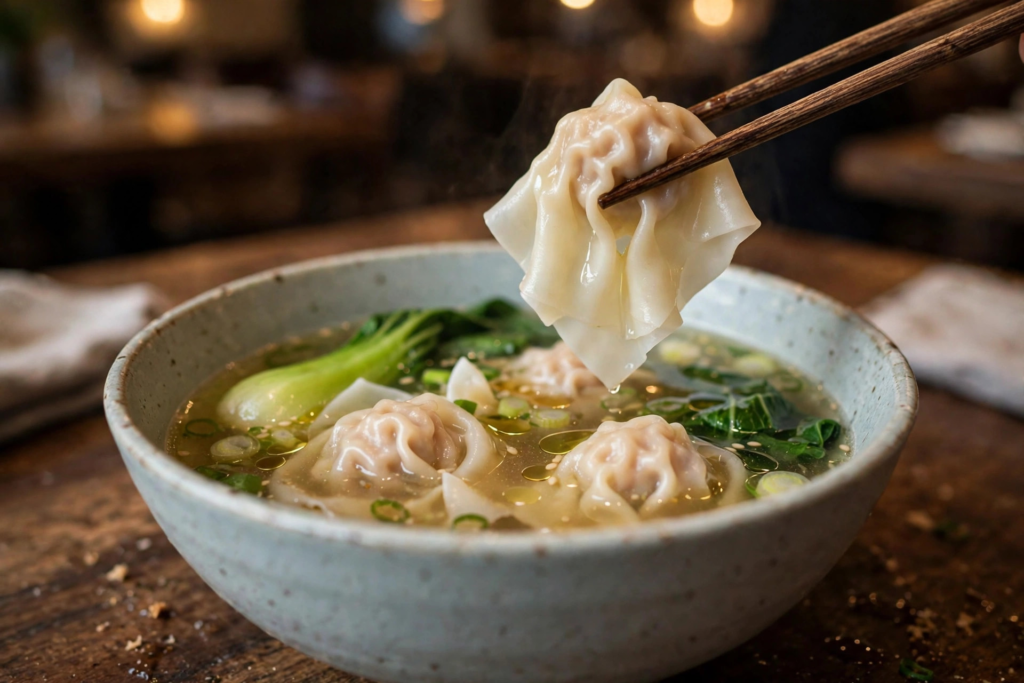
Order “dumplings” at a Chinese restaurant and you might get crescent-shaped jiaozi, pan-fried and crisp-bottomed. Order wontons and you’ll get delicate little purses floating in clear broth. They’re cousins, not twins — and mixing them up is the most common mistake in Chinese food ordering. Here’s how to tell them apart, why the difference exists, and which one you actually want.
The one-line version: a wonton is a type of dumpling, but not all dumplings are wontons. Wontons are smaller, wrapped in thin square skins, and built for soup. Dumplings — specifically jiaozi — are bigger, wrapped in thicker round skins, and built to stand up to frying, steaming, and boiling. Everything else flows from those two facts.
What Is a Dumpling?
When Chinese people say “dumpling,” they usually mean jiǎozi — the crescent-shaped parcels that are practically the national food of northern China. Legend credits their invention to the physician Zhang Zhongjing around 280 AD, who supposedly wrapped lamb and herbs in dough shaped like ears to treat frostbite. Whether or not the frostbite story holds up, jiaozi have been serious business for a very long time: by the Northern Song dynasty they symbolized wealth (their ingot shape), and today they’re the non-negotiable centerpiece of Lunar New Year dinner.
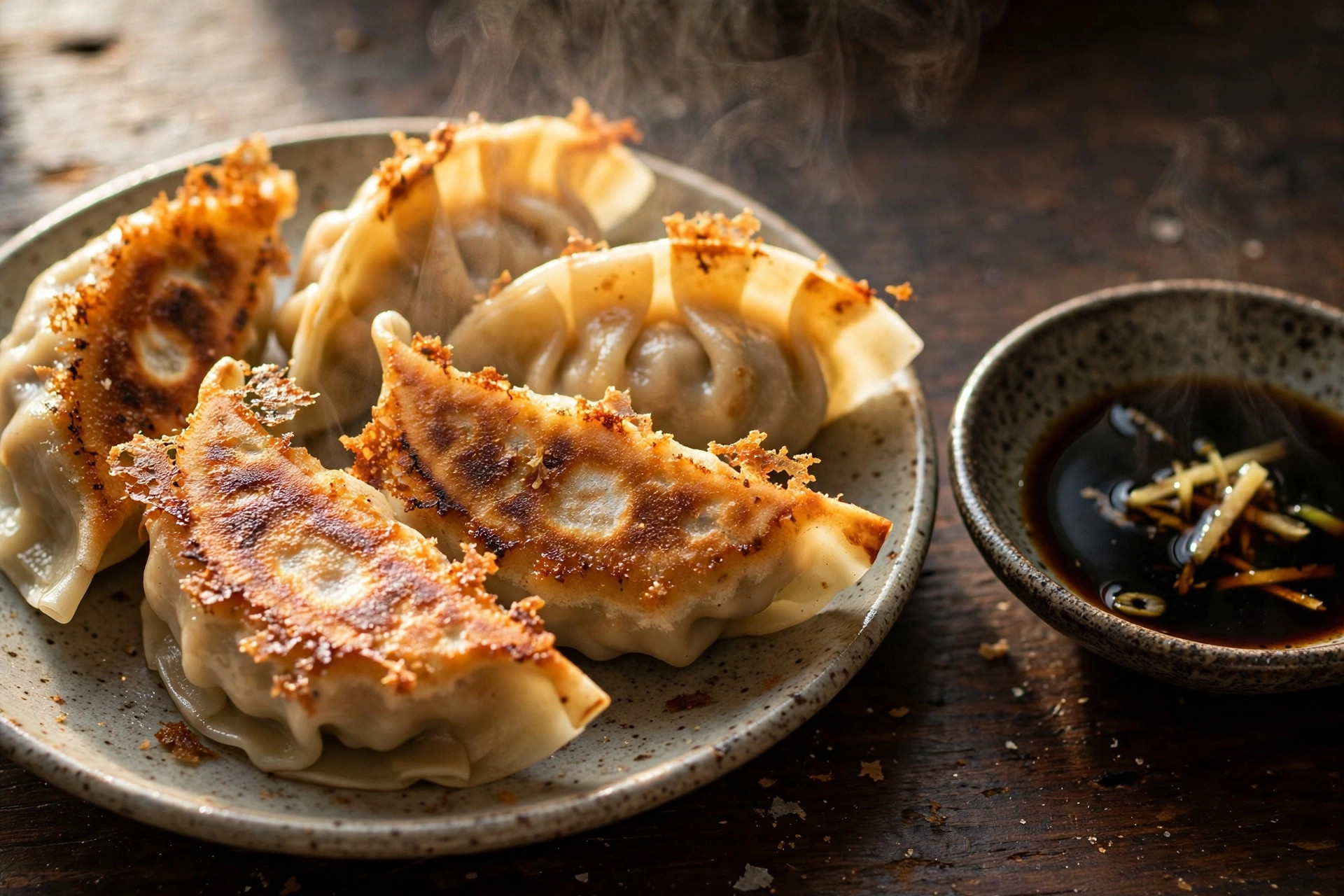
A classic jiaozi has three defining traits. The wrapper is a thick-ish wheat dough — just flour, water, and salt — rolled into round skins sturdy enough to survive boiling, steaming, or a hard sear in a screaming-hot pan. The filling is generous and hearty: pork and cabbage is the default, but lamb, beef, shrimp, and vegetarian versions all have their strongholds. And the shape is a plump half-moon, pleated along the edge, sized to be two or three satisfying bites.
Dumplings are a meal. In northern China, a plate of boiled jiaozi with black vinegar is dinner — no rice, no fanfare. That heartiness is the whole point, and it’s why the wrapper has to be robust: a dumpling that falls apart in the pan is a failed dumpling.
What Is a Wonton?
Wontons — húntún in Mandarin, wàhn-tān in Cantonese — translate roughly to “swallowing a cloud,” which tells you everything about the intended texture. Where the dumpling is built like a work boot, the wonton is built like a silk slipper.
The wrapper is the whole story. Wonton skins are thin, square, and made with egg, which gives them a pale yellow color, a silky chew, and just enough strength to survive a quick boil. They’re rolled far thinner than dumpling wrappers because they never have to face a frying pan — wontons are boiled or steamed, and most famously, simmered directly in the broth they’ll be served in.
The filling follows the wrapper’s lead: smaller, more delicate, more refined. The classic Cantonese combination is minced pork and shrimp with ginger and scallion — seasoned lightly so the sweetness of the shrimp comes through. There’s simply less of it, because the wonton is a smaller package doing a different job.
And the job is usually soup. A proper wonton soup is a study in restraint: a clear, deeply savory broth (often pork bone and dried flounder or shrimp), a handful of wontons, maybe some leafy greens and a drizzle of sesame oil. The wonton isn’t the meal — it’s the jewel in the bowl.
Wonton vs Dumpling: The Full Comparison
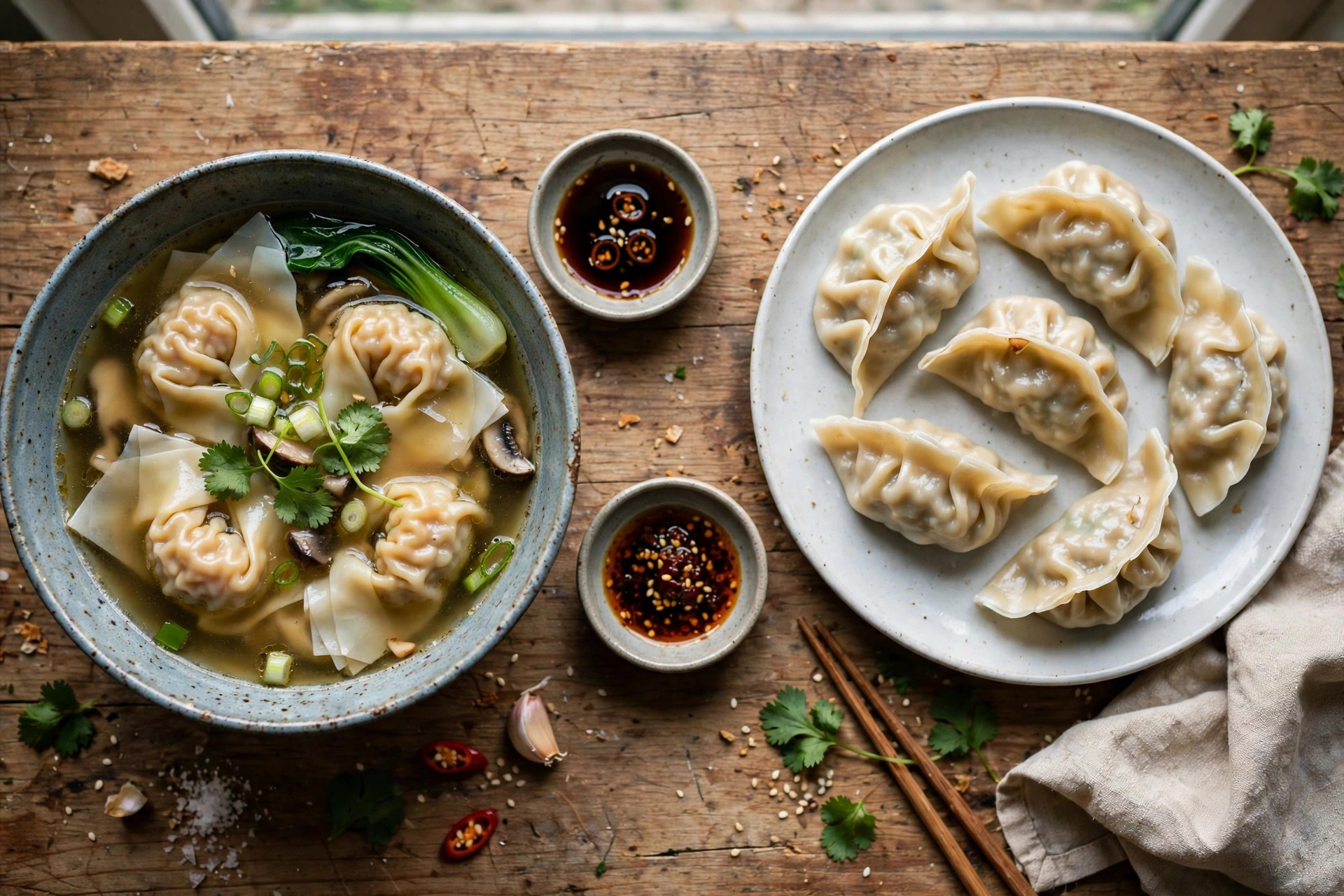
| Wonton | Dumpling (Jiaozi) | |
|---|---|---|
| Wrapper | Thin, square, made with egg | Thicker, round, flour and water only |
| Size | Small — one or two bites | Larger — two or three hearty bites |
| Filling | Delicate: pork + shrimp, lightly seasoned | Hearty: pork, lamb, beef, or veg, generously filled |
| Shape | Triangle, purse, or “nurse’s cap” | Crescent / half-moon, pleated edge |
| Cooking | Boiled or steamed; lives in soup | Boiled, steamed, pan-fried, or deep-fried |
| Serving | In clear broth, as appetizer or light meal | On a plate with dipping sauce, as a full meal |
| Home region | Cantonese south | Northern China |
Notice the logic running through the table: every difference traces back to the wrapper. Thin egg skins can’t survive pan-frying, so wontons get boiled. Thick wheat skins can take a sear, so dumplings get the full range of cooking methods. The wrapper dictates the cooking, the cooking dictates the serving, and the serving dictates the whole experience.
Why the Wrapper Makes All the Difference
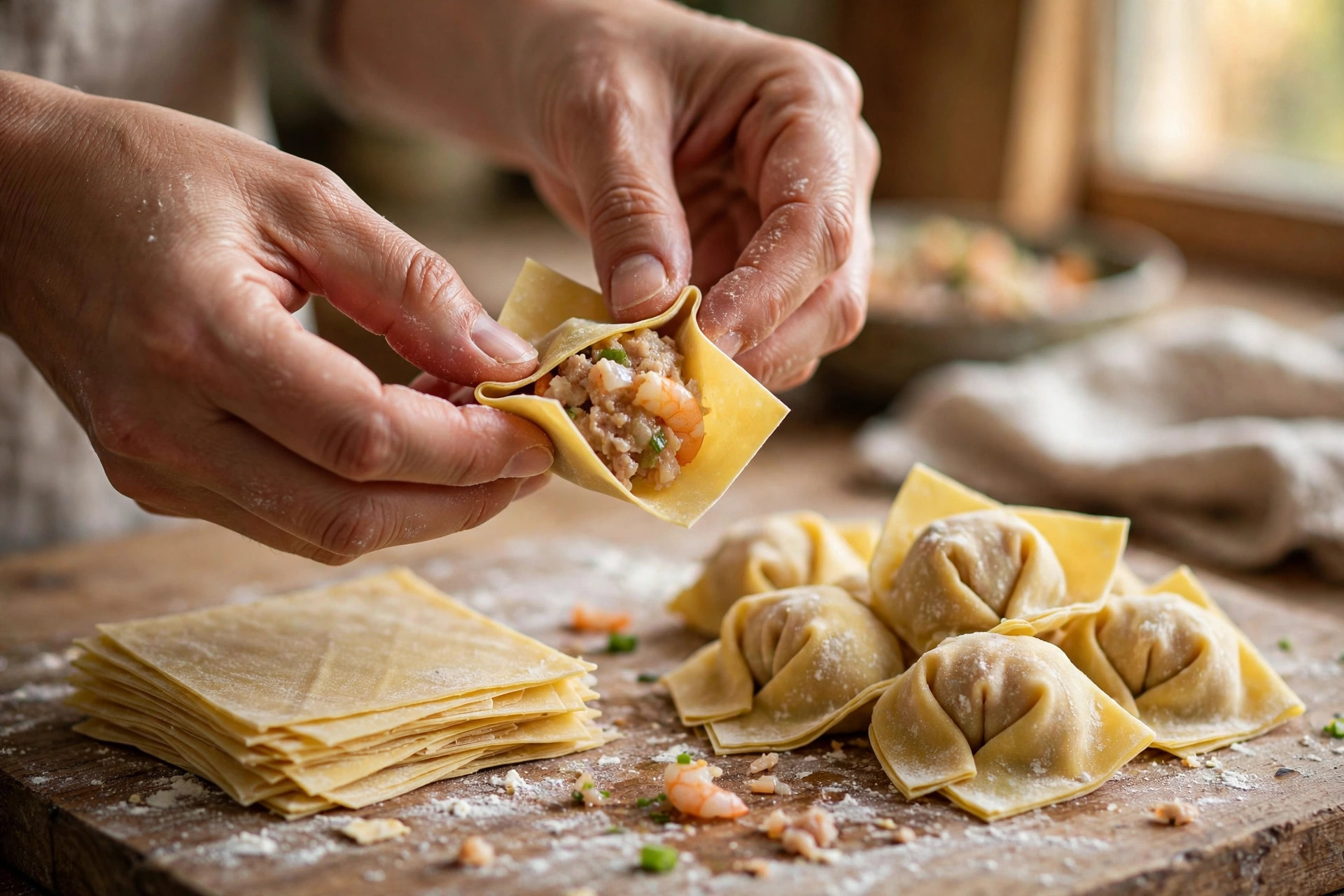
This is the part most comparison articles skip, and it’s the most interesting bit. The wrapper difference isn’t aesthetic — it’s engineering.
Wonton wrappers include egg, which does two things: it makes the dough silkier and more extensible, so it can be rolled tissue-thin without tearing, and it gives the cooked skin a tender, almost slippery bite. But thin has a cost. Drop a wonton skin into a ripping-hot oiled pan and it would scorch and shatter. That’s why wontons live in water — boiling is gentle, and the broth does half the flavoring work.
Dumpling wrappers go the other direction: no egg, more chew, rolled thicker with a slightly thicker center. That sturdiness is what makes the pan-fried potsticker possible — the bottom crisps into a golden lattice while the top steams tender under a lid. Try that with a wonton skin and you’d get shards.
So when someone asks “which is better,” the honest answer is that they’re optimized for different things. The wonton optimizes for delicacy; the dumpling optimizes for versatility. Tasting Table’s breakdown of the two lands in the same place: thinner wrappers, gentler cooking, smaller package — every trait connected.
Regional Styles Worth Knowing
Both families have regional branches, and knowing them makes you a dramatically better orderer:
- Cantonese wonton soup — the classic: pork-and-shrimp wontons in clear broth with noodles. Hong Kong’s late-night staple.
- Shanghai small wontons (xiǎo húntún) — tiny, barely a bite each, served in dozens in a light chicken broth. Breakfast food.
- Sichuan red-oil wontons (chāo shǒu) — wontons tossed in chili oil with black vinegar and Sichuan pepper instead of soup. Completely different animal.
- Northern boiled jiaozi — the Lunar New Year standard: pork and cabbage, boiled, dipped in black vinegar.
- Pan-fried guotie / potstickers — same dumpling, crisped bottom, the crowd-pleaser.
- Japanese gyoza — the Japanese riff on northern jiaozi: thinner skin, garlic-heavy filling, always pan-fried.
The Sichuan red-oil version deserves a special mention because it breaks the “wontons live in soup” rule — proof that even the rules have delicious exceptions. If you’ve ever wondered about the broader dumpling universe, our guide to Chinese dumplings maps the whole family, and dim sum vs dumplings sorts out the other common confusion.
Which Should You Order?
Quick decision guide:
- Want comfort in a bowl? Wonton soup. Especially Cantonese-style with noodles.
- Want a full meal? Boiled or pan-fried jiaozi. Fifteen of them and you’re done.
- Want heat? Sichuan red-oil wontons — the chili-crisp-and-vinegar toss.
- Feeding picky kids? Pan-fried potstickers. The crispy bottom wins everyone over.
- Making them at home? Dumplings are more forgiving — thicker skins hide sloppy pleating. Wontons punish hesitation.
And if you’re the type who likes the ritual of eating them properly, how to eat soup dumplings without burning your mouth covers the chopsticks-and-spoon technique that works for wontons too. For dipping, here’s an easy dumpling dipping sauce that suits both.
Frequently Asked Questions
Are wontons just small dumplings?
Sort of — a wonton is technically a type of dumpling, but the wrapper, shape, filling, and cooking method are all distinct enough that Chinese cuisine treats them as separate dishes with separate names. Calling a wonton “a small dumpling” is like calling a crepe “a thin pancake”: true, but missing the point.
Can you pan-fry wontons?
You can deep-fry them — fried wontons are a real thing, especially as an appetizer with sweet-and-sour sauce. But pan-frying like a potsticker doesn’t work well; the thin egg skins scorch before the filling cooks through.
What’s the difference between wontons and gyoza?
Gyoza are the Japanese version of northern Chinese jiaozi — thicker round wrappers, pan-fried, garlicky pork filling. They’re in the dumpling camp, not the wonton camp.
Do wontons always come in soup?
Almost always, with one famous exception: Sichuan red-oil wontons (chāo shǒu), which are tossed in chili oil and vinegar instead. If a menu just says “wontons,” expect soup.
Which is older?
Dumplings, by a lot. Jiaozi trace back roughly 1,800 years to northern China; wontons as we know them emerged much later in the south and became widely popular in the last century or two.
Next time you’re staring at a menu, you’ll know: soup in a bowl with clouds floating in it — wontons. Crescents on a plate with something crispy happening — dumplings. Order one of each and you’ve basically taken a guided tour of north versus south China without leaving your table.
[…] to hide. If you want to understand how wontons differ from their dumpling cousins first, our wonton vs dumpling guide breaks down the family […]