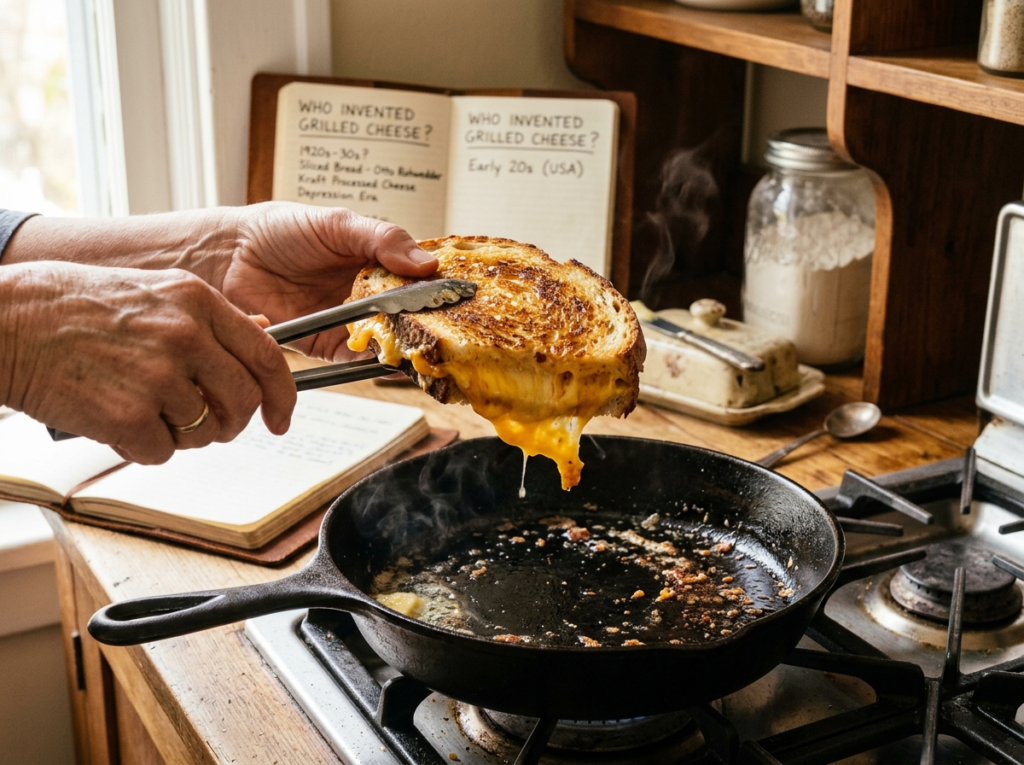
You’d think a sandwich this simple would have a simple backstory. Two slices of bread, some cheese, a hot pan — done. But ask food historians who actually invented grilled cheese, and you’ll get a shrug instead of an answer. There’s no single inventor, no patent, no eureka moment in a diner kitchen. Instead, grilled cheese kind of assembled itself over centuries, picking up pieces from Roman kitchens, French bistros, and a Depression-era grocery aisle in Chicago. Here’s how that actually happened.
So, Who Invented Grilled Cheese, Really?
The honest answer is: nobody knows, and nobody can know, because grilled cheese wasn’t invented so much as it evolved. No one seems to know who first put the idea of grilling bread and cheese together, and food historians generally agree there’s no single credited inventor.
What we do have is a timeline of small breakthroughs that, stacked together, eventually produced the sandwich you’re picturing right now. Ancient Romans get some credit for the basic concept. A French bistro dish gets credit for the “melted cheese on toast” format. And a cheese company in early 20th-century America gets credit for making the whole thing affordable enough for millions of families to eat it weekly.
Quick Fact: The actual phrase “grilled cheese” didn’t show up in print until the 1960s. Before that, everyone called it a “toasted cheese” or “melted cheese” sandwich.
Ancient Rome Started It (Sort Of)
Long before anyone called it a sandwich, people were melting cheese onto bread and calling it dinner. The Romans had a version of this dish, and it’s documented in Roman cookbooks, where they’d place cheese on bread and heat it in an early type of oven.
This wasn’t the grilled cheese you know. It was closer to a savory cheesecake made with spelt and ricotta than anything resembling a slice of American on white bread. Still, the basic idea — bread plus melting cheese plus heat — has apparently been appealing to humans for roughly two thousand years. That’s not nothing.
Fast forward a bit, and you land on Welsh rarebit, a British dish involving toast smothered in a rich cheese sauce, sometimes spiked with beer or mustard. It’s been around since at least the 18th century and shares a lot of DNA with what would eventually become the American grilled cheese: toasted bread, melted cheese, minimal fuss.
The Sandwich Itself Comes From England
Here’s a fun twist: the concept of “a sandwich” — food between two pieces of bread — has nothing to do with cheese at all. It’s named after John Montagu, the Earl of Sandwich, an English nobleman from the 1700s who reportedly wanted a portable meal he could eat without leaving the gaming table. He asked for meat between bread. The cheese came later, from other kitchens entirely.
By the mid-1800s, cookbooks were catching up to the idea of warm cheese as a meal. Victorian recipe books from 1861, including the famous “Mrs. Beeton’s Book of Household Management,” were already referencing toasted cheese dishes. Around the same time, the French were putting their own spin on things.
Enter France: The Croque Monsieur
If you’ve ever ordered a croque monsieur at a café, you’ve eaten a close cousin of grilled cheese. It’s ham and melted cheese between toasted bread, often finished with a rich béchamel sauce on top. Many food historians believe this dish first appeared in France around 1910, and some even argue it’s the true technical ancestor of the modern grilled cheese.
The croque monsieur brought something important to the table: the format. Bread, filling, bread, heat, repeat. That basic structure is exactly what shows up in American kitchens a decade or two later — just without the ham, and eventually, without needing a fancy French name to sound appealing.
If you like exploring how different cultures riff on the same core idea, it’s worth checking out how Asian breakfast foods handle their own versions of quick, warm, comforting morning meals. The instinct to combine starch and something rich and savory shows up everywhere, not just in Europe.
The Real Turning Point: Kraft and Processed Cheese
This is where the story stops being vague and starts getting specific. In 1916, an American named James L. Kraft patented a process for making processed cheese, which allowed for gooey, easily meltable cheese that didn’t spoil quickly. That single patent changed everything.
Before Kraft’s cheese, real cheddar and other traditional cheeses could get greasy, stringy, or separate when melted. Kraft’s product behaved completely differently. It stayed smooth. It stretched. It melted evenly. In other words, it did exactly what you want a grilled cheese filling to do.
Kraft sold his invention in two forms early on — bulk cheese and grated cheese — and during World War I, the U.S. Army bought six million pounds of it for soldiers. That’s a staggering amount of cheese for a product that hadn’t even existed a few years earlier.
Did you know? The earliest versions of these sandwiches weren’t even sandwiches in the traditional sense. People mixed Kraft’s grated cheese with a binder like white sauce or mustard, spread it on one slice of buttered bread, and toasted it open-faced. No top slice. No sandwich shape. Just melted cheese on toast.
Sliced Bread Changes the Game
Cheese was only half the equation. The other half showed up in the late 1920s. Frederick Rohwedder invented the automatic bread slicer in 1928 in Davenport, Iowa, which made distributing pre-sliced white bread cheap and easy for the first time.
Before this invention, home cooks sliced their own bread by hand, which meant uneven slices and a lot more effort. Once bakeries started producing loaves that were already sliced, toasting a sandwich became a genuinely quick task instead of a small production. By 1933, bakeries were actually selling more sliced bread than unsliced loaves.
Put those two inventions side by side — meltable processed cheese and pre-sliced white bread — and you can practically see the modern grilled cheese sandwich assembling itself.
The Great Depression Made It a Household Staple
Timing matters here. Kraft’s cheese and sliced bread both became widely available right as the country hit the Great Depression, when families needed meals that were cheap, filling, and didn’t require much skill to make.
The grilled cheese sandwich grew rapidly in popularity during the Great Depression, when people had limited resources and needed cost-effective meals made from basic ingredients. A few slices of bread and a smear of cheap, shelf-stable cheese could feed a family for pennies. That’s exactly the kind of math that turns a niche food into a national habit.
It’s widely believed that the second slice of bread was added sometime during the Depression specifically to make the sandwich more filling for workers who needed real calories to get through a hard day. Before that, remember, it was usually just one slice, open-faced.
If you’re into the story of how scarcity shapes comfort food, it’s a similar pattern to what you’ll find in dishes built around stretching simple ingredients — the kind of resourceful cooking you’ll also see reflected in recipes like easy egg dishes, where a handful of pantry staples turns into something genuinely satisfying.
World War II: The Sandwich Goes to War
Grilled cheese didn’t stay a civilian food for long. During World War II, Navy cooks were making what they called “American cheese filling sandwiches” for servicemen, following a government-issued recipe. This wasn’t a fringe menu item, either — it was standard fare on Navy ships and in mess halls across the country.
Soldiers who grew up eating these sandwiches at home, and then again in the service, came back after the war with the habit fully baked in. That’s a big part of why grilled cheese became such a deeply nostalgic, cross-generational comfort food in American culture instead of just another Depression-era relic that faded away once the economy improved.
The 1950s Brings the Modern Format Together
By the early 1950s, cookbooks were treating the toasted cheese sandwich as a settled classic rather than a novelty. Recipes for broiling, pan-frying, and even sautéing the sandwich in butter were showing up in major American cookbooks of the era, cementing the buttered, pan-fried method that most people still use today.
Getting the pan temperature right actually matters more than people expect here — go in too hot and you’ll scorch the bread before the cheese melts, too low and you’ll end up with pale, chewy bread and a cold center. If you want a better feel for managing heat on the stovetop generally, it helps to understand simmer temperature basics, since the same principles about controlling heat apply just as much to a skillet as they do to a saucepan.
Pro Tip: Butter your bread all the way to the edges, not just the middle. The edges are what touch the hottest part of the pan first, and unbuttered corners tend to stay soft and pale instead of golden and crisp.
Kraft Singles Seal the Deal
In 1949, Kraft Foods introduced Kraft Singles — individually wrapped slices of processed American cheese — and stores began stocking them regularly by the mid-1960s. This was the final piece of the puzzle. Instead of grating cheese or mixing it into a paste, home cooks could now grab a perfectly portioned, presliced square that melted evenly every single time.
It’s a small thing, but it standardized grilled cheese in a way that made it nearly foolproof. One slice of cheese, two slices of bread, a little butter — the exact ratio most people still use without even thinking about it.
Why Does the Pan Matter So Much?
If you’ve ever made grilled cheese in a nonstick pan versus a well-seasoned cast iron or carbon steel one, you already know the difference is real. A properly maintained pan gives you an even, deep golden crust without sticking, while a poorly cared-for one leaves you scraping burnt cheese off the surface.
This isn’t unique to grilled cheese, either. The same logic that makes a well-seasoned wok perform better for stir-fries applies to whatever pan you’re using for your sandwich: a smooth, properly built-up surface conducts heat more evenly and releases food more cleanly.
Grilled Cheese Around the World
America didn’t corner the market on melted cheese sandwiches. Plenty of countries developed their own versions, usually shaped by whatever bread and cheese happened to be local and affordable.
- Croque Monsieur (France): Ham and Gruyère, often topped with béchamel sauce.
- Toastie (United Kingdom): A grilled cheese cousin, often made in a sandwich press called a toastie maker.
- Jaffle (Australia): Made in a sealed jaffle iron that crimps the edges shut, trapping the filling inside.
- Bauru (Brazil): A melted cheese and roast beef sandwich created in São Paulo in the 1930s.
The jaffle iron itself was invented by an Australian, Dr. Earnest Smithers, right before 1950, which is why Australians still call their version of grilled cheese a jaffle. It’s a good reminder that plenty of cultures landed on roughly the same idea independently, using whatever cooking tools they had on hand.
That kind of cross-cultural overlap shows up a lot in comfort food generally — different countries solving the same basic craving (warm, filling, cheap) with whatever’s locally available. You can see a similar pattern in how bao developed in Chinese cuisine as its own answer to “bread wrapped around something warm and satisfying,” even though it has zero direct connection to a Western sandwich.
Common Questions People Have About Grilled Cheese
People searching for the history of this sandwich usually land on a few recurring questions. Here are the honest answers.
Was grilled cheese invented during the Great Depression?
Not exactly invented, but it did become genuinely popular during that period. The sandwich already existed in an open-faced form before the Depression hit, but the economic pressure of the era is what turned it into a household staple, since it was cheap, filling, and required almost no cooking skill.
Did James Kraft invent grilled cheese?
No. Kraft invented processed cheese, which made grilled cheese far easier and cheaper to make consistently. He didn’t invent the sandwich itself, but without his cheese, the sandwich as we know it probably wouldn’t exist in its current form.
Why is it called “grilled” cheese if it’s usually pan-fried?
Good catch — most people make it in a skillet, not on an actual grill. The name likely stuck around from earlier cooking methods, when broiling (sometimes described as “grilling”) was a more common way to melt the cheese before pan-frying became standard.
When did people start calling it “grilled cheese”?
Later than you’d guess. The specific phrase didn’t appear in print until the 1960s. Before that, it went by names like “toasted cheese sandwich” or “melted cheese sandwich” for decades.
What’s the difference between grilled cheese and a croque monsieur?
Mainly the ham and the sauce. A croque monsieur includes ham and is often topped with béchamel sauce, while classic American grilled cheese is just bread, butter, and cheese, cooked simply in a pan.
A Quick Safety Note
Since this sandwich lives and dies by melted cheese, it’s worth a quick reminder: if you’re using leftover cheese or storing a made sandwich for later, keep dairy refrigerated and don’t let it sit out at room temperature for more than about two hours. Reheat leftovers until the cheese is hot all the way through, not just warm on the surface, to keep things food-safe.
The Bottom Line
Grilled cheese wasn’t invented in a single moment by a single person — it was built slowly, over centuries, by Roman cooks, French chefs, a cheese company in Chicago, and Depression-era families just trying to make dinner stretch a little further. That patchwork history is part of what makes it such a genuinely comforting food. It’s not a marketing invention. It’s a sandwich that earned its place in kitchens one hard decade at a time.
Next time you’re standing over a hot pan watching the edges of the bread turn golden, you’re taking part in a food tradition that’s been evolving for close to two thousand years. Not bad for something that only takes about five minutes to make.