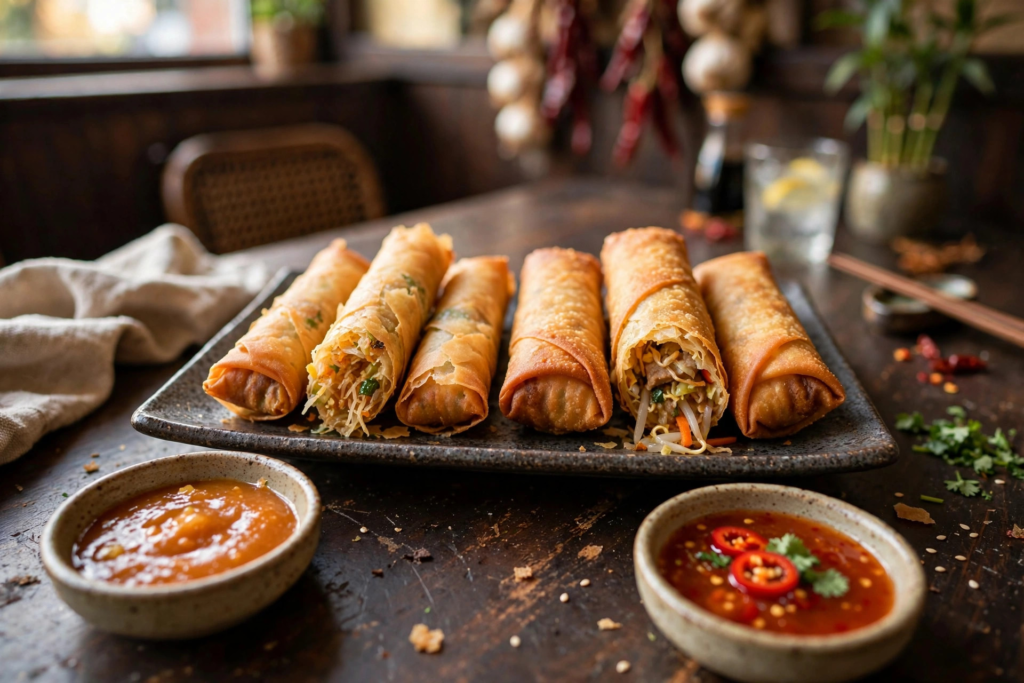
You’re staring at the appetizer section of the takeout menu, and there they are, right next to each other: spring rolls, egg rolls. They look like cousins. They sound like they should be interchangeable. And yet anyone who’s bitten into both knows they’re completely different eating experiences — one shatters, the other crunches.
Here’s the thing most menus won’t tell you: only one of them is actually Chinese. The other was invented in America. Once you know which is which — and why the wrapper makes all the difference — you’ll never confuse them again, and you’ll order with a lot more confidence.
The 30-Second Answer
Spring rolls (chūnjuǎn, 春卷) are the original: thin, delicate wheat wrappers around light fillings, fried until shatteringly crisp. They’ve been made in China for well over a thousand years.
Egg rolls are the American remix: thick, chewy, blistered wheat-and-egg wrappers stuffed generously with cabbage and meat, deep-fried to a dark golden crunch. They were almost certainly invented in a New York Chinese restaurant in the early 1930s.
Same concept — filling wrapped in dough, fried hot — but the wrapper changes everything: texture, size, calories, and the whole eating experience.
What Is a Spring Roll, Really?
The spring roll is old. Really old. The custom traces back to China’s Jin Dynasty (266–420 CE), when people rolled early spring vegetables in thin pancakes to celebrate the arrival of spring — a ritual called “biting the spring” (yao chun), traditionally performed on Li Chun, the first day of spring in the Chinese calendar.
Over the centuries it evolved into chūnjuǎn, the crisp fried roll most of the world knows. The wrapper is the whole philosophy: flour and water, rolled paper-thin (about 0.3–0.5mm), with no egg. Fried hot and fast, it turns pale gold and shatters at first bite into delicate flakes. Because the shell is so thin, the filling stays light — shredded vegetables, a little pork or shrimp, glass noodles, wood ear mushrooms. Nothing the wrapper can’t handle.
And “spring roll” is really a whole family, not one dish. Across Asia you’ll meet Vietnamese chả giò (fried, with nuoc cham for dipping), Filipino lumpia (often smaller, sometimes with banana or ube in sweet versions), Taiwanese popiah (soft, unfried, burrito-sized), and Thai po pia thot. Same idea, local accent. If you want the broader dumpling-and-roll context, our guide to Chinese dumplings maps the family tree.
Even within China, the spring roll changes its personality by region. Cantonese spring rolls are the small, crisp ones most Americans recognize — delicate, often filled with shrimp and bamboo shoots, served as dim sum. Shanghai-style rolls run slightly larger with a meatier pork-and-cabbage filling. In Beijing and the north, you’ll find heartier versions closer to a fried pancake roll, sometimes served with sweet bean sauce the way Peking duck is. The wrapper stays thin everywhere; it’s the filling and the occasion that shift.
What Is an Egg Roll, Then?
The egg roll is a Chinese-American invention, born in New York City restaurant kitchens in the early 1930s — food historian Andrew Coe makes the case in Chop Suey: A Cultural History of Chinese Food in the United States. Chinese immigrant chefs, cooking for American diners who liked their appetizers substantial, took the spring roll concept and supersized it: thicker wrapper, bigger roll, heartier filling.
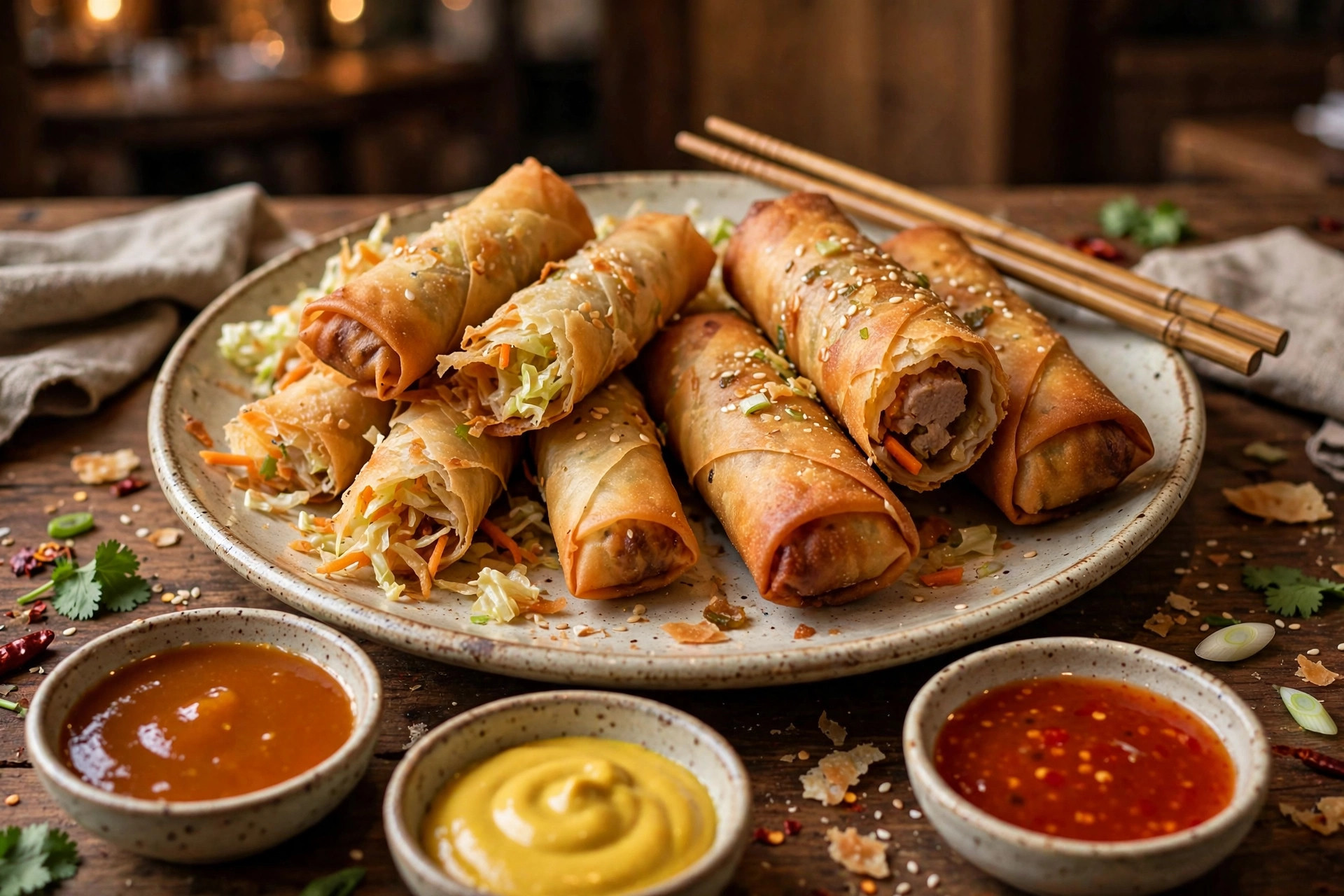
The wrapper is where the egg comes in — wheat flour, water, and egg, rolled the way you’d roll pasta dough, about 1.5–2mm thick. Fried, it goes dark golden and blistered, chewy as much as crispy. That sturdy shell can hold a serious filling: cooked cabbage, roast pork or chicken, carrots, bean sprouts, all seasoned boldly. It’s a knife-and-fork appetizer pretending to be finger food.
Why “egg” roll, when the dominant flavor is cabbage? Two theories have been floating around since a 1979 Washington Post investigation. One: the Chinese word for “egg” sounds a bit like the word for “spring,” and something got lost between the kitchen and the menu printer. Two: southern Chinese chefs really did add egg to the dough when trying to replicate thin wheat skins with American flour. Either way, the name stuck, and as PureWow’s breakdown notes, the American version has since wandered into flavor territory no spring roll would recognize — cheeseburger egg rolls, avocado egg rolls, even bananas Foster egg rolls.
The Wrapper Is Everything: Side-by-Side Comparison
| Spring Roll | Egg Roll | |
|---|---|---|
| Wrapper | Paper-thin wheat (0.3–0.5mm), no egg | Thick wheat-and-egg dough (1.5–2mm) |
| Texture when fried | Delicate, shattery, pale gold, smooth | Chewy-crunchy, blistered, dark gold |
| Size | Slim, finger-width | Fat, sausage-sized |
| Typical filling | Light: vegetables, glass noodles, small amount of pork/shrimp | Hearty: cooked cabbage, roast pork/chicken, carrots |
| Origin | China, centuries old (Jin Dynasty roots) | New York City, early 1930s |
| Calories (approx.) | 100–140 per roll | 200–250 per roll |
| Classic dips | Soy-vinegar, sweet chili, nuoc cham | Duck sauce, sweet & sour, hot mustard |
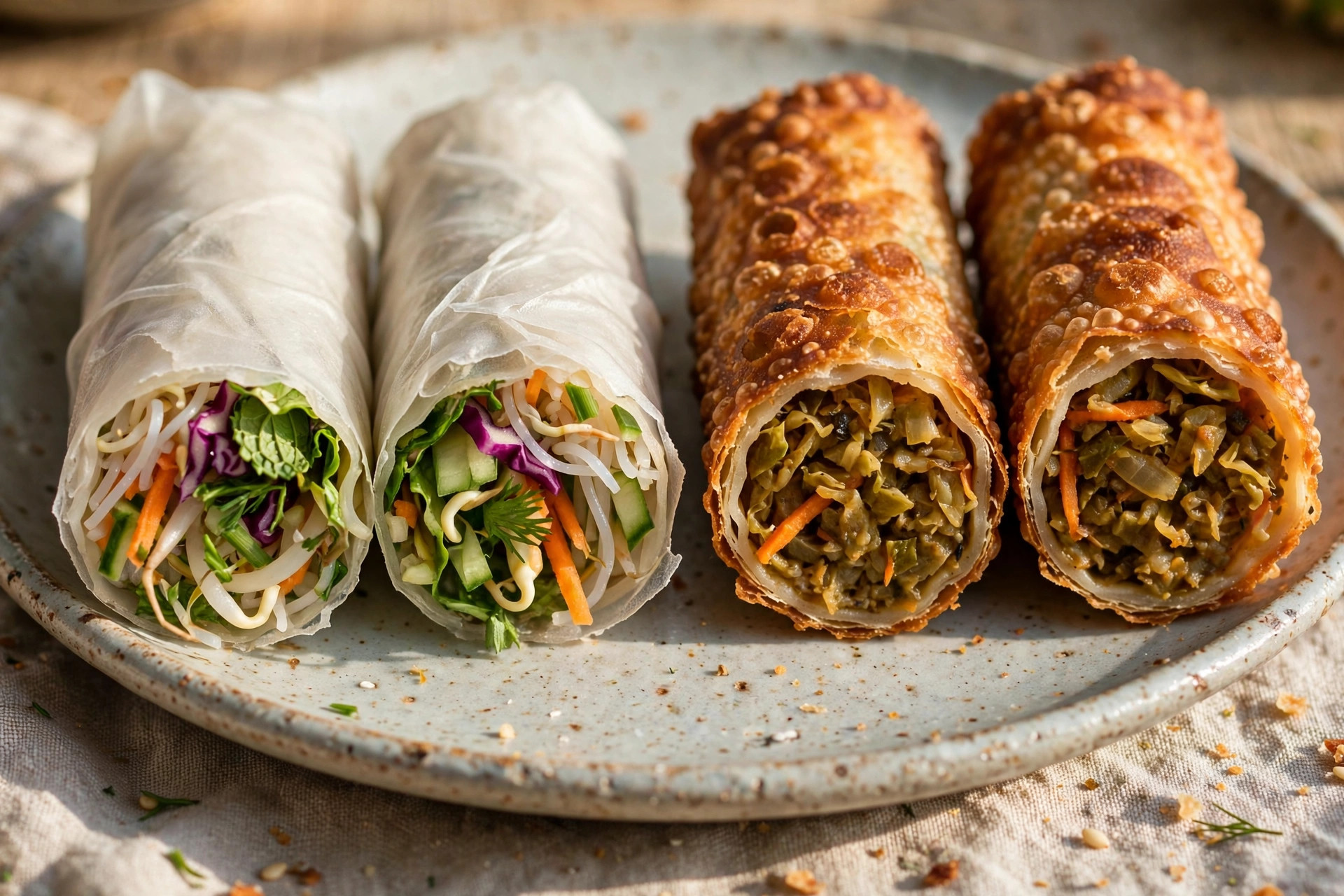
The fastest way to tell them apart on a plate? Look at the surface. Smooth and pale: spring roll. Bumpy, blistered, deep gold: egg roll. As Tasting Table’s comparison puts it, the blistered shell is the giveaway — no spring roll ever looked like that.
How They’re Cooked (and Why It Matters)
The wrapper doesn’t just change the texture — it changes the whole cooking method:
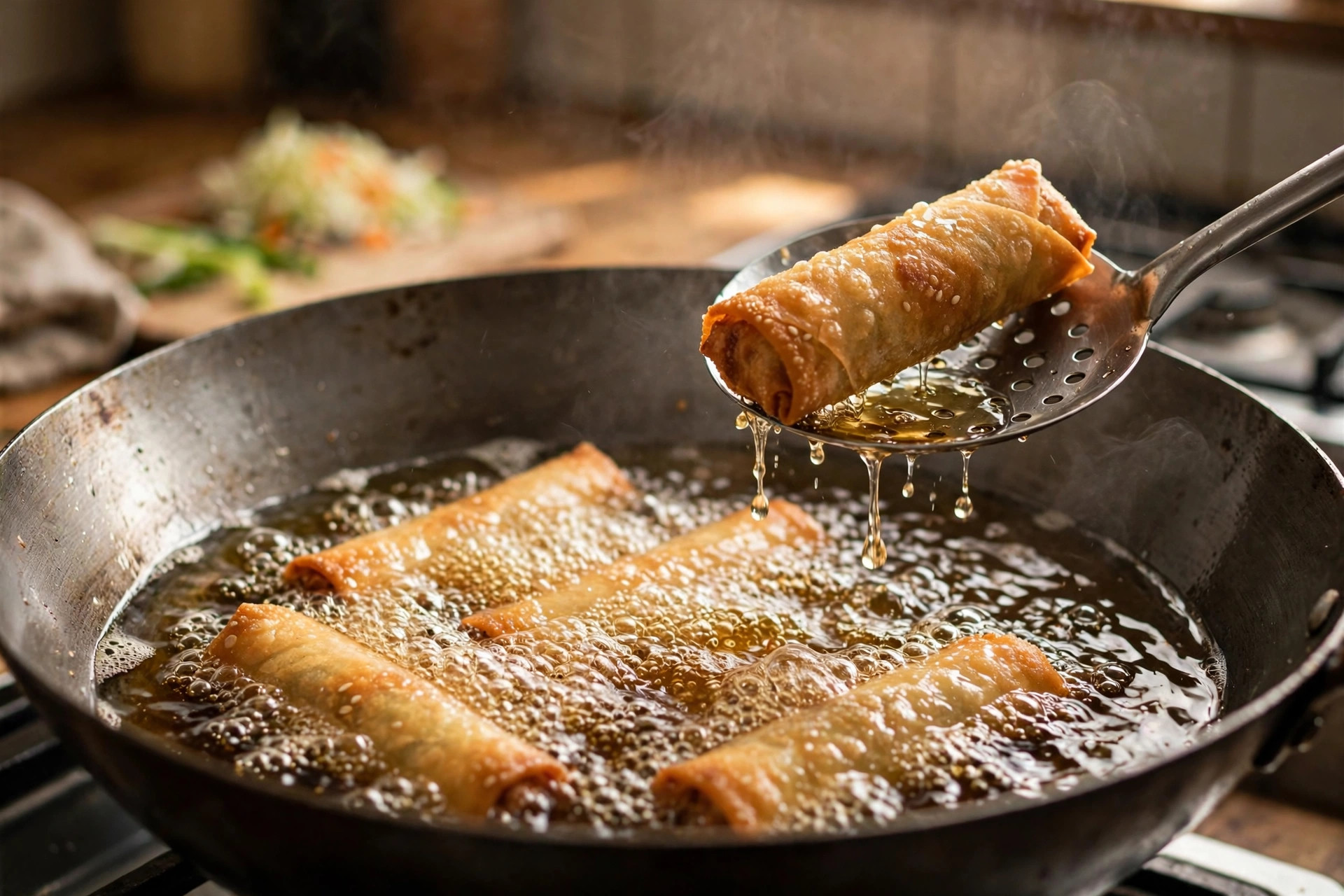
- Spring rolls fry fast and hot, around 375°F (190°C), for just 2–3 minutes. The thin skin crisps almost instantly; any longer and the delicate filling overcooks. They can also be baked, steamed, or served fresh and unfried, depending on the regional style.
- Egg rolls need a longer fry — 4–5 minutes at about 350°F (175°C) — because that thick dough has to cook through without the outside burning. They’re almost always deep-fried (traditionally in a wok), though baked and air-fried versions exist for the oil-conscious.
- Oil absorption follows the wrapper: the thick egg roll shell soaks up roughly 40–60 calories’ worth of frying oil; the thin spring roll shell picks up only 15–22. That’s most of the calorie gap right there.
If you’re frying at home, the sealing step differs too. Egg roll edges get sealed with beaten egg wash — the thick dough welcomes it. Spring roll wrappers are so thin that egg wash can weigh them down or scorch; a simple cornstarch-and-water slurry works better. And keep spring roll wrappers under a damp towel while you work. They dry out in minutes and then they crack instead of rolling.
Which One Should You Order?
Honest answer: it depends on the meal, not on some authenticity scorecard. Here’s how to think about it:
- Ordering dim sum or a multi-course Chinese dinner? Spring rolls. They’re lighter, they don’t fill you up before the main event, and they’re what the cuisine actually intended.
- It’s 11pm and you want takeout that eats like a meal? Egg roll. It’s basically engineered for that exact craving — substantial, savory, dunkable.
- Watching calories? Spring roll, and it’s not close — roughly half the calories, mostly from the thinner wrapper absorbing less oil.
- Dipping matters to you? Egg rolls were built for duck sauce and hot mustard; spring rolls shine with sharper dips. Speaking of which, here’s an easy dipping sauce that works beautifully with either.
- Feeding kids or picky eaters? Egg roll. The familiar cabbage-and-pork filling and extra crunch win over cautious eaters almost every time.
Making Them at Home: What Actually Matters
If this comparison has you wanting to try rolling your own, here’s what separates decent homemade rolls from great ones. Most of it comes down to moisture and temperature, not talent.
- Dry your filling. This is the number-one rule. Wet filling steams the wrapper from the inside, and you get soggy rolls no matter how hot your oil is. Cook the filling first, spread it on a tray, and let it cool completely — then squeeze out any liquid before wrapping.
- Don’t overfill. Two tablespoons is plenty for a spring roll; three for an egg roll. An overstuffed roll won’t seal, and it bursts in the fryer. The wrapper should close with room to spare.
- Roll tight, seal well. Roll like a burrito — fold the sides in, roll firmly to push out air pockets, and seal the final edge with your slurry or egg wash. Air pockets become oil pockets.
- Oil temperature is everything. Too cool and the rolls absorb grease and go limp; too hot and the outside burns before the inside cooks. A thermometer is worth it: 375°F for spring rolls, 350°F for egg rolls. No thermometer? Drop in a small piece of wrapper — it should sizzle actively and turn golden in about 30 seconds.
- Don’t crowd the pot. Adding too many rolls at once crashes the oil temperature. Fry in small batches and let the oil recover between them. Your patience shows up directly in the crunch.
Don’t Confuse Them With These
The roll family is bigger than these two, and menus don’t always help. Quick field guide:
Summer rolls (gỏi cuốn) are the Vietnamese fresh rolls — soft, translucent rice-paper wrappers, never fried, filled with herbs, vermicelli, shrimp, and pork, served cold with peanut sauce. If it looks like you can see through it and it’s served at room temperature, it’s a summer roll, not a spring roll.
Lumpia is the Filipino cousin — usually smaller and thinner than Chinese spring rolls, with a devoted following and both fresh and fried versions. Popiah is the soft, fresh, burrito-like roll popular in Taiwan, Malaysia, and Singapore. All delicious, all different.
The through-line: Asia has been wrapping food in thin dough for a very, very long time. The egg roll is just the newest branch on a very old tree — and as CiCi Li’s visual guide shows, once you learn the wrapper test, you can ID every one of them on sight.
Frequently Asked Questions
Are egg rolls actually Chinese?
No — egg rolls are Chinese-American, invented in New York in the early 1930s. You won’t find them in China. The authentic Chinese original is the spring roll (chūnjuǎn).
Why are egg rolls called egg rolls if they’re mostly cabbage?
Nobody knows for sure. The leading theories: the Chinese words for “egg” and “spring” sound similar and got mixed up on menus, or southern Chinese chefs added egg to the dough when adapting to American flour. The 1979 Washington Post investigation couldn’t settle it either.
Which is healthier, spring rolls or egg rolls?
Spring rolls, by roughly half the calories (100–140 vs 200–250 per roll). The difference is almost entirely the wrapper: thick egg-roll dough absorbs far more frying oil. Fresh unfried summer rolls are lighter still.
Can you bake them instead of frying?
Yes, both — brush lightly with oil and bake hot until crisp. Egg rolls adapt better to baking thanks to the sturdy wrapper; spring rolls can dry out, so watch them closely. An air fryer splits the difference nicely.
What’s the difference between spring rolls and summer rolls?
Spring rolls are fried (or baked) in wheat wrappers; summer rolls are unfried Vietnamese rolls in soft rice-paper wrappers, served cold with peanut sauce. Different wrapper, different temperature, different meal.
So next time the menu offers both, you’ve got the full picture: the thousand-year-old original with its shattering shell, and the 1930s New York remix with its blistered crunch. Order the spring roll when you want delicacy, the egg roll when you want dinner. And if anyone at the table mixes them up, you now know exactly how to settle it — just point at the wrapper.