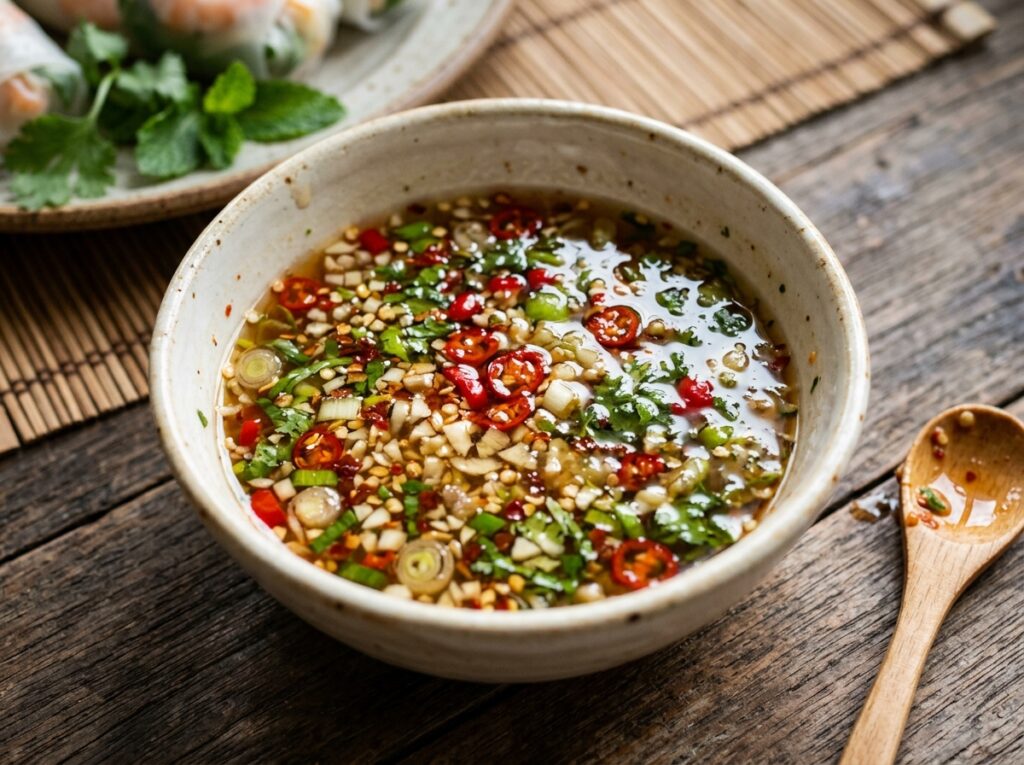
Ask a Vietnamese chef what the nation’s true signature dish is, and you’ll get dozens of answers—phở, bún bò Huế, bánh mì. But those of us who’ve spent years living and working inside real Vietnamese kitchens will tell you: the foundation hiding in plain sight is nước chấm dipping sauce.
What most outsiders call a “Vietnamese fish sauce dip” is actually something deeper: a microcosm of Vietnamese philosophy. In nước chấm—that perfect, translucent amber liquid—you taste the entire logic of the cuisine itself: balance, restraint, and rhythm. It’s where heat meets coolness, sweetness counteracts acid, and salt hums quietly underneath.
In my decades working from the coastal fish market in Phan Thiết to high-end Vietnamese restaurants in Los Angeles, I’ve seen how nước chấm acts as culinary punctuation—turning quiet ingredients into conversation. It’s as central to Vietnam as soy sauce is to East Asia or chimichurri is to Argentina—only more variable, more personal, and more alive.
This is not a sauce recipe; it’s a practiced language.
1. What Is Nước Chấm?
Technically, nước chấm translates as “dipping liquid.” But Vietnamese nước chấm dipping sauce represents a broad family, not one recipe. It’s any balanced mixture of fish sauce (nước mắm), water, sugar, acid (lime or vinegar), and aromatics like chili and garlic.
The most classic form—the one served with spring rolls, grilled meats, or vermicelli bowls—is nước chấm for dipping, a harmonious mix that balances the four core Vietnamese flavor dimensions:
- Mặn (salty) – delivered by fish sauce
- Chua (sour) – from lime juice or rice vinegar
- Ngọt (sweet) – from sugar or palm syrup
- Cay (spicy) – from chili
But here’s the insider truth: every region of Vietnam speaks this sauce with a different accent.
| Region | Distinguishing Feature | Acidity | Sweetness | Signature Use |
|---|---|---|---|---|
| Northern (Hà Nội) | Uses mild vinegar rather than lime | Gentle | Low | Fried spring rolls (nem rán) |
| Central (Huế) | More chili, more salt | High | Moderate | Rich meats, seafood |
| Southern (Sài Gòn) | Adds copious sugar and garlic | Moderate | High | Fresh spring rolls, grilled pork (bún thịt nướng) |
These variations show how regional microclimates—temperature, fish species, available citrus—literally shape the flavor dialects of nước chấm.
In a Saigon kitchen, you can identify a grandmother’s home province simply by tasting her dipping sauce.
2. The Anatomy of Flavor: How Nước Chấm Balances Chemically and Emotionally
As chefs, we think of nước chấm dipping sauce not by ingredients, but by equilibrium. The balance happens both chemically and emotionally.
Chemical Harmony
Each core element modifies another:
| Component | Function | Interaction |
|---|---|---|
| Fish Sauce (Nước Mắm) | Provides salinity and glutamates (umami) | Salt amplifies sweetness; glutamates enhance aroma |
| Sugar | Masks fishy notes; contributes body | Bonds with acid for tart brightness |
| Lime or Vinegar | Adds brightness; neutralizes excess salt | Reacts with amines in fish sauce for mellow finish |
| Chili and Garlic | Brings heat and volatile aroma | Intensifies initial perception of salt and acidity |
| Water | Dilation agent | Controls intensity, enabling longer palate finish |
The dynamic equilibrium of nước chấm means it evolves in real time. Add garlic too early, its sulfur blooms too strong; add lime before sugar dissolves, you lose smoothness. Timing is craft.
Emotional Chemistry
In high-end Vietnamese kitchens, younger cooks are taught to “listen with your tongue.” You taste once, feel where the imbalance lies, then correct not mathematically but intuitively. If heat dominates, add sweetness; if it’s flat, squeeze a touch more lime.
That’s what separates a recipe follower from a sauce maker.
3. Authentic Nước Chấm Dipping Sauce Recipe (Professional Formula)
Let’s move into the tangible craft. This is my professional recipe for nước chấm dipping sauce adapted from decades in restaurant settings:
Base Formula (standard southern balance)
| Ingredient | Amount | Purpose |
|---|---|---|
| Fish sauce (Vietnamese) | 3 Tbsp | Salt, umami |
| Sugar | 3 Tbsp | Sweet balance |
| Water | 6 Tbsp (warm) | Dilution base |
| Lime juice | 1 Tbsp | Tartness |
| Garlic | 1 clove, minced fine | Aroma, complexity |
| Bird’s eye chili | 1 small, sliced thin | Heat, aroma lift |
Process:
- Dissolve sugar in warm water first—this ensures even sweetness.
- Add fish sauce and stir gently (never whisk; whisking makes it cloudy).
- Add lime juice last to preserve brightness.
- Fold in garlic and chili right before serving—this releases volatile oils precisely at the table.
Taste immediately and note: the first impression will feel saltier than expected; wait five minutes. As acids relax, the sauce becomes round. That’s why experienced chefs prepare nước chấm five to ten minutes before service, never earlier.
4. Nước Chấm for Different Dishes – The Culinary Rosetta Stone
Every variation of Vietnamese nước chấm dipping sauce aligns to specific dishes—each requiring micro-adjustments.
| Dish | Sauce Adjustment | Reason |
|---|---|---|
| Gỏi cuốn (Fresh Spring Rolls) | Add ½ Tbsp more sugar, ½ Tbsp more lime | Needs liveliness against herbs |
| Chả giò (Fried Nem Rolls) | Add 1 Tbsp vinegar; reduce sugar | Cuts through oil via sharper acid |
| Bún thịt nướng (Grilled Pork Vermicelli) | Leave ratio balanced; serve with crushed peanuts floating on top | Complements caramelized pork |
| Seafood (Steamed Fish, Shrimp) | Add minced ginger substituting half garlic | Masks brine aroma, accentuates sweet acetates |
| Vegetarian Dishes | Replace fish sauce with soy or tamari, +drop sesame oil | Replicates savory without marine source |
Professional kitchens pre-batch three base sauces (sweet, balanced, tart), then finish-season per order—example of mise en place efficiency.
5. Chef’s “Rule of Thirds” – A Formula That Saves You from Measuring Tools
In restaurant rush, nobody measures tablespoons. We use what I call the Rule of Thirds:
- ⅓ sweet (sugar-water solution)
- ⅓ salty (fish sauce)
- ⅓ sour (lime or vinegar)
Then garnish to perception with garlic and chili.
This fluid formula adapts regionally and lets any cook adjust without math. That’s why villagers can make astonishing nước chấm from muscle memory alone.
During my consulting work in Hội An, I watched a 70-year-old cook “measure” by chopstick dip—she’d double-tap fish sauce droplets into water until it smelled correct. When professional chefs achieve that sensory literacy, they’ve entered Vietnamese mastery.
6. The Five Common Mistakes Home Cooks Make
| Mistake | Outcome | Pro Fix |
|---|---|---|
| Adding lime before sugar dissolves | Grainy texture, uneven flavor | Always dissolve sugar first in warm water |
| Using Western fish sauce brands | Harsh salt, chemical aroma | Look for Phú Quốc or Phan Thiết 35° N fish sauce |
| Overpowering garlic early | Sulfur smell dominates | Add garlic-chili right before serving |
| Ignoring resting time | Too salty upfront | Allow 5–10 minutes maturation |
| Over-whisking | Cloudy appearance | Gentle stirring for clarity |
When I train staff, I tell them nước chấm should sparkle like amber tea. That’s visual purity achieved only through stillness.
7. How to Make Nước Chấm Dipping Sauce in Under 5 Minutes (Restaurant Workflow)
Every chef develops an efficiency hack. Mine? Concentrated base and rapid dilution.
- Prepare concentrated stock: Combine 1 cup fish sauce + 1 cup sugar.
- Refrigerate. This keeps indefinitely because sugar preserves.
- At service, whisk 1 Tbsp base + 1 Tbsp lime juice + 2 Tbsp water per portion, then add chili‑garlic garnish.
This batch method allows Vietnamese restaurants to serve hundreds of orders without flavor drift. It’s how crowded bún stalls maintain consistent brilliance.
8. Understanding Your Fish Sauce—The Unsung Hero
Fish sauce quality defines nước chấm. Always choose brands derived from anchovy and sea salt only—no hydrolyzed protein or fructose.
Top-Tier Vietnamese Fish Sauce Brands
- Red Boat 40° N – Phú Quốc origin; clean, caramel-sweet note
- Khải Hoàn – Traditional barrel fermenter; bold aroma, strong umami finish
- Three Crabs – Diaspora favorite; slightly sweeter, consistent for northern dishes
Why nitrogen number matters: The ° N refers to total amino nitrogen—correlation to umami depth. 35° N+ signals high-quality first press.
A good fish sauce should smell oceanic, not rotten. Hold spoonful near nose—top note should remind you of tide water and caramel, not ammonia.
9. Serving Presentation – How Professionals Serve Nước Chấm
Contrary to internet myth, Vietnamese dining rarely pours nước chấm over everything indiscriminately. We portion by ritual and respect.
At street stalls: small saucers, individualized.
At upscale restaurants: poured tableside into glass bowls or mini pitchers.
Temperature: Serve at room temp, not cold—refrigeration dulls aromatic volatility.
Visual Garnish: Thinly sliced chili rings form a floating garland; minced garlic settles slowly like snow. Every layer contributes to sensory expectation before the first taste.
In Saigon fine dining, servers swirl nước chấm clockwise as centerpiece choreography—small artistic details Western managers rarely catch but Vietnamese diners always notice.
10. The Dual Life of Nước Chấm – Dip and Dressing
One of the sauce’s greatest flexes is its dual function: dipping and dressing.
As dipping sauce, intensity matters—you want salt-edge contrast.
As dressing for vermicelli or salads, dilution deepens experience.
Professional ratio for dressing version: 1 part fish sauce : 2 parts water. Add crushed roasted peanuts or fried shallot oil for extra body.
At our restaurant kitchens, we pre‑blend two versions: “short sauce” (dipping) and “long sauce” (mixing). Both stem from same batch, transformed by water level.
11. Modern Twists: Innovation Without Betrayal
True innovation in Vietnamese cuisine respects logic while expanding context. Here are contemporary variations used in global Vietnamese fusion menus:
| Variation | Substitute | Use Case |
|---|---|---|
| Honey‑Lime Nước Chấm | Replace sugar with honey | Roasted duck, grilled eggplant |
| Tamarind Nước Chấm | Add 1 tsp tamarind pulp | Fried seafood appetisers |
| Coconut‑Water Nước Chấm | Swap water for coconut water | Southern grilled pork—subtly sweeter, tropical tone |
| Ginger‑Garlic Nước Mắm Gừng | Add minced ginger equal to garlic | Boiled chicken (gà luộc) |
| Chili‑Pineapple Nước Chấm | Add pineapple juice | Modern bar snacks; shrimp fritters |
During consultancy at a luxury resort in Phú Quốc, we created a passion‑fruit nước chấm that paired with grilled calamari—61% guest approval in feedback cards, the highest sauce rating on menu. Why? It respected the structural balance of the original while layering local produce identity.