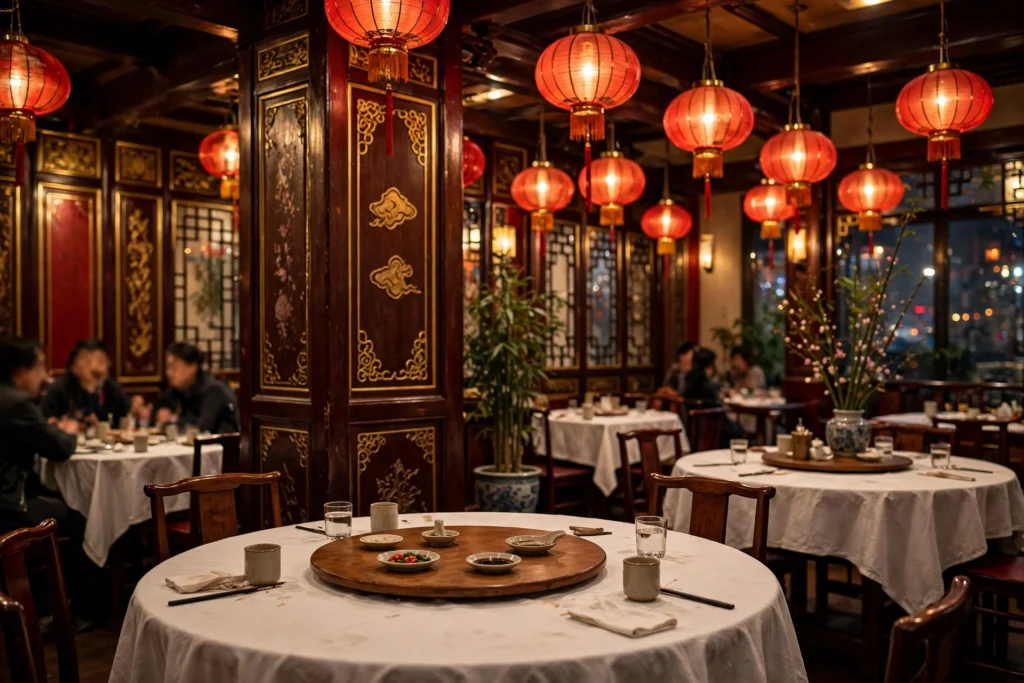
Walk into almost any Chinese restaurant in the world — a white-tablecloth banquet hall in Shanghai, a strip-mall takeout joint in Ohio, a dim sum parlor in Sydney — and you’ll see it. Red lanterns glowing over the door. Gold characters on the sign. Red walls, red tablecloths, gold trim on everything that can hold trim. It’s so consistent that it starts to feel like a franchise brand guide, as if every Chinese restaurant on earth got the same memo.
There was no memo. What you’re looking at is several thousand years of symbolism, doing quiet work on your appetite. In Chinese culture, colors aren’t decoration. They’re language. And red and gold together say two things every restaurant wants you to feel: celebrate and prosper. This guide breaks down what each color actually means, the monster legend that helped red take over, why gold shows up wherever money changes hands, and the colors you’ll notice are missing — which turn out to be just as meaningful.
Red Is the Color of Celebration — and Protection
If Chinese culture had to pick one color to represent itself, it would be red. Red is tied to the element of fire, to summer, to vitality and fertility. It’s the color of weddings — Chinese brides traditionally wear red, not white — and of every festival worth celebrating. But red does double duty: it doesn’t just announce joy, it actively protects it. Red is believed to ward off evil spirits and bad luck, which is why you’ll see it painted on front doors, tied around children’s wrists, and hanging in the entryway of just about every Chinese restaurant you’ve ever entered.
That protective streak is why red shows up before the celebration even starts. A restaurant hangs red at its entrance for the same reason a family pastes red paper charms on their door: to make sure only good fortune walks in. Linda Mandarin’s guide to color symbolism in Chinese culture notes that decorating with red is specifically believed to keep evil away — so those lanterns over the door are working as bouncers, not just lighting.
The Monster That Made Red Famous
Every culture has an origin story for its favorite color, and China’s is a good one. Long ago, the legend goes, a beast called Nian would crawl out of the sea (or down from the mountains, depending on who’s telling it) once a year to terrorize villages — eating crops, livestock, and, in the scarier versions, children. The villagers discovered three things Nian couldn’t stand: loud noise, bright light, and the color red.
So they fought back with all three at once. They pasted red paper charms on every door and window, set off deafening firecrackers, and lit the night up until the beast fled for good. The night Nian was defeated became the first Chinese New Year, and red became the color of the victory — proof, renewed every year, that the household had survived into another spring.
Whether or not you buy the monster, the story explains something real: why red in Chinese culture is inseparable from new beginnings. Red doesn’t just mean “happy.” It means “we made it through, and we’re still here.” A restaurant drenched in red is borrowing that feeling — come in, sit down, you’re safe here, let’s eat. Sartle’s Lunar New Year piece tells the Nian story with exactly the right amount of monster-movie enthusiasm, if you want the full version.
Gold Means Wealth — Literally
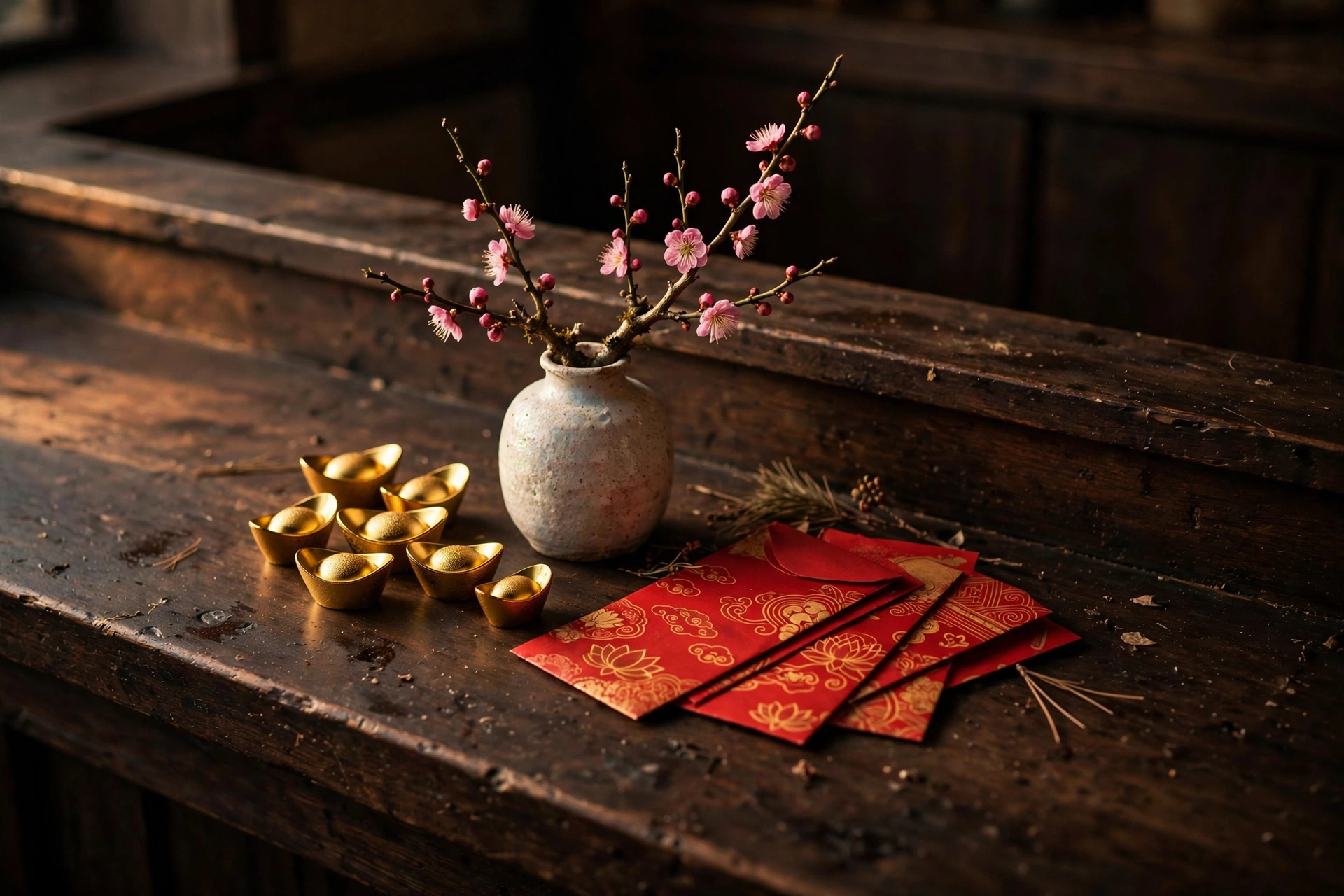
If red is the party, gold is the paycheck. In Chinese culture, gold symbolizes wealth, prosperity, and the riches passed down from ancestors. It’s not an abstract “abundance mindset” thing, either — it’s concrete. The classic gold yuanbao, those little boat-shaped ingots you’ll see as decorations, were actual currency in imperial China. When a restaurant puts golden ingots by the register, it’s making about as subtle a statement as a bank putting a vault in the window.
Gold also carries imperial weight. For centuries, yellow-gold was the emperor’s color — the roofs of the Forbidden City blaze with golden tiles for exactly this reason, and commoners were once forbidden from wearing it. Using gold in a restaurant borrows a little of that majesty. It says this place is first-class, even if you’re paying fifteen dollars for lunch.
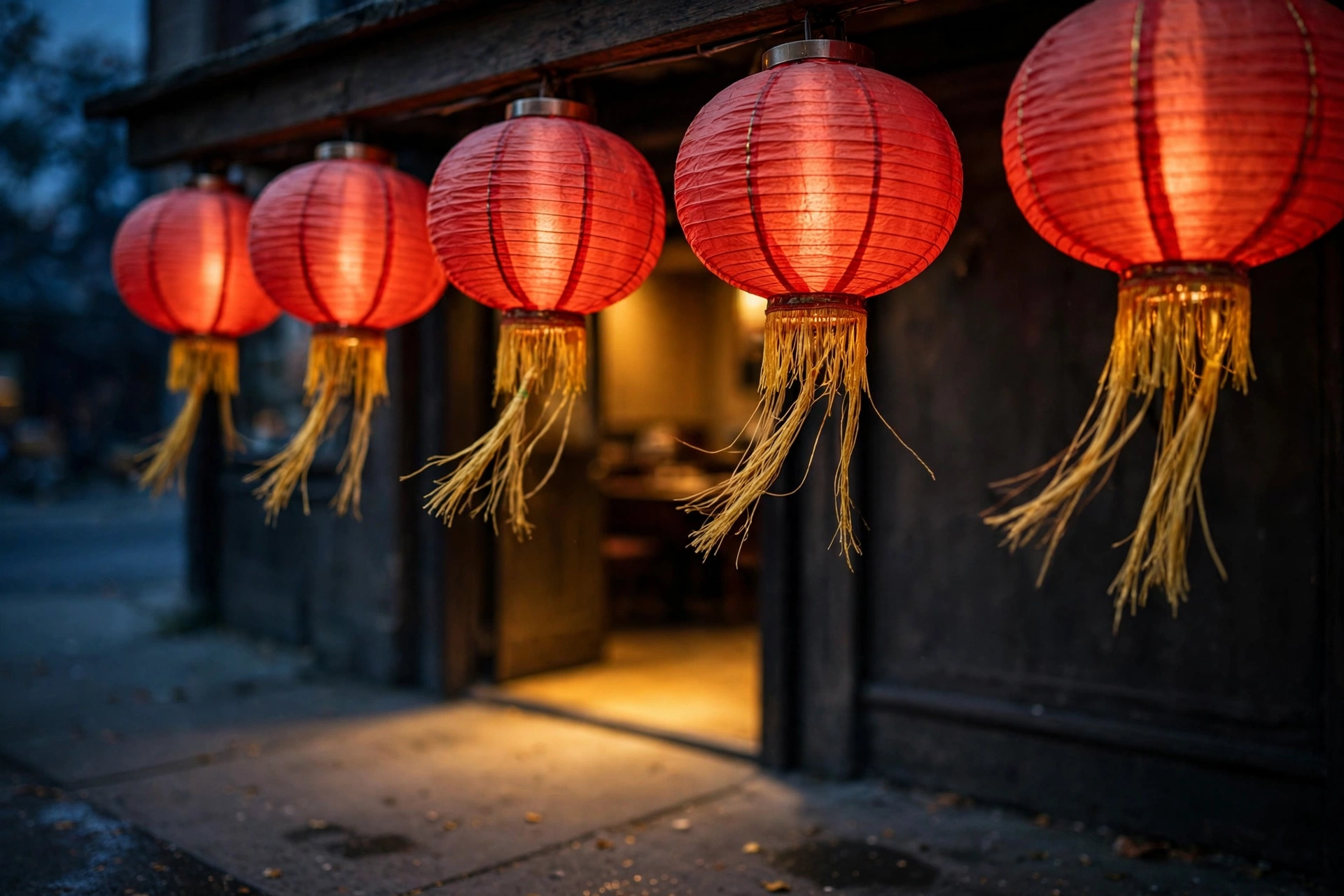
And the pairing matters. Red on its own means joy; gold on its own means wealth. Put them together — red envelopes with gold patterns, gold characters on a red sign, a red lantern with golden tassels — and the message becomes a complete wish: may you be happy and may you prosper. That’s the sentence written on the walls of nearly every Chinese restaurant in the world, in a language older than the building.
Where You’ll Spot the Pair Inside a Restaurant
Once you know what you’re looking at, a Chinese restaurant reads like a treasure map. Here’s a field guide to the red and gold you’ll find on a typical visit:
- Lanterns at the entrance. Red paper lanterns — often with golden tassels — mark the door as a place of celebration. In feng shui terms, a bright, welcoming entrance draws in good energy (and customers).
- The sign. Gold characters on a red background is the classic combination: prosperity announced with joy. Even modern minimalist Chinese restaurants usually keep some version of it.
- Spring couplets by the door. Red paper banners with gold calligraphy (chunlian) flanking the entrance carry New Year wishes for fortune and happiness. Many restaurants leave them up all year.
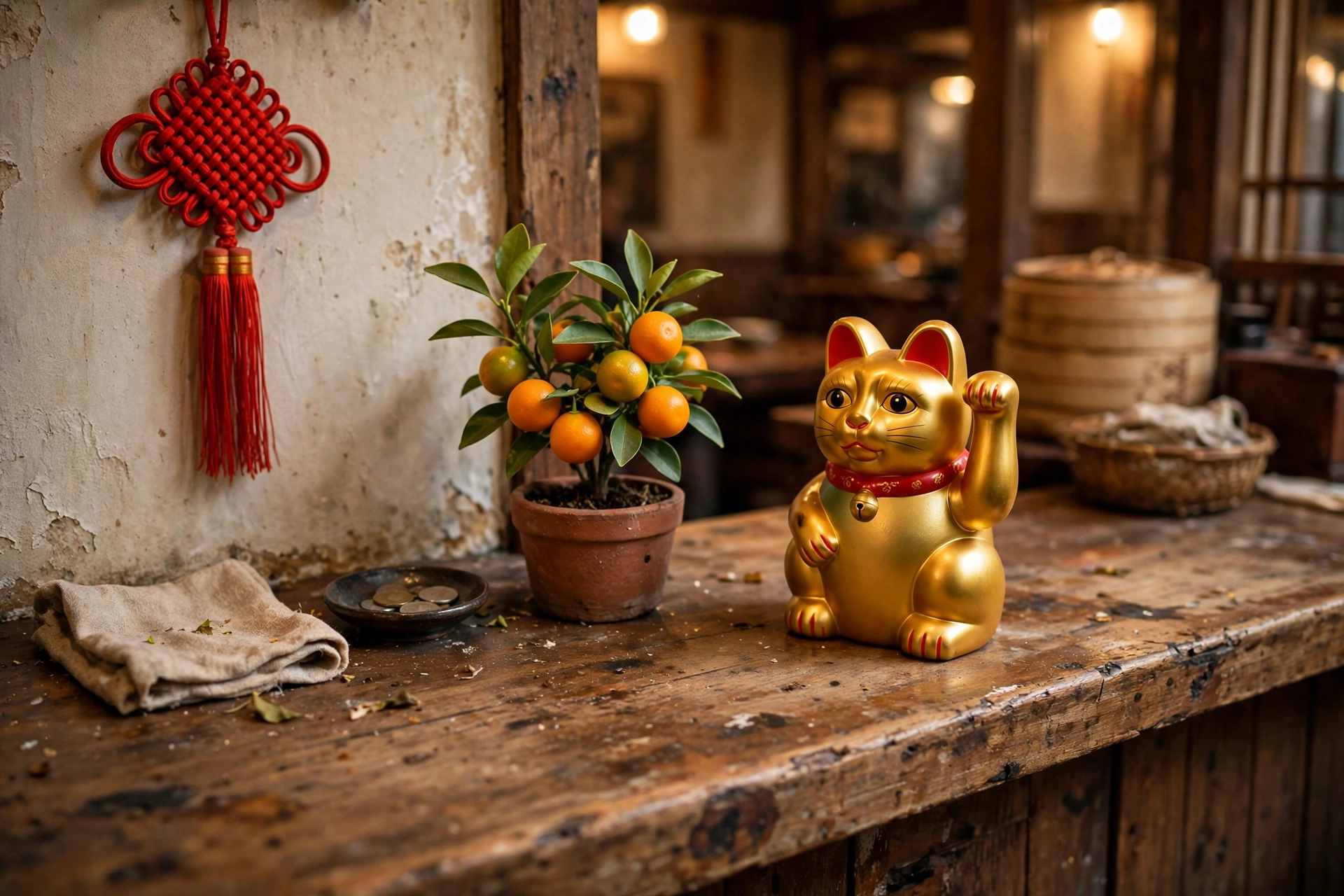
- The cashier counter. This is the wealth corner of the restaurant, and it’s decorated like one: a golden beckoning cat, miniature gold ingots, a red knotted ornament on the wall. The money-handling spot gets the money colors.
- Kumquat and tangerine plants. The gold-orange fruit symbolizes wealth (the Cantonese word for tangerine sounds like “luck”), and the green leaves add life. You’ll spot them near entrances, especially around the New Year.
- Banquet rooms. Wedding and New Year banquet rooms go all-in: red tablecloths, gold chair covers, red napkins folded into fans. A Chinese wedding banquet is basically red and gold turned up to eleven.
None of this is accidental, and none of it is just for tourists. A Chinese takeout spot in a suburban strip mall and a grand banquet hall in Guangzhou are speaking the same visual language — one just has a bigger budget for lanterns.
The Colors You’ll Never See — and Why
The fastest way to understand red and gold is to notice what’s missing. Chinese restaurants are almost never decorated in white, and that’s not a design preference. It’s a taboo.
| Color | What it means | Where it shows up in restaurants |
|---|---|---|
| Red | Joy, good fortune, celebration, protection from evil | Everywhere: lanterns, walls, tablecloths, signage, envelopes |
| Gold | Wealth, prosperity, imperial prestige | Trim, characters on signs, ingot decorations, tassels |
| White | Mourning, funerals, death | Nowhere — white is the color worn at Chinese funerals |
| Green | Health, nature, vitality | Sparingly: plants, jade accents, vegetable garnishes |
| Black | Water element; also associated with misfortune in some contexts | Rarely as a main color; sometimes in modern minimalist spots |
White is the big one. In the West, white means weddings and purity. In China, white is the color of mourning — it’s what people wear to funerals. A Chinese restaurant decorated mostly in white would feel, to a Chinese customer, the way a Western restaurant decorated mostly in black crepe would feel to you. Technically possible. Deeply unsettling.
This is also why Chinese brides wear red and why red envelopes (hongbao) carry New Year money: the color itself is part of the gift. A white envelope of cash would be an insult, not a present. The art of gift-giving in Chinese culture runs on rules like this, and color is one of the strictest.
Feng Shui: Why Red Also Makes Good Business Sense
There’s a practical layer under the symbolism, and restaurant owners know it. In feng shui, red belongs to the fire element — it creates excitement, energy, and appetite. Warm colors genuinely make people feel hungrier and eat faster, which is why fast-food chains worldwide (not just Chinese ones) lean on red and yellow. A red dining room turns tables over. That’s not superstition; it’s psychology wearing a silk robe.
Chinese restaurant feng shui goes further, treating the whole space as an energy system. The entrance should be bright and welcoming to draw in qi (and foot traffic). The cashier area — the “wealth corner” — gets red accents and golden objects like ingot figurines to symbolically grow income. Warm lighting around 3000K keeps the glow cozy and appetite-friendly, while harsh white light is avoided for feeling cold and sterile. The China Journey’s restaurant feng shui guide walks through the full playbook, from entrance design to table shapes, and red and gold show up in nearly every recommendation.
So when you see that golden cat waving at you from the counter, you’re looking at two things at once: a centuries-old wish for prosperity, and a pretty sharp piece of interior psychology. The cat waves. The red walls make you hungry. The gold trim makes the place feel worth the bill. Everybody wins.
Red and Gold Beyond the Restaurant Walls
Restaurants didn’t invent this palette; they borrowed it from the biggest celebrations in Chinese life. During Chinese New Year, entire cities turn red and gold — lanterns strung across streets, red banners on every door, gold ingots piled in shop windows. Brides wear red. Elders hand out red envelopes stuffed with cash. Even the zodiac animals that decorate New Year ornaments show up in red and gold, which is why you’ll spot Chinese zodiac symbols worked into restaurant decor in exactly those two colors.
That’s the deeper reason the restaurant look never changes: it’s not really restaurant decor at all. It’s celebration decor, on permanent display. A Chinese restaurant is telling you that eating here is an occasion — not a Tuesday-night transaction. The red and gold say your dinner matters, your family gathering matters, your presence matters. In a culture where the New Year reunion dinner is the most important meal of the year, that’s not marketing. It’s hospitality, in its native colors.
Frequently Asked Questions
Why are so many Chinese restaurants decorated in red and gold?
Red symbolizes joy, good fortune, and protection from evil, while gold symbolizes wealth and prosperity. Together they express the traditional wish for happiness and success. Restaurants use the pairing to feel celebratory and welcoming — and in feng shui, red’s fire-element energy is believed to stimulate appetite and draw customers in.
Is it bad luck for a Chinese restaurant to use other colors?
Not exactly, but some colors are avoided with good reason. White is associated with funerals and mourning in Chinese culture, so a mostly white dining room would feel funereal to Chinese customers. Modern restaurants do experiment with black, wood tones, and minimalist palettes — but they almost always keep red and gold accents somewhere, even if it’s just the sign.
What does the gold color symbolize in Chinese culture?
Gold represents wealth, prosperity, and the riches of ancestors. The gold yuanbao (boat-shaped ingots) were real imperial-era currency, so golden decorations are a direct symbol of money and abundance. Gold was also historically the emperor’s color, which adds a sense of prestige — golden touches make an ordinary space feel first-class.
Do restaurants in China still use red and gold, or is it just an overseas thing?
It’s absolutely still the norm in China, especially for banquet halls, hotpot restaurants, and anywhere hosting weddings or New Year dinners. Trendy modern spots in big cities sometimes go minimalist, but even they tend to keep red-and-gold elements at the entrance or around the cashier. The symbolism runs too deep to disappear.
What’s the story behind the red lanterns specifically?
Red lanterns combine both colors’ meanings: the red paper wards off evil and announces celebration, while the golden tassels add the wish for prosperity. They trace back to the Nian monster legend, in which red decorations helped villagers survive the beast’s annual attack — an event that became Chinese New Year. Hanging lanterns is a way of saying “we’re celebrating, and we’re protected.”
Next time you walk into a Chinese restaurant, try reading the room before you read the menu. Find the gold ingots by the cashier. Check whether the lanterns have golden tassels. Notice what’s not there — no white tablecloths at a banquet, no black walls in the dining room. You’re looking at thousands of years of wishes for happiness and prosperity, painted on the walls in the only two colors that could say it. And once you’re seated and the tea arrives, you’ll want to know how to hold your chopsticks properly — because the meal is the celebration the colors promised.