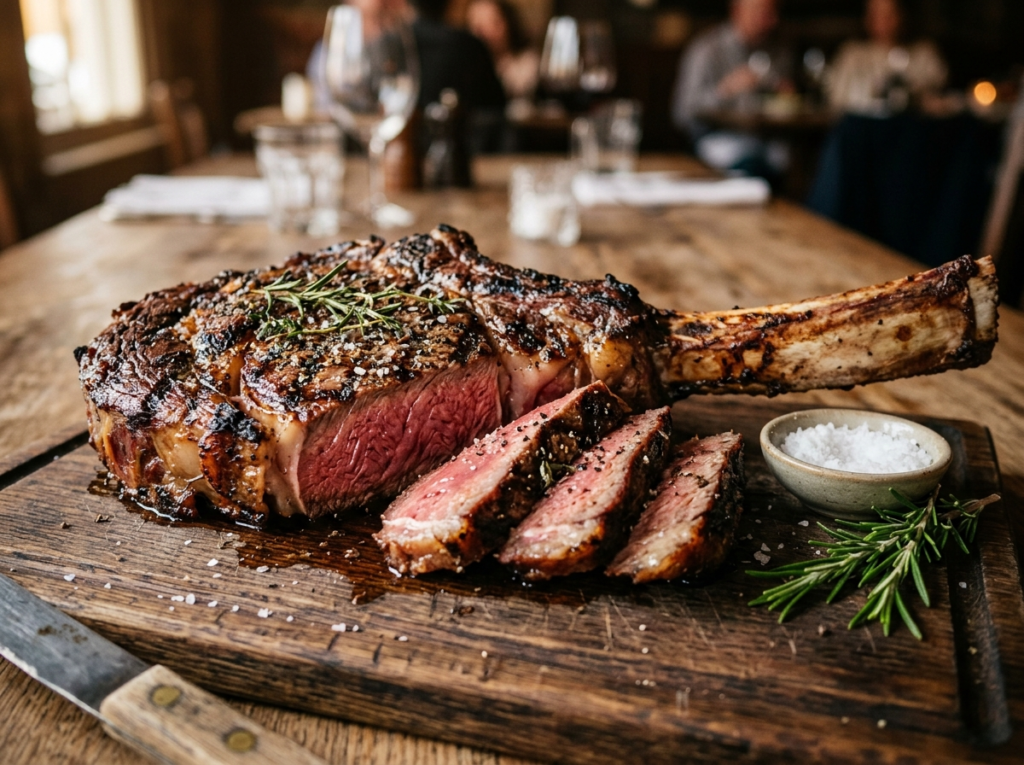
A single tomahawk steak can weigh over two pounds and sport a bone that stretches more than a foot long. It looks like something a caveman would gnaw on — and that’s exactly the point. Few cuts of beef make jaws drop the way this one does. But beyond the dramatic presentation, there’s real substance here: rich marbling, deep beefy flavor, and a bone that actually changes how the meat cooks.
If you’ve spotted a tomahawk on a steakhouse menu and wondered whether it’s worth the steep price tag — or if you’re thinking about cooking one at home — you’re in the right place. Let’s break down exactly what this cut is, where it comes from on the cow, why it costs so much, and how to cook it without ruining a very expensive piece of meat.
What Exactly Is a Tomahawk Steak?
A tomahawk steak is a bone-in ribeye that’s been “frenched” — meaning the rib bone is left long (usually 6 to 12 inches) and trimmed clean of all meat and fat. The result looks like a handle attached to a thick slab of beef, resembling a single-headed axe or, yes, a tomahawk.
That’s really the defining feature. Strip away the showmanship, and you’re eating a ribeye. The same cut, the same muscles, the same beautiful marbling. The bone is what separates a tomahawk from a standard bone-in ribeye (where the bone is trimmed short) or a boneless ribeye (where the bone is removed entirely).
The steak comes from the rib primal section of the cow, typically ribs 6 through 12. Most tomahawks are cut from ribs closer to the loin end, where the meat is most tender and well-marbled. The primary muscle you’re eating is the longissimus dorsi (the “eye” of the ribeye), along with the spinalis dorsi — often called the ribeye cap — which many butchers and chefs consider the single most flavorful muscle on the entire animal.
Quick Fact: The name “tomahawk” is a marketing term that gained popularity in the early 2000s as restaurants and butchers looked for ways to differentiate premium beef cuts. Before that, the same cut was often just called a “cowboy steak” or a “bone-in ribeye, frenched.”
Tomahawk Steak vs. Ribeye vs. Cowboy Steak: What’s the Difference?
People mix these terms up constantly, and honestly, the lines are blurry. Here’s the simple breakdown.
A boneless ribeye is the same meat with the bone removed entirely. It’s easier to cook evenly and usually cheaper per pound because you’re not paying for bone weight.
A bone-in ribeye keeps the rib bone attached but trims it short — maybe an inch or two of bone sticking out. You’ll sometimes see this labeled as a “cowboy steak,” though that term gets used loosely.
A tomahawk steak keeps the full length of the rib bone, frenched clean. It’s typically cut much thicker than a standard ribeye — often 2 to 2.5 inches thick — which means it can weigh anywhere from 30 to 45 ounces.
So the flavor and tenderness? Essentially the same across all three. You’re paying for presentation, the cooking benefits of the bone, and the experience. If you’re curious about how other premium beef cuts compare, our guide to Wagyu vs. Kobe beef breaks down another set of terms that often get confused.
Why Does a Tomahawk Steak Cost So Much?
Let’s address the elephant in the room. A single tomahawk steak at a restaurant can run you $80 to $150 or more. Even at a butcher shop or online retailer, you’ll pay $40 to $100 depending on the grade and source. That’s a lot of money for one steak.
Several factors drive the price.
You’re paying for bone weight. That long frenched bone can account for 30 to 40% of the total weight. Since beef is sold by the pound, you’re essentially buying a pound or more of bone at the same per-pound price as the meat. That’s the biggest reason the sticker price looks so high compared to a boneless ribeye.
The cut requires extra butchering work. Frenching a bone — scraping it clean, trimming it perfectly — takes skill and time. That labor gets passed along to you.
Thickness matters. Because tomahawks are cut so thick, each steak uses more of the rib primal than a thinner cut would. Fewer steaks per cow means higher prices per steak.
Presentation commands a premium. Restaurants know that a tomahawk steak is an Instagram moment. People order it for the experience, and businesses charge accordingly. This is one case where you’re absolutely paying for the “wow factor.”
Does that mean it’s a rip-off? Not necessarily. The eating experience is genuinely different from a standard ribeye — the thickness allows for a better crust-to-pink ratio when cooked properly, and the bone does contribute some flavor and insulation during cooking. But if you’re on a budget and just want great ribeye flavor, a boneless cut will serve you well at a fraction of the cost.
How to Pick a Good Tomahawk Steak
Not all tomahawks are created equal, and spending big money on a mediocre one is a mistake worth avoiding.
Look at the marbling first. Those white streaks of intramuscular fat running through the meat are what give a ribeye its flavor and juiciness. USDA Prime grade has the most marbling, followed by Choice, then Select. For a steak this expensive, Prime or upper Choice is worth seeking out.
Check the thickness. A proper tomahawk should be at least 2 inches thick. Anything thinner and you lose the ability to get a gorgeous sear on the outside while keeping the interior at your desired doneness. If a butcher is selling “tomahawks” that look more like regular bone-in ribeyes, that’s what they are.
Examine the bone. It should be frenched cleanly — no hanging bits of meat or fat on the exposed bone. A well-prepared tomahawk looks polished. Sloppy butchering on the bone can be a sign of sloppy work elsewhere.
Consider the source. Grass-fed, grain-finished, dry-aged, wet-aged — these all affect flavor and texture. Dry-aged tomahawks have a more concentrated, nutty, almost funky beef flavor. Grain-finished cattle tend to produce more marbling. There’s no single “best” option here; it depends on your taste preferences.
Pro Tip: If you’re buying from a butcher, ask them to cut the tomahawk to your preferred thickness. Most will happily do this. Two and a half inches is a sweet spot that gives you maximum control during cooking.
How to Cook a Tomahawk Steak
Here’s where things get interesting — and where a lot of people go wrong. A tomahawk steak is not something you cook the same way you’d cook a regular 1-inch steak. The thickness changes everything.
The Reverse Sear Method (Best for Most Home Cooks)
The reverse sear is widely considered the best technique for thick steaks, and it’s become the gold standard for tomahawks among both professional chefs and home grillers. The idea is simple: cook low and slow first to bring the interior up to temperature, then blast it with high heat at the end for the crust.
Step 1: Temper the steak. Take it out of the fridge 45 to 60 minutes before cooking. A steak this thick needs time to lose its chill. Cooking it straight from the fridge means the outside will overcook before the center catches up.
Step 2: Season generously. At minimum, use coarse salt and freshly cracked black pepper. The surface area on a tomahawk is huge, so don’t be shy. Some cooks add garlic powder or a steak rub, but salt and pepper alone work beautifully with high-quality beef.
Step 3: Low and slow. Place the steak on an oven rack or on the indirect heat side of your grill. Set the temperature to 250°F (120°C). Cook until the internal temperature reaches about 10 to 15 degrees below your target doneness. For medium-rare (final target of 130°F / 54°C), pull the steak when it hits around 115–120°F (46–49°C).
This phase can take 45 minutes to over an hour, depending on the steak’s thickness and starting temperature. Don’t rush it. Use an instant-read meat thermometer — guessing with a steak this expensive isn’t worth the risk.
Step 4: Sear it hard. Heat a cast iron skillet, grill grate, or chimney starter to screaming hot. Sear the steak for about 1 to 2 minutes per side until you get a deep, dark brown crust. If you’re using a skillet, add butter, fresh thyme, and crushed garlic in the last 30 seconds and baste the steak.
Step 5: Rest. Let the steak rest for at least 10 minutes before cutting. A thick cut like this holds a lot of heat, and resting allows the juices to redistribute. Cut into it too soon and those juices end up on your cutting board instead of in your mouth.
⚠️ Food Safety Note: The USDA recommends cooking whole cuts of beef to a minimum internal temperature of 145°F (63°C) with a 3-minute rest. Many steak lovers prefer medium-rare at 130–135°F, which falls below this guideline. If you’re cooking for anyone with a compromised immune system, pregnant individuals, young children, or elderly family members, follow the USDA recommendation. Always use a calibrated meat thermometer to verify temperature.
Grilling a Tomahawk Steak
If you’d rather do everything on the grill, set up a two-zone fire. One side of the grill should be hot (direct heat), and the other side should have no coals or burners lit (indirect heat).
Start the steak on the indirect side with the lid closed. Monitor the internal temp the same way you would in an oven. Once it’s 10 to 15 degrees below your target, move it to the hot side and sear aggressively. The bone acts as a bit of a handle here, making it easier to maneuver.
One nice trick: position the bone side over the direct heat during the low-and-slow phase. The bone insulates the meat near it, which helps the steak cook more evenly.
If you enjoy grilling thick cuts of meat, you might also like our guide to Korean short ribs (kalbi), which uses a completely different approach to bone-in beef on the grill.
Can You Pan-Sear a Tomahawk?
Technically, yes. Practically, it’s awkward. The long bone makes it hard to get the steak flat in most pans, and the thickness means pan-searing alone won’t cook the interior properly. If a pan is all you have, sear it on the stovetop first, then transfer the whole pan (use cast iron or another oven-safe option) to a 250°F oven to finish. It’s essentially the reverse sear in reverse order — sometimes called the “traditional sear and finish” method.
Sous Vide and Finish
For the ultimate in precision, cook the tomahawk sous vide at your exact target temperature (130°F for medium-rare) for 2 to 4 hours. Then pat it dry — really dry — and sear it in a ripping-hot cast iron pan or over a charcoal chimney. This method gives you edge-to-edge perfection with zero guesswork. The only downside is the time investment and needing a sous vide circulator.
What to Serve With a Tomahawk Steak
A steak this bold can handle equally bold sides, but it also shines with something simple that lets the beef take center stage.
Classic steakhouse sides work perfectly: creamy mashed potatoes, roasted asparagus, sautéed mushrooms, or a crisp Caesar salad. A compound butter — think garlic and herb, or blue cheese — melting on top of the finished steak adds another layer of richness.
If you want to go in a slightly different direction, think about sides with some acidity to cut through all that beefy richness. A simple arugula salad with lemon vinaigrette works wonderfully. So do quick pickled vegetables, which add a tangy crunch that balances the heavy, savory flavors of the meat.
For something heartier, roasted bone marrow, creamed spinach, or truffle fries are all steakhouse classics for a reason — they’re rich enough to stand alongside a tomahawk without getting lost.
How to Slice and Serve a Tomahawk
One tomahawk steak comfortably feeds two people, sometimes three. You don’t serve it like a regular steak — this isn’t a one-plate, one-person deal.
Here’s the best approach: after resting, lay the steak flat on a large cutting board. Use a sharp carving knife to cut the meat away from the bone in one piece, following the curve of the bone as closely as possible. Then slice the boneless piece against the grain into strips about half an inch thick.
Fan those slices out on a platter or cutting board (a wooden board looks great for presentation), and lean the bone up against the sliced meat. It’s a visual stunner — perfect for family-style dining or impressing guests.
Pro Tip: Don’t throw that bone away. It’s got marrow inside and bits of flavor clinging to it. Save it to make beef bone broth, or let someone at the table gnaw on it. No judgment.
Is a Tomahawk Steak Worth the Price?
This is the question everyone really wants answered, and the honest answer is: it depends on what you’re after.
If you’re looking for the best flavor per dollar, a boneless ribeye or even a Delmonico steak gives you essentially the same eating experience for significantly less money. You’re not paying for bone weight, and the flavor difference from the bone is subtle at best.
If you’re looking for a special occasion centerpiece — a birthday dinner, an anniversary, a holiday cookout — the tomahawk is hard to beat. Nothing else you can put on a table makes people’s eyes go wide quite the same way. The drama is real, and it’s fun.
If you love the cooking process and want to practice your skills on a premium cut, the tomahawk rewards technique. The thickness and bone create interesting cooking challenges, and nailing a perfect reverse sear on one is genuinely satisfying.
Where you should probably skip the tomahawk is a Tuesday night dinner for one, or when you’re feeding a crowd on a budget. There are smarter ways to spend your money in those situations. Something like char siu pork feeds more people for a fraction of the cost and delivers massive flavor.
Where to Buy a Tomahawk Steak
You’ve got several options, and each has trade-offs.
Local butcher shops are usually the best bet. You can see the steak before you buy it, ask for a specific thickness, and get advice on the particular animal the cut came from. Prices tend to be competitive with online retailers, and you’re not paying for overnight shipping of a perishable item.
Online meat retailers like Snake River Farms, Porter Road, Crowd Cow, and Holy Grail Steak Co. offer high-quality tomahawks shipped frozen or on ice. This is a great option if you don’t have a quality butcher nearby or want a specific grade (like USDA Prime or American Wagyu). Expect to pay $50 to $120+ per steak, plus shipping.
Wholesale clubs like Costco and Sam’s Club sometimes carry tomahawk steaks, often at lower per-pound prices than specialty retailers. Quality varies — most are USDA Choice — but the value can be excellent.
Grocery store meat counters occasionally stock them, especially around grilling season and holidays. If you see one, ask the butcher when it came in and what grade it is before committing.
If you’re interested in other specialty meat cuts and where to find them, our guide on where to buy pork belly covers some of the same sourcing strategies for another hard-to-find cut.
FAQ
How long does it take to cook a tomahawk steak?
Using the reverse sear method, plan for about 45 minutes to 1 hour in a 250°F oven or on indirect grill heat, plus 2 to 4 minutes of high-heat searing, plus 10 minutes of resting. Total time from start to plate is roughly 60 to 75 minutes. Don’t forget to factor in 45 to 60 minutes of tempering time before cooking begins.
How many people does a tomahawk steak feed?
A typical tomahawk weighs 30 to 45 ounces (roughly 2 to 3 pounds), but a significant portion of that weight is bone. You’ll usually get about 20 to 28 ounces of actual meat, which comfortably serves two adults as a main course, or three if you have generous sides.
Is the bone on a tomahawk steak just for show?
Not entirely. The bone does provide some insulation during cooking, which can create a slightly more even cook near the bone area. Some chefs believe the marrow and connective tissue around the bone add flavor to the surrounding meat, though this effect is subtle. The bigger benefit is practical: the bone acts as a natural handle for maneuvering a very heavy steak on the grill. But let’s be honest — the dramatic visual presentation is a major part of why people choose this cut over a standard bone-in ribeye.
What’s the best internal temperature for a tomahawk steak?
Most steak lovers aim for medium-rare, around 130–135°F (54–57°C), which keeps the center pink and juicy while the exterior develops a deep crust. Medium (135–145°F / 57–63°C) also works well with a richly marbled cut like this, since the fat keeps it moist even at higher temperatures. Going beyond medium on a tomahawk is generally not recommended — you lose the tenderness and juiciness that make the cut special. Remember, the USDA’s recommended minimum for whole cuts of beef is 145°F with a 3-minute rest.
Can you cook a tomahawk steak from frozen?
You can, and some people actually prefer it. Cooking from frozen (sear first, then oven) can result in a thinner band of overcooked meat beneath the crust, since the frozen interior takes longer to heat through. Just add extra time for the low-and-slow phase and rely on your thermometer, not the clock.
Your Next Move
A tomahawk steak is one of those rare foods that delivers on both spectacle and substance. It’s the same incredible ribeye you already love, just bigger, bolder, and attached to a bone that makes it unforgettable to look at.
If you’ve been thinking about trying one, pick a special occasion, find a good butcher, and commit to the reverse sear. Take your time with it. A steak like this isn’t something you rush — it’s something you enjoy from the moment you unwrap it to the last bite.
And save that bone.