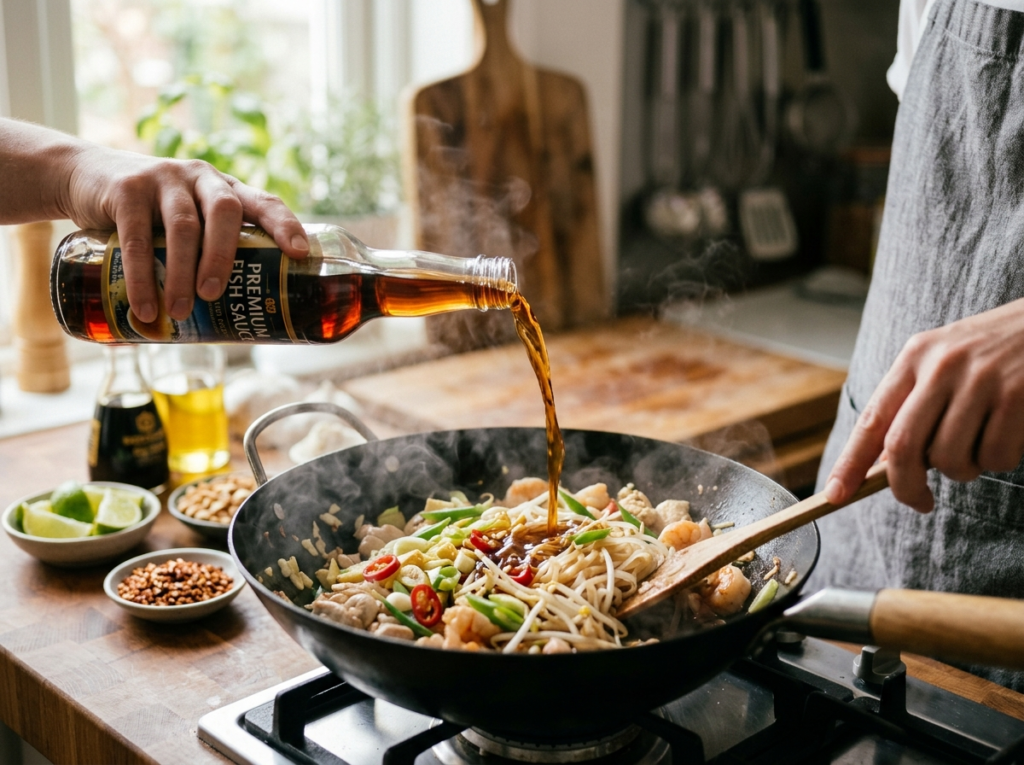
I was a young cook, maybe three years into my first real kitchen job, and I thought I knew salt. I had Maldon, I had fleur de sel, I had kosher. I was feeling pretty smug. Then the executive chef, a grizzled genius who had cooked from Paris to Saigon, watched me season a bolognese. He tasted it, nodded, and then walked over to the station. He grabbed a dark, ominous-looking bottle from the back shelf, unscrewed the cap, and dripped three drops into the pot. He stirred, tasted again, and handed me the spoon.
I took a bite. It was the same sauce, but it wasn’t. It was deeper, rounder, more… complete. It had a seismic umami shift that I couldn’t explain. “That,” he said, “is not salt. It’s liquid soul. It’s the Rosetta Stone of flavor.” That was my introduction to real fish sauce. Not the cheap, thin, watery stuff, but a complex, fermented elixir that can transform food from good to transcendent.
For two decades, that bottle has been my secret weapon. It’s in my vinaigrettes, my braises, my mayonnaise, and yes, my bolognese. Most home cooks have a bottle gathering dust in the back of the fridge, pulling it out only for a specific Thai or Vietnamese recipe. That’s a culinary crime. Today, I’m going to pull back the curtain on this misunderstood ingredient. We’re going to explore what is fish sauce, really, how to buy the best fish sauce, and how to use it in ways you’ve never imagined. This isn’t just about Asian cooking; this is about understanding the very building blocks of flavor itself.
The Alchemy in the Bottle: It’s Not Just Fermented Fish
Let’s get one thing straight. Comparing a premium fish sauce to the cheap stuff is like comparing a single-malt scotch to a malt beverage. They might technically be in the same category, but they are worlds apart. The magic lies in the process, the ingredients, and the time.
True, traditional fish sauce is an act of controlled alchemy. It starts with the freshest possible fish, almost always a specific species of anchovy called ca com in Vietnam. These are not the salty, oil-packed anchovies you get on a pizza. They are fresh, silvery, and full of oceanic flavor.
The fish are then layered with salt in enormous, earthenware vats. The salt ratio is critical—too little and the fish rots; too much and the fermentation stalls. These vats are then left to ferment in the hot tropical sun for anywhere from 12 to 24 months. During this time, enzymes from the fish’s own gut break down the proteins into free amino acids, primarily glutamates. This is the source of that profound, savory umami flavor.
Here’s the insider secret that separates the good from the great: the first press. Just like with olive oil, the first liquid drawn from these fermentation vats is the most prized. In Vietnam, this is called nước mắm nhĩ. It’s the purest, most complex, and most flavorful expression of the fish sauce. It’s amber in color, thick and viscous, with a balanced, nutty aroma that isn’t harshly “fishy.” Subsequent presses, where more water or salt brine is added to the remaining fish, yield thinner, saltier, and less complex sauces. These are the ones that give fish sauce its bad name.
When you see a bottle of Red Boat fish sauce, you’re seeing a perfect example of this philosophy. They proudly label their product as a “first press” sauce, with a high nitrogen content (a measure of umami) and only two ingredients: black anchovy and sea salt. That’s it. That’s the standard you should be looking for.
Decoding the Aisle: A Buyer’s Guide to Fish Sauce
Walking into an Asian market can be intimidating. You’re faced with a wall of bottles, all with different labels and colors. How do you choose? Don’t just grab the one with the prettiest label. You need to learn to read the language of the bottle.
| Grade/Type | What to Look For on the Label | Flavor Profile & Best Use |
|---|---|---|
| First Press (Premium) | “First Press,” “40°N” (or higher), “Ca Com” on the ingredient list. Only fish and salt. | Thick, amber, balanced, and deeply savory with a nutty finish. Best for finishing sauces, dipping sauces, and dishes where fish sauce is a star. |
| Premium/Multipurpose | May list “anchovy extract” or have a slightly lower nitrogen number (30-35°N). Might have sugar or other flavorings. | Still very good, but a bit saltier and less complex than first press. The perfect all-purpose workhorse for marinades, stocks, and general cooking. |
| Standard/Cooking Grade | Often very thin and light in color. Hydrolyzed protein or MSG may be listed in the ingredients. | Primarily salty with a one-dimensional “fishy” taste. Best used sparingly in large-batch soups or stocks where other flavors will dominate. Avoid for anything where its flavor will be pronounced. |
The key number to look for is the degrees of nitrogen (°N). This is a scientific measure of the total amino acid content, i.e., the umami level. A higher number means more flavor. Anything above 30°N is considered good. The premium stuff, like Red Boat, clocks in at 40°N.
And what about Thai fish sauce (nam pla) versus Vietnamese (nước mắm)? They are very similar, often made from the same types of fish. The main difference is regional preference in flavor balance. Thai fish sauce can sometimes be slightly saltier or have a different anchovy species, but a high-quality Thai fish sauce and a high-quality Vietnamese one are interchangeable in most applications. The key is to focus on the grade, not the country of origin.
The Culinary Philosopher’s Stone: How to Really Use Fish Sauce
If you only use fish sauce for your Pad Thai, you’re missing 90% of its potential. I think of its application in three distinct ways I call the “Three Ds”: Drip, Dash, and Drizzle.
1. The Drip (The Foundation):
This is where you use fish sauce as you would salt—as a foundational seasoning. A few drips into a liquid will transform it.
- In Soups & Stews: Add a few drips to your chicken noodle soup, your beef chili, or your French onion soup. You won’t taste “fish,” but you will taste a deeper, more savory version of the dish itself. It amplifies the existing flavors.
- In Marinades: Use it as the salt component in any marinade for chicken, pork, or beef. Its enzymatic properties also help tenderize the meat.
- In Braising Liquids: A drip into the liquid for a pot roast or braised short ribs will add an unbelievable layer of savoriness.
2. The Dash (The Umami Bomb):
This is the secret weapon. A small dash where you least expect it can create a flavor explosion.
- In Vinaigrettes: Replace half the salt in your next vinaigrette with a dash of fish sauce. It will give your salad a savory backbone that is simply addictive.
- In Mayonnaise or Aioli: Whisk a tiny dash into your homemade mayo. It creates a complex, savory dip that’s perfect for fries or seafood.
- In Savory Cocktails: I’m not kidding. A couple of dashes in a Bloody Mary or a Caesar (the Canadian one) adds a briny depth that’s out of this world.
3. The Drizzle (The Finisher):
This is where fish sauce gets to be the star, typically in a balanced sauce.
- The Classic Nước Chấm: This is the quintessential Vietnamese dipping sauce. It’s a simple, magical balance of fish sauce, lime juice, sugar, water, and fresh chili and garlic. It’s the perfect accompaniment for grilled meats, spring rolls, and rice paper wraps.
- Finishing Drizzle: A simple drizzle of high-quality fish sauce mixed with a bit of garlic oil and chopped chilies can elevate a simple bowl of rice or a piece of grilled fish into restaurant-quality fare.