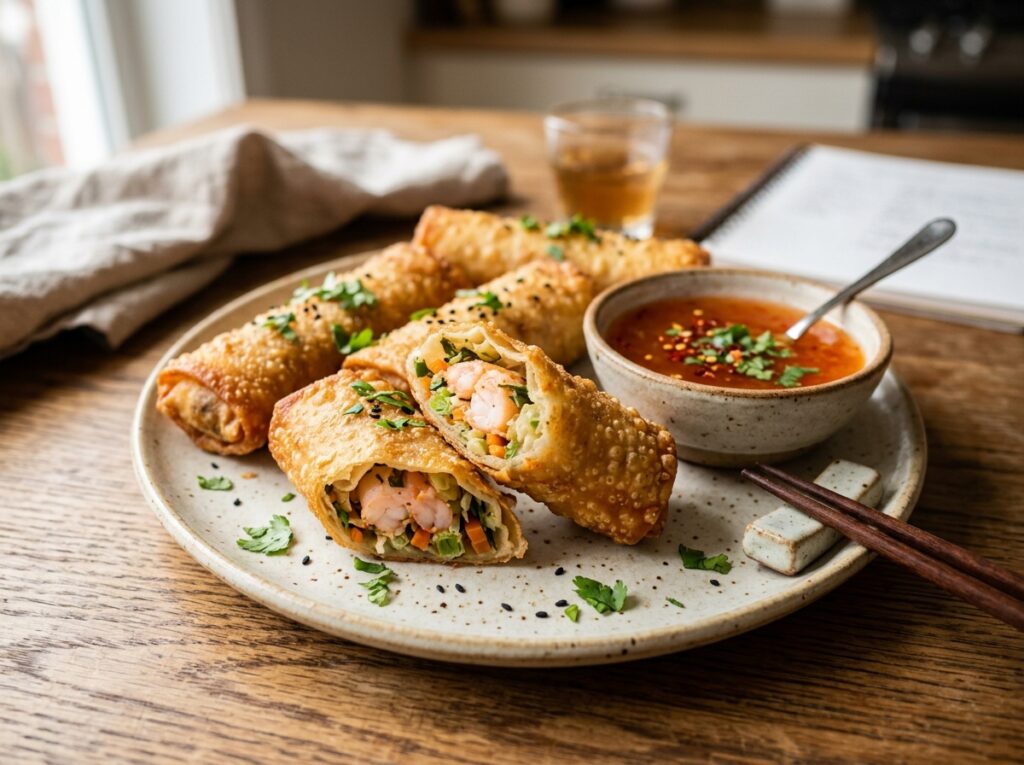
Behind every glossy restaurant menu, there’s usually one appetizer that outsells the mains during happy hour—the crispy shrimp roll. It’s unpretentious, familiar, and dangerously addictive. When I was running the fry station at a busy Thai-Vietnamese fusion kitchen in Las Vegas, we sold them by the hundreds nightly. The crunch that echoed through the dining room wasn’t just food—it was sonic branding.
Most people think of crispy shrimp rolls as just “shrimp wrapped in something fried,” but in professional kitchens, these golden cylinders are one of the ultimate tests of technical precision. Done right, they’re shatteringly crisp outside, steamy and juicy inside, with the flavor of shrimp—not grease—leading the bite.
This guide goes beyond the surface. I’ll dissect every critical element—wrapper hydration, crust physics, shrimp prep, oil strategy, and even service speed. Whether you’re replicating restaurant-level Thai crispy shrimp rolls, riffing on the famous Crispy Shrimp Rolls Grand Lux style, or inventing your own version, this insider manual will change the way you fry forever.
1. What Exactly Are Crispy Shrimp Rolls?
At their simplest, crispy shrimp rolls are shrimp (or shrimp paste mixture) wrapped in a thin pastry or rice wrapper, then deep-fried until golden brown. They originate from Southeast and East Asian street foods, merging Thai and Vietnamese banh tom ideas with Chinese spring roll technique.
But across modern Asia and contemporary American fusion restaurants, the structure morphs. You’ll see three major archetypes:
| Type | Wrapper | Shrimp Preparation | Texture Profile |
|---|---|---|---|
| Thai-Style | Spring roll pastry or wonton skin | Whole shrimp or shrimp paste with Thai herbs | Extra crisp, open-ended tubes |
| Vietnamese-Style | Rice paper | Chopped shrimp + vegetables | Lighter, translucent crunch, aromatic |
| Chinese-American Fusion | Egg roll skin | Minced shrimp, garlic, cream cheese, or sweet chili | Dense, double-fried, glossy golden crust |
The Grand Lux Cafe crispy shrimp rolls follow this third approach—tight cylindrical egg-roll wrappers filled with chopped shrimp, garlic, sometimes with cilantro and water chestnuts, served with sweet chili or citrus aioli.
What unites them all is that sound: the audible snap that precedes warmth and juicy umami shrimp flavor.
2. The Anatomy of Perfect Shrimp Roll Texture
The hallmark of a perfect shrimp roll isn’t just crispiness—it’s graduated texture. That’s what separates professional versions from home attempts.
You’re looking for three concentric layers of sensory contrast:
- Outer shell: Papery-light, clean crunch (not oily).
- Intermediate layer: Slight chew from hydrated wrapper starch.
- Core: Juicy, spring-loaded, aromatic shrimp filling.
Achieving this balance requires controlling three physical processes simultaneously: moisture migration, oil absorption, and protein contraction.
- If wrapper hydration is off, it either blisters (too dry) or flops (too wet).
- If shrimp are waterlogged, internal steam softens the crust.
- If oil temperature fluctuates, you get soggy instead of snap.
When I taught new fry cooks, I’d make them perform “audible tests”: hold a freshly fried shrimp roll near the ear. The right one gives a delicate crisp whisper, not a dull crack. That’s the difference between mastery and machinery.
3. Selecting and Prepping Shrimp – The Foundation of Flavor
A crispy shrimp roll recipe succeeds or fails long before frying. Shrimp quality dictates flavor clarity.
Best Choice:
- Wild-caught white shrimp or tiger shrimp (16/20 to 26/30 count).
- Avoid pre-brined supermarket shrimp—they taste chemical and retain too much water.
The Process
- Peel, devein, and butterfly. For whole-shrimp rolls (Thai style), remove shell but keep tail intact—it looks dramatic when extended out of the wrapper.
- Dry thoroughly. Press between paper towels. Patience here equals crispness later.
- Marinate lightly. Combine shrimp with:
- ½ tsp salt
- ¼ tsp sugar
- 1 clove garlic, crushed
- A pinch of white pepper
- (Optional) a few cilantro stems or lemongrass slices for fragrance
- Chill 15 minutes only.
Pro tip: Salt firms proteins slightly; over-marination toughens shrimp. Keep it brief—this isn’t ceviche.
4. Choosing the Wrapper: The Secret Weapon of Texture
Pick the wrapper based on the origin or texture you require:
| Wrapper Type | Origin | Characteristics | Fry Behavior |
|---|---|---|---|
| Spring Roll Pastry (Wheat) | Thai/Chinese | Paper-thin, square sheets | Crisps fast, smooth surface |
| Rice Paper | Vietnamese | Translucent, chewy-crisp | Blisters slightly, beautiful fragility |
| Wonton Skin | Chinese | Slightly thicker, egg-enriched | Bubbly, extra crunch, heavier bite |
Professional Insight:
- Wheat-based wrappers fry cleaner—the gluten forms micro-bubbles that shatter.
- Rice wrappers absorb less oil but require precise soaking (just 5–6 seconds in warm water) to remain pliable and avoid tearing.
When consulting for a Thai tapas bar in Sydney, we used a hybrid approach: pre-rolled small shrimp in thin rice wrappers, then encased them again in wheat pastry before frying—double casing for ethereal fragility. It became a signature appetizer because no competitor picked up that double-layer technique.
5. The Professional Rolling Technique
Most home cooks roll too tightly or inconsistently—killing presentation and inflating oil bubbles.
Industry Rule: “Three-point tension”.
Build even pressure from the center outward—never choke the filling.
Step-by-Step Rolling
- Lay wrapper diagonally, corner toward you.
- Place a shrimp (or tablespoon of chopped shrimp mixture) horizontally near bottom.
- Fold bottom up and over, snug but not tight.
- Roll halfway, fold in sides.
- Continue rolling to top; seal edge with flour-water paste or egg wash.
If using whole shrimp, align it so the tail protrudes slightly for restauranteur-level plating value—visual cue for diners.
Chef’s Shortcut for Volume Production:
Line finished rolls seam-side down on parchment dusted with cornstarch. Chill uncovered in fridge 15–20 minutes to dehydrate surface—this reduces splatter and improves adhesion during fry.
6. The Critical Frying Phase: Temperature, Timing, and Texture
I’ve watched thousands of batches fail because of mishandled heat. Perfect crispy shrimp rolls require “temperature choreography.”
Ideal Oil Range: 165–175 °C (330–350 °F)**
- Below 160 °C: wrapper saturates with oil.
- Above 180 °C: exterior burns before interior cooks.
For whole-shrimp styles, I use a two-stage method:
- First Fry (325 °F, 2 min) – Creates structure.
- Rest 3 minutes – Steam settles, moisture equalizes.
- Second Fry (365 °F, 45 sec) – Develops final golden tone and crunch.
Professional kitchens measure this in decibels. The sound of the second fry is sharper, shorter pop—signals air evaporation from the micro-crust.