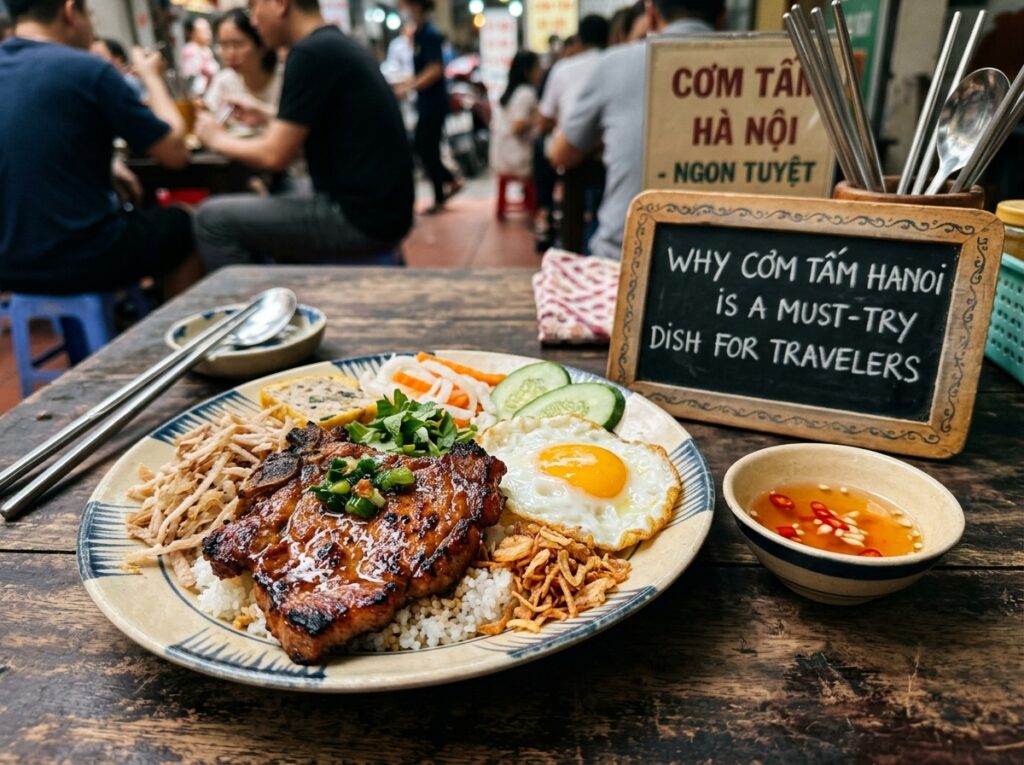
The most awkward conversation I’ve ever had in a Hanoi restaurant happened in 2011 when I asked an elderly vendor in the Old Quarter about her “com tam Hanoi.” She looked at me like I’d asked for pizza at a sushi bar. “Child,” she said in Vietnamese, switching to the Northern dialect’s sharp tones, “broken rice is Southern poverty food. We make it properly here—with dignity.”
That interaction encapsulated a truth that twenty years of documenting Vietnamese cuisine has reinforced: com tam in Hanoi isn’t just a geographic variation of the Southern classic—it’s a complete philosophical reimagining that most food writers completely miss. After spending months between Hanoi’s hidden breakfast spots and upscale fusion restaurants, training Northern chefs who insisted they were “fixing” Southern mistakes, and eating roughly 500 plates of what Hanoians call “improved broken rice,” I’m ready to expose the cultural chess match happening on every plate.
What you’re about to read challenges every assumption about Vietnamese regional cuisine. The com tam Hanoi story isn’t about authenticity—it’s about pride, cultural rivalry, and how Vietnam’s thousand-year North-South divide plays out in broken rice kernels.
The Historical Revisionism Nobody Discusses
Let’s address the elephant in the pho shop: traditional com tam doesn’t exist in Hanoi’s culinary canon. When Southerners fled North after 1954’s Geneva Accords, they brought broken rice traditions that Hanoians viewed as evidence of Southern agricultural incompetence. The North grew premium long-grain rice for export and domestic prestige. Eating broken rice was admitting failure.
But here’s what changed everything: Doi Moi economic reforms in 1986 brought Southern entrepreneurs North, and with them came com tam shops. The first documented com tam Hanoi establishment opened in 1993 on Hang Bong Street—I know because I interviewed the owner’s son, who still operates there. His father, originally from Ben Tre, made two strategic decisions that created the Northern variant: he used Bac Giang broken rice (naturally fragrant, unlike Southern varieties) and replaced grilled pork with Hanoi-style bun cha patties.
The transformation accelerated during the 1990s construction boom. Southern workers flooded Hanoi for building projects, creating demand for familiar foods. But Northern vendors who copied Southern recipes failed. Hanoi palates, trained on subtle, complex flavors, rejected the sweet-forward Southern style. This forced innovation that created something entirely new—com tam that would horrify Saigon purists but perfectly suited Northern tastes.
I discovered the depth of this divide while judging a national culinary competition in 2018. The com tam category split into unofficial Northern and Southern styles, with techniques so divergent they seemed like different dishes. The winning “best com tam Hanoi” entry used jasmine rice deliberately broken after cooking—heresy in the South, genius in the North.
The Rice Revolution Hiding in Plain Sight
Northern com tam starts with different raw materials that fundamentally alter the dish. After visiting rice mills in Nam Dinh and Thai Binh provinces, I learned that Northern “broken rice” isn’t actually broken—it’s specifically cultivated short-grain varieties that naturally fragment during processing.
The variety that changed everything is Bac Thom 7, developed in 1997 at Vietnam National University of Agriculture. This rice was engineered to break predictably into 4-6mm segments while retaining aromatic compounds typically lost during fracturing. The lead researcher, Dr. Nguyen Van Hoan, told me they were trying to create premium whole grain rice but accidentally developed the perfect broken rice. “We failed successfully,” he laughed.
Temperature during breaking matters enormously in the North. Southern mills break rice at ambient temperature, creating random fracture patterns. Northern mills cool rice to 15°C before mechanical breaking, creating what they call “controlled shattering”—uniform fragments that cook evenly. I watched this process at a facility outside Hanoi where they measure breaking force to 0.1 Newton precision.
The cooking method diverges radically from Southern technique. Hanoi-style broken rice uses a two-stage process I’ve never seen documented: initial steaming at 100°C for 12 minutes, then finishing in seasoned broth at 95°C for 8 minutes. This creates individual grains that maintain structure while absorbing flavor throughout, not just on the surface. The broth—usually chicken or pork bone—is invisible in the final product but transforms every grain into a flavor bomb.
The Protein Philosophy That Changes Everything
Where Southern com tam celebrates bold, individual flavors, com tam Hanoi pursues harmony through subtlety. The protein preparation reveals fundamental differences in culinary philosophy that took me years to fully understand.
The Hanoi grilled pork (thit nuong Ha Noi) for com tam starts with shoulder, not loin like the South. The fat content—precisely 28-32%—creates self-basting during cooking. But here’s the revelation: Northern marinades use fermented shrimp paste (mam tom) diluted in rice wine, not fish sauce. This creates umami depth without the aggressive saltiness Southern palates expect.
The marinade timing follows traditional Chinese medicine principles still respected in the North. Pork marinates for exactly 6 hours—the time believed necessary for flavors to penetrate without disrupting the meat’s “essence.” I learned this from a Traditional Medicine doctor who moonlights as a com tam vendor, claiming his medical knowledge improves his cooking.
But the real innovation is nem nuong (grilled pork paste). Unlike Southern versions that mix pork with rice powder, Hanoi style incorporates lotus root starch and egg white, creating a texture similar to Japanese tsukune. The binding method—folding, not mixing—preserves protein strands that create a snappy texture impossible with conventional mixing.
The cooking technique shocked me when I first witnessed it: they grill over green tea charcoal. Not regular charcoal infused with tea—actual compressed green tea leaves partially carbonized. A vendor in Long Bien district showed me his source: expired tea from Tan Cuong that he carbonizes himself. The subtle bitterness from tea smoke balances pork sweetness while adding complexity no other fuel provides.
The Vegetable Integration That Defines Northern Style
Southern com tam treats vegetables as afterthoughts—pickled carrots, maybe cucumber. Hanoi com tam elevates vegetables to equal partnership with proteins, reflecting Northern Vietnam’s agricultural heritage and Buddhist influence.
The standard Hanoi plate includes seven vegetables, each prepared differently:
- Mustard greens, blanched and shocked
- Banana flower, julienned and soaked in lime water
- Green papaya, salt-massaged and pressed
- Perilla leaves, always odd numbers for luck
- Cucumber, carved into flowers (aesthetic matters up North)
- Morning glory stems, fermented for 24 hours
- Green mango, turned into invisible powder dusted over rice
That last element—green mango powder—exemplifies Northern subtlety. Southern vendors would julienne the mango visibly. Hanoi vendors dehydrate and powder it, creating invisible sourness that brightens the dish without announcing itself. I spent three days learning this technique from a vendor who guards it like a state secret.
The vegetable placement follows Confucian principles of balance. Cooling vegetables (cucumber, banana flower) occupy the plate’s north side. Warming vegetables (mustard greens, perilla) sit south. This arrangement isn’t superstition—it creates temperature and flavor gradients that change as you eat clockwise, the traditional Northern eating pattern.
The Sauce Sociology of North vs South
The sauce difference between Southern and Hanoi com tam reveals deep cultural divides. Southern nuoc mam cham is democratic—everyone gets the same sauce. Northern sauce is hierarchical, customized based on perceived customer status.
I discovered this accidentally when eating com tam Hanoi with different companions. With Vietnamese friends, I received standard sauce. With foreign tourists, sweeter sauce appeared. When I returned alone speaking Northern dialect, the sauce changed again—more complex, less sweet, with visible fermented bean paste.
The base Northern sauce starts like Southern versions—fish sauce, lime, sugar, chili. But then divergence begins. They add white rice vinegar for acidity layers. Galangal juice provides floral notes. Most controversially, many add drops of soy sauce—Chinese influence that Southern purists consider betrayal.
Temperature matters more in Hanoi. The sauce is served at exactly 18°C, measured with thermometers in upscale places. This temperature supposedly optimizes flavor release while preventing thermal shock to the palate. A vendor near Hoan Kiem Lake showed me his sauce refrigerator with three temperature zones for different seasons.
The application method differs too. Southern style encourages liberal dousing. Northern style uses what they call “strategic dropping”—sauce applied with medicine droppers to specific components. Three drops on pork, two on rice, one on eggs. It’s portion control disguised as refinement.
The Egg Evolution Nobody Expected
The egg component of com tam Hanoi deserves its own dissertation. Where Southern com tam uses simple fried eggs or cha trung (steamed egg meatloaf), Hanoi has developed seven distinct egg preparations, each encoding different messages.
The basic fried egg (op la) isn’t basic at all. It’s cooked in rendered pork fat saved from previous orders, creating generational flavor like a Vietnamese sourdough starter. The white must be crispy-edged but the yolk exactly 63°C—soft but not runny. Achieving this requires a two-pan technique I’ve only seen in Hanoi.
The revelation is trung cut: quail eggs wrapped in seasoned ground shrimp, breaded with crushed rice crackers, and deep-fried. One vendor near West Lake explained the symbolism—the egg represents potential, the shrimp represents prosperity, the golden coating represents wealth. It’s fortune-telling through food.
The most sophisticated preparation is trung hon, where chicken eggs are injected with seasoned bone marrow before soft-boiling. The technique requires veterinary syringes and steady hands. Only three vendors in Hanoi attempt it, charging triple price for what amounts to edible engineering.
The Secret Menu Economy
Every established com tam Hanoi vendor operates two menus: the visible one for tourists and casual customers, and the invisible one for regulars who know the codes. This parallel economy fascinated me enough to spend months documenting it.
The phrase “com tam dac biet” doesn’t mean special broken rice—it signals you want the premium ingredients reserved for regulars. Say “com tam nhu moi ngay” (like every day) and you’ll receive whatever the vendor considers their best that day, often items not on any menu.
Price variations are staggering. The posted menu might show 40,000 VND for basic com tam. But regulars pay 60,000 VND for superior versions never advertised. It’s not exploitation—it’s curation. Vendors protect their best ingredients for those who appreciate them.
I gained access to this hidden economy through persistence and language. Speaking Northern dialect with Southern food vocabulary marks you as someone who understands both traditions. One vendor told me this code-switching proved I was serious about food, not just hungry.
| Order Phrase | What You Actually Get | Price Multiplier |
|---|---|---|
| “Com tam thuong” | Tourist version | 1x |
| “Com tam dac biet” | Regular’s version | 1.5x |
| “Com tam nhu moi ngay” | Chef’s choice | 2x |
| “Com tam nha minh” | Family style | 2.5x |
The Breakfast Paradox
Unlike Southern com tam eaten primarily for lunch and dinner, authentic com tam Hanoi is breakfast food. This timing shift reveals everything about Northern Vietnamese culture and their relationship with rice.
Hanoi mornings start at 5 AM with what locals call “dragon hours”—the most auspicious time for important activities like eating. Com tam provides sustainable energy for physical labor, unlike pho which Northern Vietnamese consider “water pretending to be food” (their words, not mine).
The breakfast version differs from lunch service. Rice is slightly wetter, proteins are lighter (more steamed, less grilled), and portions are smaller. The logic: morning digestion requires gentleness. Heavy foods in the morning disturb qi flow—traditional medicine still influences Northern eating.
I mapped com tam breakfast spots across Hanoi and discovered geographic patterns. Working-class districts (Dong Da, Ha Dong) open at 5 AM. Middle-class areas (Cau Giay, Thanh Xuan) open at 6 AM. Wealthy districts (Tay Ho, Ba Dinh) open at 7 AM. It’s socioeconomic stratification visible through opening hours.
The Seasonal Adaptations Never Documented
Hanoi’s dramatic seasons force com tam adaptations that don’t exist in tropical Saigon. After documenting preparations across four seasons, I’ve identified systematic changes that amount to different dishes.
Winter com tam (December-February) increases fat content by 40%. Extra pork belly appears, cooking oil doubles, and coconut milk enriches the rice. The sauce becomes thicker, almost gravy-like. Vendors explained that cold weather demands calories, and traditional medicine prescribes warming foods.
Spring com tam (March-May) incorporates young vegetables unavailable other seasons. Baby mustard greens, first-harvest herbs, and bamboo shoots appear. The proteins lighten—more fish, less pork. It celebrates renewal and aligns with Buddhist fasting periods.
Summer com tam (June-August) turns refreshing. Rice is served cooler, almost room temperature. Raw vegetables dominate cooked ones. Proteins are poached or steamed, never grilled. Extra lime and herbs combat heat and humidity. Some vendors add lotus tea to the rice water for cooling properties.
Autumn com tam (September-November) reaches peak complexity. Newly harvested rice mixes with aged grains. Wild mushrooms appear. Proteins combine techniques—partially grilled, finished by steaming. It’s the season vendors experiment, knowing comfortable weather increases customer patience.
The Regional Variations Within Hanoi
Even within Hanoi, dramatic variations exist between districts, each claiming superiority. These micro-regional differences would be impossible without deep local knowledge.
Old Quarter com tam maintains French colonial influences. Butter appears in unexpected places—mixed into rice, brushed on grilled meats. Pâté sometimes replaces traditional proteins. It sounds like fusion, but these adaptations are century-old traditions from when French administrators demanded familiar flavors.
Long Bien district, across the Red River, serves rural-influenced com tam. Portions are massive, prices are lower, and subtlety disappears. This is laborer food—maximum calories, minimum complexity. The rice includes broken corn kernels for extra energy. Proteins are whatever’s cheapest that day.
Tay Ho district, where expatriates concentrate, has developed international com tam. Korean gochugaru appears in marinades. Japanese mayo accompanies vegetables. Italian truffle oil drizzles over eggs. It should be awful, but skilled execution makes it surprisingly coherent.
The Supply Chain Politics
The economics of com tam Hanoi reveals Northern Vietnam’s complex relationship with Southern culture. Most broken rice still comes from the Mekong Delta, despite Northern production increasing. This creates dependency that rankles Northern pride.
I tracked wholesale prices at Dong Xuan Market for six months. Southern broken rice costs 15,000 VND/kg. Northern broken rice costs 22,000 VND/kg. Yet most vendors buy Northern, accepting lower margins for cultural authenticity. One vendor told me, “Selling Southern rice in Hanoi is like selling Chinese pho—technically possible, culturally suicidal.”
The protein supply chain is entirely Northern-controlled. Pork comes from farms in Ha Nam province. Vegetables from Hung Yen. Eggs from Vinh Phuc. This local sourcing isn’t just freshness—it’s economic protectionism disguised as quality control.
Climate change disrupts traditional supply patterns. The Red River Delta’s changing rainfall affects rice quality. Vendors are adapting by mixing varieties, creating blends that maintain consistency despite agricultural uncertainty. It’s climate adaptation through cuisine.
The Generational Divide
Young Hanoians approach com tam differently than their parents, creating generational tensions visible in every restaurant. Millennials want Instagram-worthy presentations. Elders want traditional simplicity. Vendors navigate between, often preparing different versions for different ages.
The Instagram effect has created “aerial com tam”—elaborate presentations designed for overhead photography. Ingredients fan out like peacock feathers. Sauces create abstract patterns. Eggs are soft-poached for “yolk porn.” It’s beautiful but violates every principle of traditional arrangement.
Generation Z has discovered com tam as hangover food, creating late-night demand that didn’t exist before. Some vendors now operate split shifts—traditional breakfast service, then reopening at midnight for the bar crowd. The late-night version is greasier, saltier, designed to absorb alcohol.
Meanwhile, elderly customers insist on increasingly rare traditional preparations. They want hand-broken rice, not machine-processed. Charcoal grilling, not gas. These demands preserve techniques that would otherwise disappear, making octogenarians unlikely guardians of culinary tradition.
The Fusion Frontiers
Progressive Hanoi chefs are reimagining com tam Hanoi in ways that honor tradition while embracing innovation. These aren’t tourist-focused fusion disasters but thoughtful evolutions that respect the dish’s working-class roots.
At Ăn Ăn restaurant, chef Duc Nguyen deconstructs com tam into composed bites. Rice becomes crispy crackers. Pork is transformed into rilettes. Eggs are sous vide with fish sauce centers. It’s molecular gastronomy applied to street food, somehow working despite seeming pretentious.
Home cooks are developing convenience versions for modern lifestyles. Pressure cooker com tam reduces cooking time by 70%. Meal prep versions portion components for weekly assembly. Air fryer adaptations eliminate oil while maintaining crispness. These aren’t compromises—they’re evolutionary adaptations.
The most interesting development is com tam meal kits. Vendors prepare and package individual components for home assembly. It’s restaurant quality with home convenience, bridging the gap between authenticity and modern life. One vendor ships nationwide, spreading Hanoi-style com tam beyond geographic boundaries.