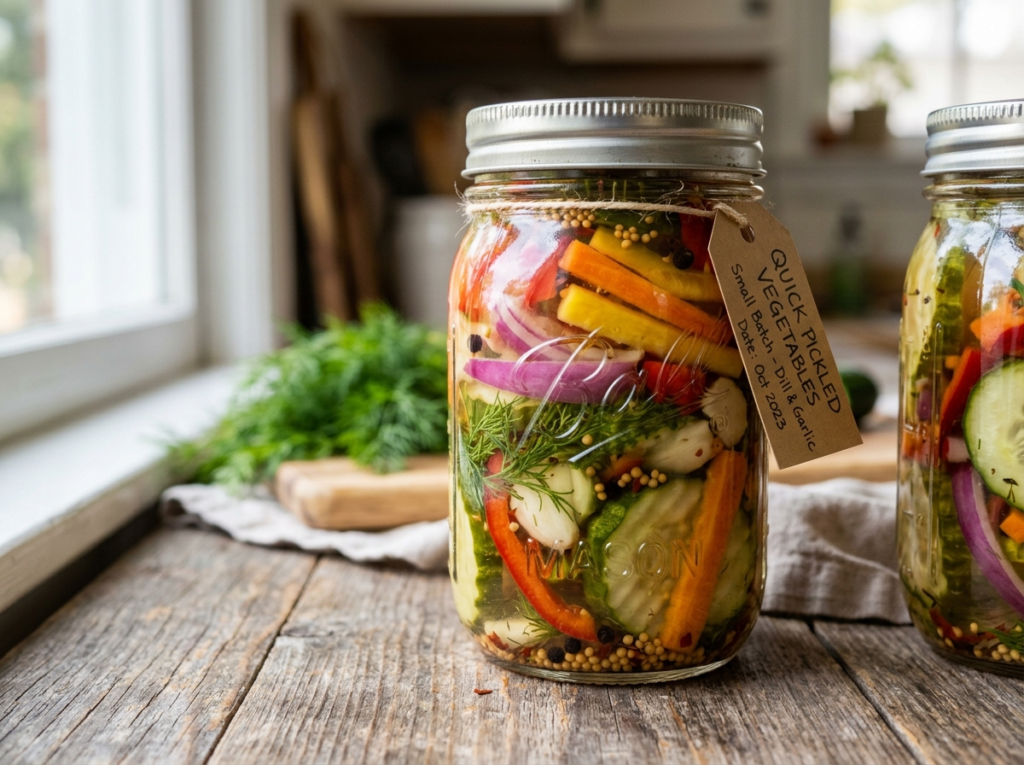
If you’ve ever wondered why seasoned chefs speak about pickled vegetables with the same reverence as dry-aged beef or wine, it’s because pickling isn’t preservation—it’s controlled transformation. In skilled hands, humble roots and greens cross from raw immediacy into orchestral flavor
I’ve spent over twenty-five years in professional kitchens—Japanese omakase counters, farmhouse Italian trattorias, Korean banchan bars—and pickled vegetables are the one element that consistently bridges them all. They cleanse the palate, extend shelf life, and inject acidity exactly where richness threatens to overwhelm.
But behind every great pickled vegetables recipe lies a deep understanding of salt diffusion, sugar ratios, microbial factions, and texture control. That’s where most “quick recipes” fall flat—they treat pickling like seasoning, not fermentation chemistry.
Today, you’ll see pickling from an insider’s viewpoint: how brine balance dictates crunch, why carrot density differs by variety, the surprising difference between lacto-fermented pickles and vinegar-cured ones, and the mistakes even pros won’t admit in public.
1. The Foundation: What Pickling Really Is (and Isn’t)
People often assume pickling is just an acid bath. Wrong. That’s one pathway, but not the full picture. There are two philosophical families of pickles:
| Method | Mechanism | Typical Flavor | Shelf Type |
|---|---|---|---|
| Vinegar Pickling | Uses acetic acid to instantly acidify environment | Bright, sharp | Shelf-stable (if canned) |
| Fermented Pickling (Lacto-Fermentation) | Relies on lactic acid bacteria feeding on sugars from vegetables | Deep, complex, tangy | Requires refrigeration after culturing |
True old-world artisans tend to prefer the latter—fermentation. Vinegar pickles are quick and reliable; fermentation pickles are alive, dynamic, and unpredictable.
I learned early the fundamental rule of balance: pickling is about taming one force with another—salt versus sugar, acid versus sweetness, texture versus permeability. The entire craft is that fine line between structure and surrender.
2. Choosing the Right Vegetables for Pickling
If you want pickles that stay crisp, colorful, and crave-worthy, selection matters just as much as brine composition.
Best Candidates for Pickling:
- Root vegetables: carrot, daikon, turnip, radish—dense, resilient.
- Cucurbits: cucumber, zucchini—high crunch factor, low sugar.
- Brassicas: cauliflower, cabbage, broccoli stems—ferment beautifully.
- Alliums: onion, garlic, shallots—flavor boosters more than snacks.
- Peppers: sweet bell or spicy jalapeño—heat translates into vibrant brine.
Pro insight: Density equals time. The thicker the cell wall, the slower the saline diffusion. That’s why daikon or turnip need longer marination than cucumber. When I train new line cooks, I make them taste brine every 12 hours—not for flavor alone but to understand extraction rate.
Avoid overripe vegetables or those with waterlogged flesh—they collapse, turning brines murky and lifeless. Optimal produce should feel taut, almost “spring-loaded.”
3. The Ratio: Master Formula for Pickling Brine
Once you know your vegetables, it’s time to learn the universal brine ratio—the mathematic baseline every professional uses.
| Ingredient | Ratio (by weight) | Purpose |
|---|---|---|
| Water | 100% | Solvent base |
| Vinegar (5% acidity) | 50% | Acidify and preserve |
| Sugar | 3–7% | Round acidity and boost color |
| Salt | 2–3% | Draw moisture, control microbial balance |
| Optional aromatics | ~1–2% | Complexity—herbs, spices, garlic |
Example: For 1 L of water, use ~500 mL vinegar, 25 g sugar, 20 g salt.
Insider trick: I drop the salt slightly (1.8%) for red bell pepper pickles—they’re naturally sweet and need less saline to balance their sugars. For daikon, I push 3% to combat its wateriness.
Remember, this ratio defines preservation potential—change one element, and you adjust lifespan, not just flavor.
4. Quick Pickled Vegetables (Vinegar Method): The 10-Minute Restaurant Fix
Even in high-end kitchens, we rely on quick pickled vegetables when service speed outruns fermentation time. These “flash brines” eliminate waiting by heat-infusing flavor into vegetables within minutes.
My Standard “Fast Pickle Brine”:
- 1 cup vinegar (apple cider or rice vinegar)
- 1 cup water
- 1 ½ tbsp sugar
- 1 tbsp salt
- Optional: bay leaf, mustard seeds, or red chili flakes.
Bring to a near boil, pour over sliced vegetables, cool uncovered, and refrigerate. Within 30 minutes, they’re service-ready.
In Michelin kitchens, we use quick pickles to balance fatty proteins (like pork belly, duck, or short rib). I once plated roasted lamb with pickled kohlrabi ribbons—tables practically smelled the harmony: lamb fat met gentle radish acidity.
5. Natural Fermentation: How to Pickle Without Vinegar
If vinegar pickling is about certainty, fermentation is about faith. You’re inviting nature’s microbiome to the party—particularly Lactobacillus plantarum, the bacterium responsible for turning sugars into lactic acid.
Basic Lacto Brine (by Weight)
- 1000 g water
- 20–30 g sea salt (2–3%)
That’s it.
Submerge vegetables completely—oxygen’s enemy here—and seal with airlock lids or lightly loosened jars to allow CO₂ release. Keep at room temperature (18–22 °C). Bubbles indicate fermentation.